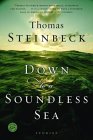
Thomas Steinbeck discusses his first collection of short stories and some of the themes from the stories such as redemption, the power of nature, the architecture of language, the inequities of society ... and a great deal more.
An aura of performance, as suggested by the author’s note, permeates
Down to a Soundless Sea. As a devout raconteur, do you see these stories as
attempts to translate the experience of storytelling? Does the act of fixing
them on the page complicate or simplify the stories?
In my humble opinion, all storytelling, and in turn writing, by virtue of
its human origin, entails profound elements of performance. Authors either
perform on their own account, such as historians, journalists, and essayists;
or, like novelists and playwrights, they fashion characters to perform specific
roles at the author’s behest. One way or the other, the puppeteer remains the
same. It is specifically because I’m a carrier of raconteur’s disease, in
its most virulent form, that I have come to realize that one can never really
cross-pollinate the act of live storytelling with its literary reflection. But I
can think of any number of great authors who have come within a hairsbreadth of
convincing me they could.
I’ve never known a story, whether true or false, to remain fixed to any
page for long. If it has legs at all, it will self-propagate through numerous
generations and variations, until not even the author would recognize his own
child. On the other hand, if a story’s basic structure should prove totally
paraplegic, the moral hopelessly pathetic, and the general presentation
tragically pointless, it will probably find great success as a television movie
of the week. Which goes to prove, you can’t keep a dead man down.
These stories are animated by an attention to history and the shared
import of the oral tradition. Is writing, in this sense, a collaborative
venture?
All reasonable stories are basically collaborative affairs insofar as
they are, in the main, salvaged from an oral tradition and therefore rewoven
from previously milled strands. Some are reborn from the ashes of ancient myths,
some are rooted in our personal or national histories, while still others, like
Robin Hood or Frankenstein’s Monster, are inextricably bound to "popular
culture," and therefore recycled and repackaged continuously as demand requires.
It is true that I indulge an energetic interest in histories of every category,
such as they are, but the one all-encompassing fact I have learned through my
years of reading is that there are as many colorfully different versions of
history as there are colorful authors writing about it. It then should follow
that as simple weavers of entertaining stories, most writers should have plenty
of room in which to maneuver their narratives. It remains a mystery that so many
plots keep colliding into each other in such an open channel. "Damn the
hyperbolae! Topsails set ahead!"
We don’t use phrases like "to put the tail on the dog" or "kissing
feathers" much anymore. What kind of research went into the colorful
vocabulary of these stories?
To unearth accurate tints of dialect, phrasing, and language long since
out of common usage, I find it helpful to read letters and articles written
during the era I’m exploring. I’ve discovered it interesting that many
phrases in present usage have parallels in past dictums that use different key
phrases meaning very much the same thing as they do today. For instance, "To put
the tail on the dog" means the same as inserting a "drag-line" into a yarn with
an appropriate hook to fit the moral of the story, a spontaneous "punchline" in
modern terms. And the phrase "kissing feathers" means the same as pressing
one’s face into the pillows of exhausted repose.
Are any of the characters, such as the faux-crazed scholar Clarke in
"An Unbecoming Grace," based on real people from the Monterey Peninsula?
Almost all the characters in the book are based on real people and their
life experiences. In some cases, as in the story "The Night Guide," the key
incident was related to me by Bill Post, the grandson of the boy described in
the narrative. All the stories came down to me through a long oral tradition,
and of course the best stories are always about real people. As a writer, one is
hard-pressed to invent material that is as entertaining and informative as
reality.
You seem attracted to youthful and wayward protagonists. Is this simply a
consequence of genre or is it evidence of a more personal inclination?
I’m not principally attracted to any one character for any particular
reason. I always attempt to portray people as I find them, warts, halos, and
all. I studiously avoid prejudice for artistic reasons only. Bias clouds vision,
and chauvinism hobbles creativity. Since I have never come across anyone who
stands without blame in one realm or another, it would appear senseless to
portray them in any but the most realistic contours and hues. Pure objectivity
may be impossible in a subjective world, but like Diogenes and his search for an
honest man, impartiality is hardly an unrewarding lamp to follow. The process
has its own tar pits, of course, but if I’d been looking for a sure thing, I
wouldn’t have become a writer.
Often your characters struggle with the vast inequities of society.
How has this struggle been updated since the time of these stories? Do you
encounter similar characters in modern-day Monterey?
Social inequity (in some instances applied on a statutory basis), and the
implied manipulation of inequality, has been one of the darker hallmarks of
human society since our troglodyte ancestors decided who was going to get the
dry part of the cave. The struggle of any one minority to liberate its momentum
from the constraints so stringently applied by the rest of society appears to be
a never-ending repetition of a primeval human dilemma. Class paranoia has always
insisted on the necessity of maintaining the status quo, regardless of how
socially counterproductive and morally bankrupt such instincts prove to be. In
that regard, one can’t swing a broken promise without striking parallels in
all directions. My characters are taken from life portraits, and therefore I
assume they endure the same social spurs as the rest of us. In a nutshell,
little has changed in human affairs since before written history. It’s no
great challenge to find identical threads binding past to present, and present
to future when it comes to the conduct of human affairs.
In Down to a Soundless Sea, you’ve created a well rounded world in a
relatively limited geographical area. Were you intentionally seeking to showcase
this microcosmic diversity?
The fact that all the stories in the book concern people who once lived
in the Big Sur was no accident, but the location was by no means chosen as a
literary device. Though I would not fault a reader for coming to that
conclusion. In truth, the microcosmic aspect of the completed work didn’t
occur to me until after I’d finished the manuscript. I had spent so much time
immersed in the details of each individual story that the ultimate impact of the
format never came to mind.
In these stories, each sentence benefits from a lush architecture of
language. Do you approach writing as an arduous craft that requires intricate
planning and careful construction or is your method more organic and
improvisational?
If I could truly understand, and calibrate for the edification of others,
how I do what I do, I probably wouldn’t do it at all. Everything in life is
relatively arduous, and most human endeavors require some degree of careful
planning. I find this human concern admirable every time I drive my car or board
an aircraft. But I must confess that writing for me is a means and an end in
itself. I write to become a better writer. Like all great crafts, the more you
do, the better you get. Many times this requires grasping for technical literary
straws, which rarely serve the purpose, and other ventures seem to come into
bloom with little or no assistance from me whatsoever. But if one can’t resist
the search for labels, then I will plead no contest to "organic" and "improvisational"
for lack of a better list of charges.
Redemption, when and if it arrives in these stories, is marked by a quiet,
simple, and lonely sort of dignity. What is it about this dignity that appeals
to you as a writer? As a person? Does it strike you as a specifically small-town
or California coast kind of dignity?
I rarely think in terms of downfall or redemption as a central theme, if
only because spiritual journeys between those two well-defined extremes are
literarily predictable as a plot vehicle. I really don’t concern myself with
the moral ambiguities of society or individuals unless those insights might lead
to a greater comprehension of instinct, motive, or conduct. Whether or not the
struggles of individual characters are worthy to be labeled as ‘dignified’
is speculative. At the very least, it’s a decision I would rather leave to the
reader.
In congruence with the title, the strongest character in Down to a
Soundless Sea is perhaps nature itself. Many of the stories are centered on
man’s timeless struggle with nature and end with his eventual concession to
it. What do you see as the proper, or necessary, approach that man must
take in his relationship with the natural world?
It has been my general experience that mankind, though doomed to fiddle
and fudge with everything within reach just for the hell of it, habitually
ignores the subtle fluidity and changing pulse of the natural world, usually
with horrific consequences. Gilgamesh, Osiris, and Noah could all testify to the
challenging implications of rising water. The human lexicon of myths repeatedly
chronicles mankind’s run-ins with the deadlier forces of nature. As always,
the moral rests on the once and future premise that survival requires not just
insight, but ever-vigilant flexibility. And it appears, according to most
mythological and meteorological references, that only those creatures capable of
swift adaptation, and prepared to take advantage of natural chaos, survive it.
In other words, if the waves have already covered the temple, don’t bother
building a damn boat. At that point you have better odds with prayer.
For a writer with a terminal case of historic curiosity, I find the interplay
among humans, their all-prevailing self delusion, and the dynamic forces of
nature, an abundant source of intellectually nutritious material; manna from
chaos, as it were. As an unbiased observer, I prefer not to take sides in the
struggle between man’s nature and Nature itself. Suffice it to say that I
never bet on long odds, and from my vantage point, the forces of nature have the
deck stacked and the bones loaded against us. If it weren’t for mankind’s
inflated image of self-importance, humans would have realized that they don’t
own the world. The world owns them. Perhaps it’s this secret knowledge that
fuels the contest between the savage and the coming of the night.
Unless otherwise stated, this interview was conducted at the time the book was first published, and is reproduced with permission of the publisher. This interview may not be reproduced or reprinted without permission in writing from the copyright holder.
Rick Bass was born in Fort Worth, Texas in 1958. His father was a geologist who passed on his passion to his son. Bass received a B.S. in petroleum geology at Utah State University in 1979, and then worked as a gas ... (more)
If you enjoyed:
Down To A Soundless Sea
Try:
The Lives of Rocks
by Rick Bass

Charlotte Gullick is a novelist, essayist, editor, educator, and Chair of the Creative Writing Department at Austin Community College. A first-generation college graduate, she received her AA with High Honors from Santa Rosa... (more)
If you enjoyed:
Down To A Soundless Sea
Try:
By Way of Water
by Charlotte Gullick
We recommend 6 similar authors

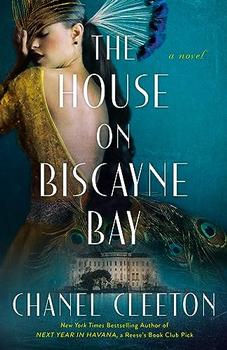
The House on Biscayne Bay
by Chanel Cleeton
As death stalks a gothic mansion in Miami, the lives of two women intertwine as the past and present collide.

The Flower Sisters
by Michelle Collins Anderson
From the new Fannie Flagg of the Ozarks, a richly-woven story of family, forgiveness, and reinvention.

The Funeral Cryer by Wenyan Lu
Debut novelist Wenyan Lu brings us this witty yet profound story about one woman's midlife reawakening in contemporary rural China.
Your guide toexceptional books
BookBrowse seeks out and recommends the best in contemporary fiction and nonfiction—books that not only engage and entertain but also deepen our understanding of ourselves and the world around us.