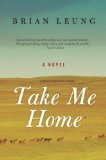
Brian Leung answers questions about Take Me Home, his second novel which is set in 1880s Wyoming and explores justice in a time of violence, and the sweeping landscape between friendship and love.
I climbed to the top Pilot Butte, a fantastic formation of orange rock jutting up and out of the grayish green Wyoming landscape not far from Rock Springs. It sits on the plain like an oil tanker at anchor, and the view from its peak reveals something like an ocean caught in freeze frame, an undulating, unpopulated vista, unpopulated except for wild horses and the shadows of single clouds sliding over the surface like dark slugs. Wind in my face, sun at my back, I said it aloud. "They've been here."
I was speaking about the characters in Take Me Home, the novel for which I had yet to write a single word. But I'd been thinking about them for years, knew my heroine Addie Maine as well as if we'd met every day over a breakfast of venison and hard coffee. She would have insisted on bringing Wing Lee to Pilot Butte, and not far off, to the great white Killpecker Dunes. But I also knew that very willfulness, the fact of a white woman hiring a Chinese man and befriending him that would be the fuel, if not the match to all their troubles.
When my own parents met in the 1960s it was difficult enough for a white woman and a man recently arrived from China to imagine a future together. Both sets of my grandparents were against their marriage. But that tension was nothing compared to what Addie and Wing face in 1880s Wyoming. The Chinese exclusion act had passed but it was a time when the Union
Pacific Railroad was powerful enough to observe its own laws, using Chinese labor to build the railroads, and later, work in Wyoming's coal mines. But this isn't the same-old story of one immigrant group pitted against an aggrieved white population. No, I understood that from the beginning when I began my research in 2002. Certainly the UP was using Chinese labor, but those coal mining towns were also populated with immigrants, Finns, Tyroleans, Brits, and others. For some, the mines were a desperate last line of subsistence, for others, perhaps a way to save enough to get back home, wherever that might be.
In the middle of all this, Addie and Wing would find themselves, I knew, and I could at first imagine them in Rock Springs and the fictional Dire Draw because by coincidence I'd been to Rock Springs when I was fourteen, taken the train to visit my great uncle and aunt and cousins, all of whom lived in the shadow of White Mountain, the mountain on top of which Pilot Butte sits. These were relatives on my mother's side. Why didn't it occur to them to tell me, their half-Chinese nephew, that a hundred years earlier this was the infamous site of a massacre of Chinese miners? Did they even know about it? Later, as an adult, I would travel back to the region for research, in the archives, certainly, but more importantly, in the back roads where around almost every bend I found myself saying things like "This is where Wing field dresses a Pronghorn," "This is where Addie finds the bones," and "This is where Addie and Wing..." - well, I'll leave that sentence for the novel.
Questions for Brian Leung about Take Me Home
You grew up in San Diego and now live in Louisville, Kentucky. What brought you to set your new novel in Rock Springs, Wyoming? When did you first come across this landscape?
The phrase gets over-used, but I truly felt born to write this story.
I was doing research on a wholly different topic when I learned quite by accident about this massacre of Chinese coal miners in 1885, which, it turns out, was one of major events during the time just after the Chinese Exclusion Act. The President was notified and troops were sent in and even Congress held hearings about it.
Two simple things jolted me. 1) That as a Chinese American I had never heard of this event and 2) By coincidence as a teen I had taken the train from San Diego to visit relatives in Rock Springs and there wasn't so much as hint that anything like this had every happened there.
When I went back to do research, and was out in the Wyoming landscape, I found myself standing atop Pilot Butte, the sight of what would become an important scene in the book, and I thought "they've been here." I was speaking of the Addie and Wing. It really was at that moment I understood what I was about to write.
How did you go about doing your research? Did any surprises in the history books lead you in unexpected directions?
The research showed events to be really complex. To understand the event one has to get their head out of our contemporary world. To say "White" conjures some sort of Arizona Glenn Beck mob angry over illegal immigration. But the fact is, the mines were filled with immigrants, white and Chinese alike. And government and the Railroad were taking advantage of them both.
I took my friend who is a historian along with me to the Wyoming State archives in Cheyenne and the American Heritage Center at the University of Wyoming in Laramie. We dug through primary documents, the originals, read countless newspapers from the time, and sorted through hundreds of photographs.
There was a moment when I got a chill during the research at the Sweetwater County Museum. By way of background I should mention there were 28 confirmed murders, and even though a grand jury was convened, not a soul was convicted. Apparently no one would witness against the accused. It struck me, of course, that it was very likely the grand jury itself was being willfully impotent. I wanted to read a transcript of their discussions, something. But I discovered what previous researchers have, that there just isn't any such record. Still, the person who runs the museum took me over to the county office, and into the back offices where, on a shelf with several others just like it, was a huge leather bound volume with handwritten records of various sorts. When we flipped through the pages to September 1885, there in thin, loopy script was the list of names comprising the grand jury. I felt an immediate jolt, as if they were in the room, these men who might have brought the Chinese some brand of justice.
I think what you learn on a project like this, is how much history is changed over time by the people who write it, sometimes out of willfulness, sometimes out of laziness. For example, one of the texts I consulted makes a big leap in claiming certainty that the massacre began when the Chinese attacked white miners in one of the mines.
There is a relationship at the heart of Take Me Home, but it's not your traditional love story. How did you decide to approach the connection between the characters Addie and Wing?
With Addie and Wing, I started out knowing there's just no way they could carry through a successful romance in a place like Dire in 1885. And it's not just that it's Wyoming. Think of all the prejudices Addie arrives with by the time she steps off the train. Wing, at least, has lived in San Francisco, where he's seen both Chinese and White women. But then, too, they're both young and stranded, and have ambition. It's natural that they would be drawn to one another. So, given both the impossibility of a true romance and inevitability of their pairing, well, that was where I discovered the intensity of their relationship.
Your last novel, Lost Men, featured a father and a son as narrators. Was it difficult, for Take Me Home, to get into the head of Addie, a woman character portrayed at two very different times in her life?
I know what you mean. There's that kind of The Trip to Bountiful version of Addie who is traveling back to Dire after forty years to confront her old life, and then the larger part is the younger version of her immersed in Wyoming (and here and there Kentucky). But if you look back, there's not a lot of work done to convince the reader it's the same woman. Addie returns not as some doddering, weepy-eyed elderly woman but as an only slightly physically diminished version of the young woman we will come to know. And on that note, let me say by way of modeling that my mother has four sisters, and all five of them are just as broad and feisty as decades ago, and smarter. And this latter thing was the key note I was trying to hit. Addie as a young woman is experiencing almost everything for the first time, making her way on instinct. She is self possessed, but not in control. Notice how the older Addie, as little as we see her, is so much more in control of her life's journey. That final gesture toward Muuk is only something older Addie could execute with true heart.
As a kind of coda, I can mention here that there's actually a final chapter that doesn't appear in the novel, a chapter that records Addie Maine's last evening, thirty-something years beyond the current final chapter. I mention this, because getting into her head meant doing something very different than the work described above. This was a process of understanding a woman who has let fall away everything that's not truly important in life. What are the lessons she's learned to arrive at this point? I had to know those, though not report them to the reader, and then just let her final scene quietly play out.
Unless otherwise stated, this interview was conducted at the time the book was first published, and is reproduced with permission of the publisher. This interview may not be reproduced or reprinted without permission in writing from the copyright holder.
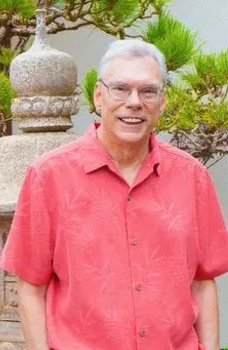
Alan Brennert is a novelist, screenwriter, and playwright. He was born in 1954 in Englewood, New Jersey, to Herbert E. Brennert, an aviation writer, and Almyra E. Brennert, an apartment rentals manager. He has lived since ... (more)
If you enjoyed:
Take Me Home
Try:
Honolulu
by Alan Brennert

Jamie Ford is the great-grandson of Nevada mining pioneer Min Chung, who emigrated from Hoiping, China to San Francisco in 1865, where he adopted the western name Ford, thus confusing countless generations. His debut novel, ... (more)
If you enjoyed:
Take Me Home
Try:
Hotel on the Corner of Bitter and Sweet
by Jamie Ford
We recommend 7 similar authors






The Flower Sisters
by Michelle Collins Anderson
From the new Fannie Flagg of the Ozarks, a richly-woven story of family, forgiveness, and reinvention.
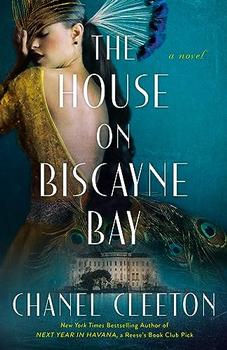
The House on Biscayne Bay
by Chanel Cleeton
As death stalks a gothic mansion in Miami, the lives of two women intertwine as the past and present collide.

The Funeral Cryer by Wenyan Lu
Debut novelist Wenyan Lu brings us this witty yet profound story about one woman's midlife reawakening in contemporary rural China.
Your guide toexceptional books
BookBrowse seeks out and recommends the best in contemporary fiction and nonfiction—books that not only engage and entertain but also deepen our understanding of ourselves and the world around us.