Summary | Excerpt | Reviews | Beyond the book | Read-Alikes | Genres & Themes | Author Bio
Critics' Opinion:
Readers' Opinion:
First Published:
Oct 2011, 512 pages
Paperback:
Apr 2013, 512 pages
 Book Reviewed by:
Beverly Melven
Buy This Book
Engaging the reader in a lively conversation about how we think, Thinking, Fast and Slow will transform the way you think about thinking.
Daniel Kahneman, recipient of the Nobel Prize in Economic Sciences for his seminal work in psychology that challenged the rational model of judgment and decision making, is one of our most important thinkers. His ideas have had a profound and widely regarded impact on many fields - including economics, medicine, and politics - but until now, he has never brought together his many years of research and thinking in one book.
In the highly anticipated Thinking, Fast and Slow, Kahneman takes us on a groundbreaking tour of the mind and explains the two systems that drive the way we think. System 1 is fast, intuitive, and emotional; System 2 is slower, more deliberative, and more logical. Kahneman exposes the extraordinary capabilities - and also the faults and biases - of fast thinking, and reveals the pervasive influence of intuitive impressions on our thoughts and behavior. The impact of loss aversion and overconfidence on corporate strategies, the difficulties of predicting what will make us happy in the future, the challenges of properly framing risks at work and at home, the profound effect of cognitive biases on everything from playing the stock market to planning the next vacation - each of these can be understood only by knowing how the two systems work together to shape our judgments and decisions.
Engaging the reader in a lively conversation about how we think, Kahneman reveals where we can and cannot trust our intuitions and how we can tap into the benefits of slow thinking. He offers practical and enlightening insights into how choices are made in both our business and our personal lives - and how we can use different techniques to guard against the mental glitches that often get us into trouble. Thinking, Fast and Slow will transform the way you think about thinking.
Chapter 1
The Characters of the Story
To observe your mind in automatic mode, glance at the image below.
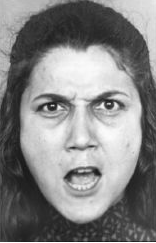
Figure 1
Your experience as you look at the woman's face seamlessly combines what we normally call seeing and intuitive thinking. As surely and quickly as you saw that the young woman's hair is dark, you knew she is angry. Furthermore, what you saw extended into the future. You sensed that this woman is about to say some very unkind words, probably in a loud and strident voice. A premonition of what she was going to do next came to mind automatically and effortlessly. You did not intend to assess her mood or to anticipate what she might do, and your reaction to the picture did not have the feel of something you did. It just happened to you. It was an instance of fast thinking.
Now look at the following problem:
17 × 24
You knew immediately that this is a multiplication problem, and probably knew that you could solve it, with paper and pencil, if not without. You ...
Science writing can be difficult to make interesting, but Kahneman does a good job of constantly engaging the reader with real examples for each idea that he presents... If you like reading Malcolm Gladwell, or if you enjoy exploring the inner workings of the human mind, this book may be for you...continued
Full Review
(648 words)
This review is available to non-members for a limited time. For full access,
become a member today.
(Reviewed by Beverly Melven).
Daniel Kahneman is a Nobel Prize-winning psychologist who, along with Amos Tversky, revolutionized economic theory in the 1970s and is widely regarded as one of the world's most influential living psychologist.
 Born in Tel Aviv in 1934 to Lithuanian Jewish parents, Kahneman grew up in Paris, during which time his father was taken by Nazis in one of the first "round ups" of Jewish prisoners. Though he was later released, Kahneman's family spent the rest of the war years ill at ease in their surroundings. In 1948, four years after his father passed away from diabetes, Kahneman and his family moved to Palestine (which, on May 14, 1948, would become Israel). While there, he experienced a period of great social growth and intellectual ...
This "beyond the book" feature is available to non-members for a limited time. Join today for full access.

If you liked Thinking, Fast and Slow, try these:

by Henry Hemming
Published 2016
The untold story of an enigmatic genius who changed warfare forever.
by Susan Cain
Published 2013
An extraordinary book with the power to permanently change how we see introverts and, equally important, how introverts see themselves.






The House on Biscayne Bay
by Chanel Cleeton
As death stalks a gothic mansion in Miami, the lives of two women intertwine as the past and present collide.

The Flower Sisters
by Michelle Collins Anderson
From the new Fannie Flagg of the Ozarks, a richly-woven story of family, forgiveness, and reinvention.

The Funeral Cryer by Wenyan Lu
Debut novelist Wenyan Lu brings us this witty yet profound story about one woman's midlife reawakening in contemporary rural China.
Your guide toexceptional books
BookBrowse seeks out and recommends the best in contemporary fiction and nonfiction—books that not only engage and entertain but also deepen our understanding of ourselves and the world around us.