return to home  
Join   |  Gift   |  Member Login   |  Library Login
BookBrowse Mobile
Follow Us: 
   Reading Guides

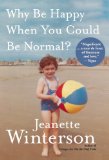
Why Be Happy When You Could Be Normal? by Jeanette Winterson: Questions, plus a reading group guide, with links to reviews, excerpt, author biography at BookBrowse.com.

Why Be Happy When You Could Be Normal?

Why Be Happy When You Could Be Normal?
by Jeanette Winterson
Hardcover: Mar 2012,
224 pages.
Paperback: Mar 2013,
240 pages.

Publication information
Author Information
Critics' Opinion:   
Readers' Rating:    Not Yet Rated
About BookBrowse Rankings
Share: 
Buy This Book

Reading Guide Questions

 Printer Friendly Guide

Please be aware that this discussion guide may contain spoilers!

  1. "My mother tried to throw me clear of her own wreckage and I landed in a place as unlikely as any she could have imagined for me" (p. 225). How does Jeanette become reconciled to her birth story and adoption?

  2. "It took me a long time to realise that there are two kinds of writing: the one you write and the one that writes you. The one that writes you is dangerous. You go where you don't want to go. You look where you don't want to look" (p. 54). How is Jeanette's life reflected in "you go where you don't want to go"?

  3. Does Jeanette love her captor/tormentor who is her mother? In many ways Mrs Winterson is the powerful center of the book. Do you agree?

  4. "Mrs Winterson was too big for her world, but she crouched gloomy and awkward under its low shelf, now and again exploding to her full three hundred feet, and towering over us" (p. 35). Lillian, Mr Winterson's second wife, declared Jeanette's mother, Connie, certifiably mad, with her Royal Albert collecting and displaying, her apocalyptic religion, and the beatings and locking up her daughter in the coal-hole. How does Jeanette deal with this likelihood of a crazy mother? "She was my mother. She wasn't my mother" is her thought when she returns from her first term at Oxford and sees Mrs Winterson, "her back to the window onto the street, very upright, very big, playing her new electronic organ - 'In the Bleak Midwinter,' with a jazz riff and cymbals... There was a barrier between us, transparent but real" (p. 99).

  5. "She's a fault to heaven, a fault against the dead, and a fault to nature" (p. 29) is a refrain launched against Jeanette from her earliest memory, in the spirit of her being taken from "the wrong crib." The Hamlet lines are words Mrs Winterson levels equally at the faulty gas oven given to explosion. If "that is a heavy load for a gas oven to bear," what is it for a child (p. 29)? How does Jeanette's irony, her ear for cant, save her - as well as provide marvelous material for her writing? ("I was writing the past and discovering the future" (p. 226)).

  6. Instead of cringing under her parents' abuse, Jeanette stiffens, develops a carapace and a sense of humor. She secretly reads books she sneaks into the house and hides under her mattress. Mrs Winterson thought "the trouble with a book is that you never know what's in it until it's too late" (p. 33). The exception was the Bible, read out loud. What did the King James language give to Jeanette and to many others?

  7. What are the results of Mrs Winterson's cataclysmic book burning (pp. 40-41)? Think about the child in her nightgown, clutching at volumes before they go up in flames. "I watched them blaze and blaze and remember thinking how warm it was, how light, on the freezing Saturnian January night. And books have always been light and warmth to me" (p. 41). The next day she collected some scraps, "burnt jigsaws of books." Now, as an established writer, Jeanette says, "It is probably why I write as I do - collecting the scraps, uncertain of continuous narrative. What does Eliot say? These fragments have I shored against my ruin..." (p. 41).

  8. In the aftermath of the book purging, what does Jeanette understand about herself? She is on her own emotionally and intellectually, but does she begin to see that as a strength? "I had lines inside me - a string of guiding lights. I had language" (p. 42). "And standing over the smouldering pile of paper and type, still warm the next morning, I understood that there was something else I could do. 'Fuck it,' I thought, 'I can write my own'" (p. 43).

  9. How does Jeanette relate her own reactions to violence, and some she is subjected to, in the context of a generalized brutality in working class northern England? Think of the ramifications of generations of poverty, lack of education, and angry frustration. About her own beatings, she says, "I didn't respect them for it. I didn't fear it after a while. It did not modify my behaviour. It did make me hate them - not all the time - but with the hatred of the helpless; a flaring, subsiding hatred that gradually became the bed of the relationship" (p. 45). As Jeanette thinks back on her own violence, she recalls with ominous chill, "Kids were slapped most days... Kids fought all the time... I used to hit my girlfriends until I realised it was not acceptable... Even now, when I am furious, what I would like to do is punch the infuriating person flat on the ground" (p. 46).

  10. Literature - A to Z - gives the growing child a lifeline. How does Jack and the Beanstalk provide myths she can latch onto? Not only the fairy tales and comic strips about triumphant underdogs appeal to her, but why were quest stories so important? "The stories of Arthur, of Lancelot and Guinevere, of Merlin, of Camelot and the Grail, docked into me like the missing molecule of a chemical compound. I have gone on working with the Grail stories all my life. They are stories of loss, of loyalty, of failure, of recognition, of second chances" (p. 37).

  11. Growing up in the best circumstances is hard, and Jeanette had a lion's portion of challenges. "I was confused about sex and sexuality, and upset about the straightforward practical problems of where to live, what to eat, and how to do my A levels" (p. 39). Why does the following passage from "Murder in the Cathedral" by T. S. Eliot resonate strongly with the author? "This is one moment, / but know that another / shall pierce you with a sudden painful joy" (p. 39) "The unfamiliar and beautiful play made things bearable that day, and the things it made bearable were another failed family - the first one was not my fault but all adopted children blame themselves. The second failure was definitely not my fault... I had no one to help me, but the T. S. Eliot helped me... A tough life needs a tough language - and that is what poetry is. That is what literature offers - a language powerful enough to say how it is. It isn't a hiding place. It is a finding place" (pp. 39-40). Does Jeanette's own language reflect the toughness she seeks in her own reading? Does she spare herself?

  12. The Pentecostal obsessions of Jeanette's parents assure her of a most unusual childhood that is often very funny in the retelling. About her mother and father, "both smoked before they found Jesus" (p. 19). And despite battering religion around the clock, Jeanette says, "I was excited about the apocalypse because Mrs Winterson made it exciting, but I secretly hoped that life would go on until I could be grown up and find out more about it. The one good thing about being shut in a coal-hole is that it prompts reflection" (p. 23). Explain how Jeanette rolls us into both the calamity of her life and the joke of her own response. What other writers operate this way? Kundera? Beckett? Shakespeare?

  13. What are incidents you remember that sharpened Jeanette's interest in the role of women and their being recognized? "The school song at Accrington High School for Girls was 'Let Us Now Praise Famous Men', a terrible choice for an all-girls' school, but one that helped turn me into a feminist" (p. 98). Who are some of the compelling women she writes about in the memoir? For instance, there was the cello teacher, "one of those electrical trapped women of a particular generation who are half mad because they are trapped, and half genius because they are trapped. She wanted her girls to know about music - to sing it, to play it, and to make no compromises" (p. 98). Remember, too, her perplexity and growing anger at finding almost no women on the library shelves.

  14. Stories - an oral tradition - were alive in Jeanette's often bleak midwinter world. "For the people I knew, books were few and stories were everywhere, and how you tell 'em was everything (p. 30). "My mother told stories - of their life in the war and how she'd played the accordion in the air-raid shelter and it had got rid of the rats. Apparently rats like violins and pianos but they can't stand the accordion..." (p. 31). Mrs Winterson desperately tried to limit Jeanette's exposure to literature, but consider how her own affinity for storytelling contributed to Jeanette's talent for narrative.

  15. "Soon after that time I began to go mad" (p. 161). Thus Jeanette begins an account of a depression that immobilized her. It is a harrowing tale. How does madness intersect with the quest and her writing? "The psyche is much smarter than consciousness allows. We bury things so deep we no longer remember there was anything to bury" (p. 162). Did therapy help her? What was her attitude toward medication? "I was thinking about suicide because it had to be an option... It gave me back a sense of control... On bad days I just held onto the thinning rope. The rope was poetry. All that poetry I learned when I had to keep my library inside me now offered a rescue rope" (pp. 162-163).

  16. What are the other life lines Jeanette clings to in her despair? The bottoming out is dramatic: "But often I could not talk. Language left me. I was in the place before I had any language. The abandoned place" (p. 163). A love affair has failed, and she feels she will always be seeking home. But she has a persistent drive for life and the creativity that has gone underground. And more. "The countryside, the natural world, my cats, and English Literature A - Z were what I could lean on and hold onto. My friends [such as Ruth Rendell] never failed me and when I could talk, I did talk to them (p. 163).

  17. Talk about the quest for Jeanette's birth mother. "I have opened a door into a room with furniture I don't recognise. There is a past after all, no matter how much I have written over it" (p. 160). What are Jeanette's reactions to her discovery in a Long John Silver treasure box after Lillian dies? What does she think of her blood mother and family? Are you surprised by her thoughts? For instance, "I am interested in nature/nurture. I notice that I hate Aann criticising Mrs Winterson. She was a monster but she was my monster" (p. 229).

Reader's guide by Barbara Putnam


Unless otherwise stated, this discussion guide is reprinted with the permission of Grove Press. Any page references refer to a USA edition of the book, usually the trade paperback version, and may vary in other editions.


Become a Member
Click Here
Editor's Choice
  •  May 18 
  •  May 16 
  •  May 15 
The Woman Upstairs
Claire Messud

The Woman Upstairs Jacket

The riveting confession of a woman awakened, transformed, and betrayed by passion and desire for a world beyond her own.
How to Create the Perfect Wife
Wendy Moore

How to Create the Perfect Wife Jacket

Stranger than fiction, blending tragedy and farce, How to Create the Perfect Wife is an engrossing tale of the radicalism, and deep contradictions, at the heart of the Enlightenment.
Happier Endings
Erica Brown

Happier Endings Jacket

A wise and affirming meditation on living fully and preparing for death, written by a highly regarded spiritual teacher.
Click Here
   Most Recent Blog Entries
Jewish Young Adult Books That Are Not About The Holocaust
Books to Give This Mother's Day
A Short History of Chechnya
rss  RSS   rss  subscribe
Recent Reader Reviews
Flight Behavior by Barbara Kingsolver
Although heavy on the scientific details, which slowed down the story for me (OK, I admit, I was one of those liberal arts majors who skipped out on... read more
The House at the End of Hope Street by Menna van Praag
Loved this book. Magical, quirky, enchanting I could go on. All books do not have to be literary fiction, sometimes it is just so comforting to read... read more
Ordinary Grace by William Kent Krueger
Can an wiser, older narrator view the past with more wisdom than he might have possessed forty years earlier in the summer he was thirteen? Ordinary... read more
RSS RSS feed More...  
Most Viewed This Week
Book Club Recommendations
The Gods of Gotham
by Lyndsay Faye
Paperback (Mar/13)
Forgotten Country
by Catherine Chung
Paperback (Mar/13)
Philida
by André Brink
Paperback (Feb/13)
Gone Girl
by Gillian Flynn
Hardback (Jun/12)
More...
First Impressions
Members read and review books often months before they're published. See what they think in First Impressions!
A Dual Inheritance
by Joanna Hershon
Four Stars            (May/13)
The Sisterhood
by Helen Bryan
Four Stars            (Apr/13)
The Laws of Gravity
by Liz Rosenberg
4.5 Stars            (May/13)
More...
  Latest BookBrowse News
U.S. ebook sales up in 2012, but rate of growth is slowing (May 16 2013)
In 2012, trade book sales (i.e. non academic book sales) rose 6.9%, to $15.049 billion, and e-book sales continued to grow, although the rate of growth... Full Story
rss RSS feed More...
 
BookBrowse Poll
Q: Do you mainly read newly published or older books?
Mainly newer books
Mainly older books
A mix of new and old books
Search: Title or Author
Free Newsletters
Bring Up the Bodies

Online Book Club
More about
Five Days
Join the discussion!


Win This Book!
The Pigeon Pie Mystery


Enter To Win Now!

wordplay
Solve this clue:
"I I M B T Give T T R"

and be entered
to win....
frame top
New Author
Interviews
Menna van Praag
Erica Brown
Helga Weiss
Kate Morton
frame bottom
HOME Book Submissions | Advertising | Library Subscriptions | Reviewing for BookBrowse | Contact Us