Reading Guide Questions

Please be aware that this discussion guide will contain spoilers!
IntroductionIn the American Southwest, an ancient city of intricate masonry rises
from the floor of an utterly desolate canyon. A roofless but intact Norse
church perched over a fjord in Greenland attests to a Christian colony that
flourished for hundreds of years—but not a single survivor remains. In
Australia, sheep and rabbits compete for sparse vegetation in vast prairies
that were thick with native grasses two centuries ago. Haiti and Rwanda,
both desperately overcrowded and environmentally degraded, have repeatedly
exploded in appalling violence.
What do these seemingly random scenarios, remote from each other in space
and time, have in common? In
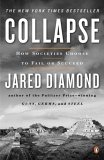
Collapse, Pulitzer Prize–winning author
and UCLA professor Jared Diamond supplies the key. Like his previous book,
the international bestseller
Guns, Germs, and Steel,
Collapse
is a monumental study of the interaction between history, culture, climate,
and the environment—but from the other side. Where
Guns, Germs, and Steel
examined how and why Western civilizations came to dominate the world,
Collapse probes the mysteries of why cultures decline suddenly and
catastrophically—often immediately after reaching their peak. In
Collapse,
Diamond broadens his perspective and his reach as he links the crash of past
civilizations—including the Anasazi of the American Southwest, the Maya of
Central America, the Norse colonists of Greenland, and the Polynesian
creators of Easter Island's famed monumental statues—with what is happening
today in troubled nations around the world.
Diamond opens with a chapter about the spectacular Bitterroot Valley in
western Montana, a choice that he acknowledges may initially seem puzzling.
What could the Bitterroot with its ranches and trout streams and inspiring
mountain vistas share with the desolation of the Anasazi ruins in Chaco
Canyon or the bare eroding hillsides of Haiti? As the narrative unfolds, the
parallels become unmistakable and increasingly alarming. Diamond identifies
five sets of factors that precipitate societal collapse: environmental
damage like deforestation, pollution, soil depletion, or erosion; climate
change; hostile neighbors; the withdrawal of support from friendly
neighbors; and the ways in which a society responds to its problems, be they
environmental, political, or social.
These five key factors played out in different ways in each of the
historical societies Diamond studies. For example, deforestation and a
prolonged drought combined to ignite the Anasazi collapse, while the Maya
cities fell on account of overpopulation, environmental degradation, a sharp
increase in warfare, and poor leadership. All five factors worked together
to undermine and finally destroy the Norse colonies that had flourished on
Greenland for nearly five centuries. When Diamond turns from past to
present, it becomes clear that the conditions for collapse are now coming to
a head in the nations of major world powers like China and Australia as well
as in political flash points like Iraq and Indonesia. In the context of
Diamond's sweeping synthesis, the opening chapter on Montana's Bitterroot
takes on a stark new meaning. The conclusion is inescapable that collapse
can and
will happen again, even in a seemingly blessed nation
like ours, unless we recognize the warning signs and choose to act
responsibly.
How can we avoid destroying our world—and our own species? It is a
tribute to Jared Diamond's brilliance and intellectual honesty that he poses
this question not in fear but with courage, lucidity, and cautious hope.
Discussion Questions
- There is a lot of talk these days about how environmentalists have
damaged their credibility by crying wolf—for example, issuing dire
warnings about exploding population and the effects of global warming that
have not been borne out. Do you think Diamond is vulnerable to the charge
of crying wolf in Collapse? If not, why not? How does his argument
and approach differ from alarmist environmentalists?
- "I am writing this book from a middle-of-the-road perspective," writes
Diamond in the introduction, "with experience of both environmental
problems and of business realities" (p. 17). The middle of the road is
often a tough place to be—since it opens one to attacks from either side.
How successful is Diamond in staking out this position? How does he
balance (or fail to balance) environmental concerns with business
realities?
- "The past is a foreign country; they do things differently there," is
the famous opening line of L. P. Hartley's novel The Go-Between. Collapse is based on the implicit assumption that the past is not
really that foreign after all—that the mistakes and blindness and bad luck
that led to past collapses can and will happen again, that a lot of the
problems of the world today result from the fact that we don't do
things differently. Do you agree with Diamond's position that the past and
present are closely connected, or do you think there is an essential
quality that definitively sets us apart from previous civilizations?
- Diamond describes Tikopia as a kind of island paradise where natives
saved their environment through eco-friendly gardening and devised a kind
of rudimentary democratic system of government. Yet Tikopians also
practiced infanticide and abortion to limit population growth. What does
this say about our ability to judge the morality of past societies? Can
one (must one?) differentiate between macro- and micro-morality?
- What view of human nature do you think underlies Collapse?
Where do you think Diamond would stand on the nature vs. nurture
debate—i.e., the role of genetics versus culture in determining human
behaviors and responses?
- How important are leaders in determining the ecological success or
failure of a civilization? To what extent did bad leadership contribute to
or cause the collapses Diamond talks about? What about in our own
culture—do you think progress will come from enlightened leadership or
rather from grassroots activism?
- Some critics feel that Guns, Germs, and Steel is more
successful than Collapse because it is more tightly organized.
Others praise Collapse because the issues it wrestles with hit so
close to home. If you have read both books, how would you compare them in
terms of structure, central thesis, and relevance to the world today?
Which did you enjoy reading more and why?
- If the United States does collapse, how do you think it will
happen? Which of Diamond's five factors would play a role in the demise of
American civilization as we know it? Do you think our collapse will occur
suddenly, like the crash of Easter Island or Maya civilization, or is it
more likely that we'll experience a gradual but stable decline, as Great
Britain did after World War II?
- Which example of civilizational collapse described in the book do you
find most compelling and why? Which best fits Diamond's thesis? Diamond
notes that "no other site that I have visited made such a ghostly
impression on me as Rano Raraku, the quarry on Easter Island" (p. 79).
Which image or passage in the book made the most powerful impression on
you?
- Diamond writes that our world "cannot sustain China and other Third
World countries and current First World countries all operating at First
World levels" (p. 376). Yet how can we ethically deny Third World
countries the comforts and advantages that we in the First World enjoy? In
your opinion, what should our leaders do to lessen or resolve looming
conflicts over resources between First and Third World countries?
- Diamond reveals that while writing the book he found himself lurching
between hope and despair. What emotions did Collapse inspire in you? Did
you come away depressed, cautiously hopeful, or did you have an entirely
different reaction?
Page numbers refer to the USA hardcover edition, and may vary in
other editions.
Unless otherwise stated, this discussion guide is reprinted with the permission of Penguin.
Any page references refer to a USA edition of the book, usually the trade paperback version, and may vary in other editions.
 Book Reviewed by: