Reading Guide Questions

Please be aware that this discussion guide will contain spoilers!
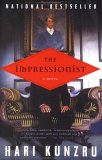
Fathered, through circuitous circumstances, by an Englishman,
Pran Nath
Razdan, the boy who will become the Impressionist, was passed off by his
Indian mother as the child of her husband, a wealthy man of high caste. Growing
up spoiled in a life of luxury just down river from the Taj Mahal, at fifteen
the news of Pran's true parentage is revealed to his father and he is tossed out
into the street—a pariah and an outcast. Thus begins an
extraordinary, near-mythical journey of a young man who must reinvent himself to
survive—not once, but many times.
Imprisoned by a brothel and dressed in women's clothes, his sensuous beauty
is exploited as he is made to become
Rukhsana, a pawn in a game between
colony and empire. To a depraved British Major he becomes
Clive, an
object of desire taught to be a model English schoolboy. Escaping to Bombay he
begins a double life as
Robert, dutiful foster child to a Scottish
missionary couple and as
Pretty Bobby, errand boy and sometime pimp to
the tawdry women of the city's most notorious district.
But as political unrest begins to stir, Pran finds himself in the company of
a doomed young Englishman—an orphan named
Jonathan
Bridgeman. Having learned quickly that perception is a ready replacement for
reality, Pran soon finds himself on a boat bound for Southampton where, with
Bridgeman's passport, he will begin again. First in London, then at Oxford, the
Impressionist hones his chameleon-like skills, making himself whoever and
whatever he needs to be to obtain what he desires.
From Victorian India to Edwardian London, from an expatriate community of
black Americans in Paris to a hopeless expedition to study a lost tribe of
Africa, Hari Kunzru's unforgettable novel dazzles with its artistry and wit
while it challenges with its insights into what it means to be Indian or
English, black or white, and every degree that lies between them.
Discussion Questions
- The pale splendor of Pran Nath's skin was proof, in his aunts' opinion, of
the family's distinguished bloodline. But later, his milky complexion became
a telltale trait of his tainted heritage. Discuss the benefits and drawbacks
of this chameleon-like characteristic.
- Anjali chooses to reveal the truth of Pran Nath's ancestry at a point of
utter conflict, blaming the young master's blended blood for the epidemic
that had shadowed the city of Agra. Explain the magnitude of this
implication for Amar Nath Razdan.
- Does the protagonist choose to adopt each new guise, or do pressures of
the political or social climate force him to find a new persona? When does
he exhibit free will in his decision to change?
- Anjali's indictment of Pran Nath states how his presence in the household
breaks the tenets of the orthodox Hindu religion and suggests that it has
brought a curse on them all. What other symbols led Anjali to be wary of
Pran Nath and his mother? What other cabalistic methods do characters employ
to interpret life?
- In every manifestation, the title character must face caste systems and
social hierarchies. Discuss the various make-up of the societies and the
working of their social construct. Does he ever penetrate one of these sects
or is he perpetually an outsider?
- Discuss the concept of pure blood versus mixed. How did the British
imperialistic campaign, the Great War for Civilization, contribute to the
extreme opinions regarding race and culture? What parallels can be drawn
between the climate in colonial India and Africa and other significant
social conflicts?
- The tiger hunt exposed countless political and personal motivations. How
was the Nawab's party attempting to indulge the visiting British faction?
What other schemes were devised to earn the loyalty of the English?
- The duplicity of the Impressionist's skin could not create alternate
identities on its own. Discuss the various attire worn by the Impressionist
in his many incarnations. From schoolboy uniforms and silk saris to academic
robes and adventurer's khakis, how did his clothing shape others'
impressions?
- What motivation is the strongest for the Impressionist on his journey?
What is his ultimate goal? Does his objective change as the book progresses,
or is there an enduring, instinctual drive that maintains him?
- After Robert is taken in by Mrs. Macfarlane, he does not submit to a
focused life as a dutiful foster child. What factors contributed to his
double life in Bombay? How might the severed Macfarlane household have
perpetuated his bewildered sense of self?
- After assuming the role of Jonathan Bridgeman, the main character had only
one fearful brush with exposure. How does he deal with his meeting with Aunt
Berthilda? What conclusions regarding perception can be drawn from the
Headmaster's and Mr. Spavin's reactions to the event?
- How was Star's dalliance with Sweets comparable to Jonathan's pursuit of
Star? Was Star attracted to Sweet's humanity, or his blackness? Was Star's
reaction when Sweets arrived at the club genuine? Were her intentions with
Jonathan honorable?
- When he is dispelled from his home, Pran considers himself entirely
Indian. At what point, and under what influences, does he begin to recognize
his English heritage. Why does he not strive harder to reestablish himself
as an Indian?
- Why was the Impressionist spared by the Fotse? What was the significance
of the ceremony conducted in the cave? What is the Impressionist's fear if
the old man draws the European spirit out?
- In the end, what connections can be drawn between the Impressionist and
his biological parents? What has he inherited from them?
- In his fifteen years as the only son of a wealthy academic of high caste,
Pran Nath could do no wrong in his family's opinion, yet his arrogance,
unappealing practical jokes, and disrespectful nature alienated the servants
and townspeople. Was his attitude a reflection of his upbringing? Or was it
a sign of bad blood? Did his childhood misdeeds foreshadow his later
transgressions?
- As he starts to make his way through his succession of personalities, the
Impressionist also begins a pattern of betrayal. Who does he deceive the
most? Who stands to be hurt the most by him? And whom does he most regret
misleading? Why?
- The visit of Sir Wyndham Braddock to Fatehpur emphasizes the cultural
distinctions between the military representative of the Crown and their
colonial constituents. Discuss the stagings of Sir Wyndham's ceremonial
procession to the palace and the afternoon tea party at Gus and Charlie
Privett-Clampe's residence and the incongruities these events unveil.
- Compare the lifestyles and interests of the Nawab, the Sublime Ruler, and
Prince Firoz. How do these two brothers illustrate the struggle between
traditional Indian culture and the western influence?
- Discuss the character of Reverend Macfarlane. What do his allegiance to
the missionary lifestyle, his relationship with his wife, his opinion of the
Bombay population, and his devotion to his anthropological research convey
about his personal conflicts?
- What was Bobby's intention when he decided to accompany the original
Jonathan Bridgeman on his search for a tart? What might he have anticipated
from the evening's events?
- In adopting new identities, can one's innate sense of morality change?
What kind of person is the Impressionist? Are his decisions immoral,
unlawful? How would his actions be viewed in different societies, according
to different ethical codes?
- Why is Jonathan so lonely after Paul Gertler's forced departure? What made
Paul an exception? Why was he worthy of Jonathan's friendship?
- Why did Jonathan gravitate to Astarte Chapel? Did his attraction go beyond
her English Rose appeal? Why did Star find Jonathan's quintessentially
British façade boring, almost offensive?
- Pran's beauty is noted in his initial description. Heralded in his family
as physical evidence of their fine Kashmiri bloodlines, his beauty is his
only charm. How would Pran's story be different, in all its stages, if he
were not as definitively attractive?
- Professor Chapel found a very different tribe when he returned to
Fotseland for the final time. Discuss the tribe's evolution and the
instigating factors. Why might the Fotse have named the English "sorcerors?"
- When Jonathan returns from recording information for the census, the other
members of the exhibition accuse him of not being "a joiner."
While this statement is true, it is also ironic. Discuss the emotional state
of the group and how their reaction affects Jonathan.
- Can anyone be himself while attempting to like everyone else? In an
attempt to fit in, did Jonathan take conventionality too far and lose
individuality altogether?
- How would the main character's fate be different if the story were to take
place in the twenty-first century?
- There are specific moments in which the main character is seized by fear,
a panic of identity. Did the man who was once Pran Nath strip himself of his
own persona? Can an individual erase his or her soul?
For information about other Penguin Readers Guides, please call the Penguin
Marketing Department at (800) 778-6425, email at reading@penguinputnam.com
or write to them at: Penguin Books,
Marketing Department CC,
Readers' Guides,
375 Hudson Street,
New York, NY 10014-3657
Unless otherwise stated, this discussion guide is reprinted with the permission of Plume.
Any page references refer to a USA edition of the book, usually the trade paperback version, and may vary in other editions.