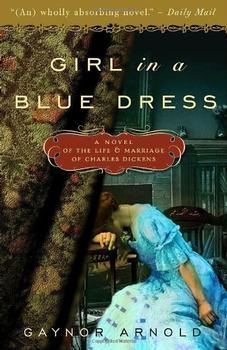
Girl in a Blue Dress by Gaynor Arnold: Questions, plus a reading group guide, with links to reviews, excerpt, author interview and author biography at BookBrowse.com.
Girl in a Blue Dress A Novel Inspired by the Life and Marriage of Charles Dickens
by Gaynor Arnold
Hardcover: Jul 2009,
432 pages.
Paperback: Aug 2010,
432 pages.
Please be aware that this discussion guide may contain spoilers!
Longlisted for both the Man Booker Prize and the Orange Prize, Gaynor Arnold's Girl in a Blue Dress is an intimate peek at a woman who was behind one of literature's most esteemed men.This guide is meant to help your reading group in its discussion of this remarkable novel.
Arnold titled her novel Girl in a Blue Dress, yet for most of the book, Dorothea is a grown woman. Why did the author choose this title? In what ways does Dorothea's growth from a girl to a woman affect the narrative?
Victorian England is known for its restrictiveness and prudishness when it comes to discussing matters of the heart. If Mr. and Mrs. Gibson were to go into marriage counseling today to discuss their "issues," what would those issues be?
Mrs. Gibson never seems quite comfortable in her role as a mother. How was parenthood different in the Victorian world than it is in the present day?
It's obvious that Alfred loved Dorothea's sister, Alice. How would this novel have been different if he had married her, not Dodo? Would he have stayed faithful and loving throughout?
Throughout the novel, there are oblique references to "the workhouse." What was the workhouse, and why do you think Alfred was so terrified of its prospect?
When Alice dies, Dorothea does not dress in mourning because Alfred disapproves. After his death, Dorothea still refuses to dress in blackat least until her audience with the Queen. Why do you think this is? Is her refusal defiance of convention, a force of habit leftover from her days with Alfred, or something else entirely?
In spite of it all, Dorothea never admits to feeling bitterness or hatred towards Alfred. Is this a sign of her strength, or her weakness? Explain.
Arnold's novel leaves a lot unsaid, and a lot up to the imagination of its readers. In what ways do you think Alfred Gibson was unfaithful to his wife? Do you think he was a serial adulterer? Or were his infidelities less physical, more psychological?
If you were Dorothea, would you have wanted to meet Miss Ricketts? What would you have said to her if you did?
Who is the villain in this bookor is there one at all?
Unless otherwise stated, this discussion guide is reprinted with the permission of Three Rivers.
Any page references refer to a USA edition of the book, usually the trade paperback version, and may vary in other editions.

A bold, mesmerizing novel about the woman known as "Typhoid Mary," the first known healthy carrier of typhoid fever in the burgeoning metropolis of early twentieth century New York.
Z, the novel about the life of Zelda Sayre Fitzgerald is at points charming and; like another reviewer, I kept thinking of the movie, "Midnight...
read more
Although heavy on the scientific details, which slowed down the story for me (OK, I admit, I was one of those liberal arts majors who skipped out on...
read more
Loved this book. Magical, quirky, enchanting I could go on. All books do not have to be literary fiction, sometimes it is just so comforting to read...
read more
British Parliament asks Amazon to clarify why it pays $9 million in income tax on $23 billion of UK sales.(May 20 2013) Amazon will be called back to give further evidence to members of the British Parliament "to clarify how its activities in the U.K. justify its low corporate...
Full Story