Reading Guide Questions

Please be aware that this discussion guide will contain spoilers!
Introduction
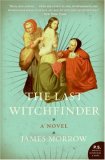
The Last Witchfinder tells of one woman's heroic quest to overturn the
Parliamentary Witchcraft Act of 1604. Set in Restoration England and the
American provinces, James Morrow's historical epic is a meticulously researched
and richly detailed narrative of sorcery, science, and the sea change from the
witch-hunting era to the Age of Reason.
Jennet Stearne, the daughter of Witchfinder-General Walter Stearne, is
quick-witted, sharp-tongued, and hungry for knowledge. Under the tutelage of her
beloved Aunt Isobel, our heroine acquires a passion for "natural philosophy" and
an abhorrence of her father's work. After witnessing Isobel's unjust execution
as a witch, Jennet makes it her life's mission to destroy the statute that
sanctions the hanging and burning of innocent women.
In a tour-de-force writing performance, Morrow follows Jennet as she emigrates
with her family from Colchester to America, where she becomes entangled in the
machinations of the Salem Witch Court, the designs of her Nimacook Indian
captors, and the bedsheets of her fascinating lover, the young Benjamin
Franklin. But Jennet faces the ultimate challenge when she courageously puts
herself on trial for sorcery in Colonial Philadelphia, thus sparking a
monumental confrontation between two incompatible worldviews.
Set many generations ago,
The Last Witchfinder features characters whose
goals and obsessions sometimes seem remote from our way of thinking.
Nevertheless, Jennet's adventures raise many issues—concerning religious
beliefs, the scientific picture of reality, and the role of women in public
life—that resonate for contemporary readers. We hope the following questions
will help you connect the universe of James Morrow's novel to our modern,
post-Enlightenment world.
Questions for Discussion
- It's easy to see why Jennet Stearne calls her campaign against the 1604
Parliamentary Witchcraft Act a "quest." If it succeeds, her mission will
have enormous social ramifications. But must a "quest" always be so lofty?
Did you ever undertake a personal project that also felt like a quest?
- Walter Stearne, the self-appointed "Witchfinder-General" who dominates
the first third of the novel, systematically detects Satanists using such
"proofs" as "swimming the witch" and pricking her supposed Devil's mark. In
performing these tests, is Walter practicing a kind of science? How do
Walter's "proofs" differ from the experiments with light and acceleration
that Jennet and Aunt Isobel perform in chapter one?
- In the late 1750s the playwright Oliver Goldsmith remarked that he "who
would court a lady must be capable of discussing Newton and Locke."
Goldsmith meant that, for his generation and those immediately before it,
women no less than men took a keen interest in "natural philosophy." Does
this same situation hold today? Does an intelligent man assume that his
female friends will want to discuss scientific and philosophical matters?
- The author periodically interrupts the narrative flow with commentary by
a conscious, immortal, opinionated book: Isaac Newton's Principia
Mathematica. How does the Principia's commentary help us grasp
the fuller implications of Jennet's adventures? Do the book's remarks
sometimes seem biased or self-serving?
- During her life Jennet acquires five lovers: Okommaka, Tobias Crompton,
Benjamin Franklin, Pussough, and—unbeknownst to herself—the Principia
narrator. Which of these characters understands our heroine best? Could
Jennet have found long-term happiness in any of these relationships?
- Upon her deliverance from the Nimacooks by Tobias Crompton, Jennet
happily plights her troth to him, knowing that this union will enable her to
continue the quest. How do you feel about Jennet's "marriage of
convenience"? Did she have any alternatives?
- After Jennet's first argumentum grande is rejected by Parliament,
she resolves to write a superior sequel, even though her husband worries
that "in constructing this second and more elaborate treatise, you will
grievously neglect our daughter." Should Jennet have taken Tobias's fears
more seriously, postponing her project until Rachel became self-sufficient?
Is Tobias holding Jennet to a standard of parental self-sacrifice that men
have normally been free to ignore?
- In the second half of the novel we witness Jennet's brother, the "last
witchfinder" of the title, executing people for supposed heresy. What is the
root of Dunstan's cruelty? Is he innately evil? Or is the Principia
narrator correct when he asserts, in chapter three, "You must remain
mindful, however, that the true villains of my story are not depraved
persons but psychotic theologies"?
- Marooned on a Caribbean island, Jennet finally discovers the "demon
disproof" she has sought all her life. Explaining her argumentum grande
to Benjamin Franklin, she notes that "but for my years as a savage Indian, I
would ne'er have hit upon this proposition." What role did Jennet's Nimacook
past play in her conclusion that the world is holistic and "alive"?
- At one level The Last Witchfinder is about the historical clash
between religion and science. But must faith and reason necessarily
conflict? Does Jennet lay the groundwork for a reconciliation when, pleading
her case before the Philadelphia witch court, she asserts that "God hath
gifted His creatures with two great books, one called Scripture, the other
Nature"?
- For Jennet it seems to go without saying that she must sign her
treatises "J. S. Crompton," rather than using her full name and thus
revealing her sex. At some point in her quest should she have disclosed her
gender to the world?
- Throughout The Last Witchfinder the author uses historical
figures to personify the Age of Reason—Franklin, Newton, Hooke,
Montesquieu—all of them presented as wild and quixotic characters. Does
Morrow succeed in his apparent ambition to dramatize the human side of
science? Would you join him in questioning the common dichotomy between
intellect and passion?
- Perhaps you've attended a revival of Arthur Miller's The Crucible,
or maybe you've seen the 1997 film adaptation starring Daniel Day-Lewis and
Winona Ryder. Whereas Miller sees the Salem Witch Trials as foreshadowing
the McCarthy era, with ruthless people exploiting a transient hysteria to
advance their own interests, Morrow evidently interprets the Salem tragedy
as one more battle in a protracted war between Renaissance theology and
scientific rationality. Which understanding of the 1692 trials do you find
more compelling?
- The Last Witchfinder contains an epilogue in which contemporary
equivalents of Jennet and Aunt Isobel participate in a middle-school rocket
club. Why do you think the author included this coda?
- Perhaps the most remarkable characteristic of the Principia
narrator is his romantic feelings toward Jennet. Do you sometimes feel that
books have lives of their own? Do you love your favorite books as friends?
Unless otherwise stated, this discussion guide is reprinted with the permission of Harper Perennial.
Any page references refer to a USA edition of the book, usually the trade paperback version, and may vary in other editions.
 Book Reviewed by: