Reading Guide Questions

Please be aware that this discussion guide will contain spoilers!
About This Book
James Frey wakes up with a broken nose, missing teeth, a hole in
his cheek, and eyes so swollen he can hardly open them. His
clothes are "covered with a colorful mixture of spit, snot,
urine, vomit and blood" [p. 1]. He's on a plane, but he does not
know where he's going or where he's come from. And now his life
is about to get really difficult.
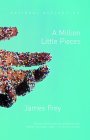
A Million Little Pieces is James Frey's scorching account
of his descent into the hell of addiction and the brutal journey
to recovery. When he arrives at a famous clinic in Minnesota, he
is nearly dead from a decade of drug and alcohol abuse so
spectacular even doctors who have spent their entire careers
treating addicts are amazed. He took everything he could find,
and as much as possible: Cocaine, crack cocaine, crystal meth,
PCP, glue, and alcohol in quantities so great he blacked out
every day for years. His body is shot, and his mind is in an
almost constant rage of self-hatred and destructiveness. He is
wanted in three states for crimes ranging from DUI and resisting
arrest to assaulting an officer, attempted incitement of a riot,
and felony mayhem. He has, as they say, hit bottom. A few more
drinks, the doctors tell him, will kill him.
His ordeal inside the clinic is hardly less harrowing. Balancing
on the razor's edge between hope and despair, Frey describes the
writhing delusions of withdrawal, the constant need of
addictions screaming to be fed, and the blinding Fury that
overtakes him and makes him want to run. That he completely
rejects the clinic's Twelve Steps program makes his recovery
seem even less likely. But he meets a fellow patient, Leonard,
who will not give up on him, his brother gives him a copy of the
Tao Te Ching, which speaks to him more profoundly than
anything he reads in the AA literature, and he falls in love
with Lilly, a beautiful and doomed crack addict. In them he
finds reasons to try to heal himself. And he insists, in a
gesture either heroic or just plain stubborn, that whatever the
sources of his addictions might be, he will place the
responsibility for his life and its disasters, the pain he's
caused himself and others, squarely on his own shoulders. He
will stay sober not by attending AA meetings in church
basements, or praying to a god he can't believe in, but by
deciding not to act on his addictions. A recipe for failure,
his counselors tell him, but a risk he decides he has to take.
In writing that jumps off the page with all the rawness and
immediacy of life,
A Million Little Pieces.
Discussion Questions
- A Million Little Pieces presents some unusual formal
innovations: Instead of using quotation marks, each piece of
dialogue is set off on its own line with only occasional
authorial indications of who is speaking; paragraphs are not
indented; sentences sometimes run together without punctuation;
and many passages read more like poetry than prose. How do these
innovations affect the pace of the writing? How do they
contribute to the book's rawness and immediacy? How is James
Frey's unconventional style appropriate for this story?
- A Million Little Pieces is a nonfiction memoir, but does it
also read like a novel? How does Frey create suspense and
sustain narrative tension throughout? What major questions are
raised and left unresolved until the end of the book? Is this
way of writing about addiction more powerful than an objective
study might be?
- Why does the Tao Te Ching speak to James so
powerfully? Why does he connect with it whereas the Bible and
Twelve Steps literature leave him cold? How is this little book
of ancient Chinese wisdom relevant to the issues an addict must
face?
- James is frequently torn between wanting to look into his
own eyes to see himself completely and being afraid of what he
might find: "I want to look beneath the surface of the pale
green and see what's inside of me, what's within me, what I'm
hiding. I start to look up but I turn away. I try to force
myself but I can't" [p. 32]. Why can't James look himself in the
eye? Why is it important that he do so? What finally enables him
to see himself?
- When his brother Bob tells James he has to get better,
James replies, "I don't know what happened or how I ever ended
up like this, but I did, and I've got some huge fucking problems
and I don't know if they're fixable. I don't know if I'm
fixable" [p. 131]. Does the book ever fully reveal the causes of
James's addictions? How and why do you think he ended up "like
this"?
- Why are James and Lilly so drawn to each other? In what
way is their openness with each other significant for their
recovery?
- Joanne calls James the most stubborn person she has ever
met. At what moments in the book does that stubbornness reveal
itself most strongly? How does being stubborn help James? How
does it hurt or hinder him?
- The counselors at the clinic insist that the Twelve Steps
program is the only way addicts can stay sober. What are James's
reasons for rejecting it? Are they reasons that might be
applicable to others or are they only relevant to James's own
personality and circumstances? Is he right in thinking that a
lifetime of "sitting in Church basements listening to People
whine and bitch and complain" is nothing more than "the
replacement of one addiction with another" [p. 223]?
- What are the sources of James's rage and self-hatred? How
do these feelings affect his addictions? How does James use
physical pain as an outlet for his fury?
- How is Frey able to make the life of an addict so
viscerally and vividly real? Which passages in the book most
powerfully evoke what it's like to be an addict? Why is it
important, for the overall impact of the book, that Frey
accurately convey these feelings?
- When Miles asks James for something that might help him,
James thinks it's funny that a Federal Judge is asking him for
advice, to which Miles replies: "We are all the same in here.
Judge or Criminal, Bourbon Drinker or Crackhead" [p. 271]. How
does being a recovering addict in the clinic negate social and
moral differences? In what emotional and practical ways are the
friendships James develops, especially with Miles and Leonard,
crucial to his recovery?
- James refuses to see himself as a victim; or to blame his
parents, his genes, his environment, or even the severe physical
and emotional pain he suffered as a child from untreated ear
infections for his addictions and destructive behavior. He
blames only himself for what has happened in his life. What
cultural currents does this position swim against? How does
taking full responsibility for his actions help James? How might
finding someone else to blame have held him back?
- Bret Easton Ellis, in describing A Million Little
Pieces, commented, "Beneath the brutality of James Frey's
painful process, there are simple gestures of kindness that will
reduce even the most jaded to tears." What are some of those
moments of kindness and compassion and genuine human connection
that make the book so moving? Why do these moments have such
emotional power
- In what ways does A Million Little Pieces
illuminate the problem of alcohol and drug addiction in the
United States today? What does Frey's intensely personal voice
add to the national debate about this issue?
Suggested Reading
Charles Bukowski, Barfly; Augusten Burroughs, Dry;
William S. Burroughs, Junky; Susanna Kaysen, Girl,
Interrupted; Ken Kesey, One Flew Over the Cuckoo's Nest;
Hubert Selby, Jr., Last Exit to Brooklyn; Irvine Welsh,
Trainspotting.
Reproduced by permission of the publisher, Anchor Books.
Unless otherwise stated, this discussion guide is reprinted with the permission of Anchor Books.
Any page references refer to a USA edition of the book, usually the trade paperback version, and may vary in other editions.