Summary | Excerpt | Reading Guide | Reviews | Beyond the book | Read-Alikes | Genres & Themes | Author Bio
Critics' Opinion:
Readers' Opinion:
First Published:
Feb 2013, 400 pages
Paperback:
Feb 2014, 416 pages
 Book Reviewed by:
Bob Sauerbrey
Buy This Book
In his 7th symphony, English composer Ralph Vaughan-Williams uses music he composed for the 1948 film, Scott of Antarctica, which documents Robert Scott's disastrous 1912 attempt to be the first to reach the South Pole. The expedition was a double failure: The Norwegian expedition led by Roald Amundsen reached the Pole before Scott's group and, on the return journey, Scott's whole party perished. Vaughan-Williams captures the essence of the heroic spirit both in the music and in the literary citations that precede each movement. In the Prelude, he quotes the last lines of Shelley's Prometheus Unbound:
To suffer woes which hope thinks infinite, To forgive wrongs darker than death or night, To defy power which seems omnipotent… Neither to change, nor falter, nor repent: This ... is to be Good, great and joyous, beautiful and free, This is alone Life, Joy, Empire and Victory.
Shelley and Vaughan-Williams sum up the "hero's journey," the call beyond the ordinary boundaries of life to test and then to surpass human limits, to make what Neil Armstrong called "one giant leap for mankind."
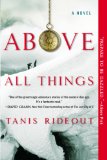
 In her first novel, Above All Things, Tanis Rideout follows George Mallory and his companions on the 1924 British Everest Expedition, the third attempt by British teams led by Mallory to reach the summit of what was considered the Third Pole - important to the British because the Americans and Norwegians had already reached the other poles first and only Everest remained as a seemingly unconquerable goal. Mallory embodied all the qualities of the hero that Shelley described, and Everest was the far boundary that drew him.
Tanis Rideout expands the hero's quest to include all those affected when someone leaves behind a life and a love to follow that higher calling. For every Odysseus there is a Penelope left weaving at her loom. For every Aeneas there is an abandoned Dido. For every Amelia Earhart there is a George Palmer waiting. Every embrace of a goal "because it's there" also involves turning one's back, at least for a time, on "what's here." Though Ruth and George Mallory's relationship was deep, committed, and firmly embedded in their lives, George's obsession with Everest – his being drawn by the siren call of Chomolungma, the Goddess of Everest – stood 'above all things' in his heart. In standing on Everest, George stood above every other physical feature on Earth, and George's quest for Everest's summit stood above every other one of his concerns.
 Rideout tells a masterful story of the adventure of the expedition, the hardships of the climb, and the inner conflict within each member of the team. She also explores Ruth's proud support along with her doubts, anxiety, and fears. Ruth knows she could be facing a future empty of the husband and father that form the center of her family, even in his absence. At the same time, however, Ruth is drawn to the very mountain she hates for taking away her lover and husband. The letters between Ruth and George and the inner dialogue Rideout creates from these and from her research give entrance into hearts torn between two loves, and Rideout does so without the judgment that would create a victim or a villain. We have to look to Emma Bovary or Anna Karenina to find such victimless conflict in women, and perhaps to the Ulysses of Tennyson who "…cannot rest from travel: [but] will drink/ Life to the lees…yearning in desire/To follow knowledge like a sinking star/ Beyond the utmost bound of human thought," to find it in men. Rideout skillfully allows us to feel the pain of both, joined with compassion for each.
In one conversation, Ruth says, "This is not a marriage. I want to be with you. Isn't that what you said you wanted?" And George replies: "It's for something greater, Ruth, I promise you. If I do this, I'll never have to go away again… I want you to be proud of me. I want the children to be proud." George is convinced that "only claiming the summit could make things right between them." In the end, George loses all: the mountain and his family. What "is there" has also taken away "what's here."
I am a particular fan of first novels since authors often pour the depths of their hearts into them. Many authors never surpass the masterwork with which they started their careers. If Tanis Rideout writes no other novel, she has achieved mastery in this first long work and has given us a treasure. I personally hope she will continue to write so skillfully of the inner human struggle. Some would call this a historical novel, but it is more than that: it is an exploration of the conflict of the human heart, which all must face and within which we each must shape our destiny.
Photo of George and Ruth courtesy of Audrey Salkeld Collection
Tanis Rideout talks about Above All Things here:
 This review was originally published in The BookBrowse Review in March 2013, and has been updated for the
February 2014 edition.
Click here to go to this issue.
This review was originally published in The BookBrowse Review in March 2013, and has been updated for the
February 2014 edition.
Click here to go to this issue.

If you liked Above All Things, try these:
by Nancy Horan
Published 2014
A much-anticipated second novel which tells the improbable love story of Scottish writer Robert Louis Stevenson and his tempestuous American wife, Fanny.

by Jonathan Franzen
Published 2011
Freedom comically and tragically captures the temptations and burdens of liberty: the thrills of teenage lust, the shaken compromises of middle age, the wages of suburban sprawl, the heavy weight of empire. An indelible and deeply moving portrait of our time.


The Flower Sisters
by Michelle Collins Anderson
From the new Fannie Flagg of the Ozarks, a richly-woven story of family, forgiveness, and reinvention.
The House on Biscayne Bay
by Chanel Cleeton
As death stalks a gothic mansion in Miami, the lives of two women intertwine as the past and present collide.
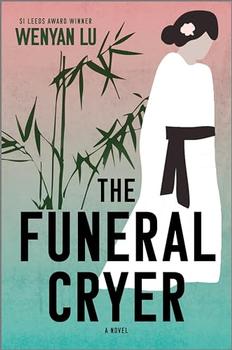
The Funeral Cryer by Wenyan Lu
Debut novelist Wenyan Lu brings us this witty yet profound story about one woman's midlife reawakening in contemporary rural China.
Your guide toexceptional books
BookBrowse seeks out and recommends the best in contemporary fiction and nonfiction—books that not only engage and entertain but also deepen our understanding of ourselves and the world around us.