Summary | Excerpt | Reviews | Beyond the book | Read-Alikes | Genres & Themes | Author Bio
 Book Reviewed by:
Kim Kovacs
Buy This Book
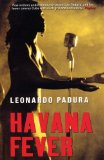
Leonardo Padura's latest novel, Havana Fever, is a cold-case
investigation into the disappearance of a beautiful bolero singer forty-seven
years prior to current events. Padura does a wonderful job of crafting the
mystery. Clues are revealed gradually, building suspense and ultimately leading
the reader to its dark but satisfying conclusion. Purely as a mystery novel,
Havana Fever is top-notch and a terrific example of modern noir.
The real highlight of the book, though, is Padura's rich and evocative
writing style. He brilliantly conjures up both the smoky nightclubs of Batista's
Havana in the 1950s and the city's present poverty, comparing and contrasting
the two different eras. Both are dark, gritty and rife with corruption. The
modern scenes in particular are cloaked in an oppressive, unrelenting gloom that
doesn't begin to lift until the book's final pages. The writing is almost poetic
at times. This is one of those novels that one simply can't rush through; it
must be savored.
"Not worried why he was doing so – and not really interested in finding out - perhaps driven by a mixture of alcohol and the persistent allure of certain phantoms and fascinations, Conde hailed a taxi going in the opposite direction to his house and asked the driver to take him to the corner of Twenty-Third and L, or any other street corner that might encompass the same evocative ciphers. He was pleased to see that even at that late, late, hour of the night, the fast-beating heart of the city was still packed with spaced-out youths and adults trawling for illicit offerings … Gays of every tendency and category, rockers with no stage or music, savage hunters and huntresses of foreigners and dollars, bored birds of the night with one, two and even three hidden agendas seemed anchored to that spot, not fearing the imminent dawn, as if hoping something out of the blue might drag them down the street, perhaps out to sea, or maybe up into the sky."
Havana Fever is the fifth novel to feature Mario Conde, a now-retired
police inspector. Often, even sequels that stand well on their own leave the
reader feeling like they've missed something, that they'd understand the novel
better had they read the previous books first. This is not the case with
Havana Fever, which is self-contained and relatively independent of the
previous entries in the series.
Padura's only misstep is the story's pacing. The mystery and its
investigation don't really get rolling until the novel's second half. While much
of the narrative is necessary to really envelope the reader in the book's
atmosphere, there's a lot here that feels superfluous and the exceptionally slow
beginning may be enough to keep some readers from progressing beyond
the first few chapters. In spite of this, I still rate Havana Fever a "5"
out of 5 stars - readers who persist to the book's end will find it well
worth their time. It's sure to appeal both to those who enjoy high-quality
mysteries and those who are interested in reading about life in the steamy
barrios of Havana past and present.
About the Author
Leonardo Padura was born in 1955 in Havana and lives in Cuba. He has published a
number of short-story collections and literary essays but international fame
came with the Havana Quartet, all featuring Inspector Mario Conde. Like
many others of his generation, Padura had faced the question of leaving Cuba,
particularly in the late 80s and early 90s, when living conditions deteriorated
sharply as Russian aid evaporated. He chose to stay. And to write beautiful
ironic novels in which Soviet-style socialism is condemned by implication
through scenes of Havana life where even the police are savagely policed.
The crime novels feed on the noises and smells of Havana, on the ability of its
inhabitants to keep joking, to make love and music, to drink rum, and to survive
through petty crime such as running clandestine bars and restaurants.
Padura's books are translated from Spanish into English by Peter Bush, well
known for his extensive work on Juan Goytisolo. He has also completed
translations of Daniel Chavarria, Nuria Amat and Pedro de Alarcón.
The Inspector Mario Conde Series to Date
 This review
first ran in the May 21, 2009
issue of BookBrowse Recommends.
This review
first ran in the May 21, 2009
issue of BookBrowse Recommends.

If you liked Havana Fever, try these:
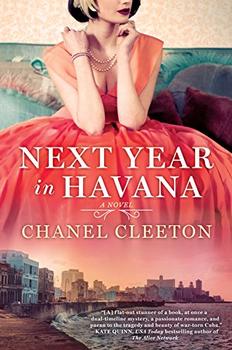
by Chanel Cleeton
Published 2018
After the death of her beloved grandmother, a Cuban-American woman travels to Havana, where she discovers the roots of her identity--and unearths a family secret hidden since the revolution...
by Roberto Ampuero
Published 2013
Evocative, romantic, and full of intrigue,The Neruda Case is both a glimpse into the life of Pablo Neruda as death approaches and a political thriller that unfolds during the fiercely convulsive end of an era.




The Flower Sisters
by Michelle Collins Anderson
From the new Fannie Flagg of the Ozarks, a richly-woven story of family, forgiveness, and reinvention.

The House on Biscayne Bay
by Chanel Cleeton
As death stalks a gothic mansion in Miami, the lives of two women intertwine as the past and present collide.

The Funeral Cryer by Wenyan Lu
Debut novelist Wenyan Lu brings us this witty yet profound story about one woman's midlife reawakening in contemporary rural China.
Your guide toexceptional books
BookBrowse seeks out and recommends the best in contemporary fiction and nonfiction—books that not only engage and entertain but also deepen our understanding of ourselves and the world around us.