
-
Your next favorite book
is waiting.
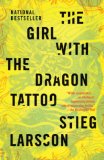
 Book Reviewed by:
On one level, The Girl
with the Dragon Tattoo
by Stieg Larsson is a
traditional "closed-room"
mystery, albeit an
exceptionally well-written
one. It compares favorably
with the works of Agatha
Christie and Dorothy Sayers.
The characters are
well-drawn, there is a
profusion of suspects, and
the reader is presented with
lots of logical, thorough
detective work.
Additionally, there are
enough twists and turns to
prevent the story from
becoming dull or
predictable. Simply viewed
as a mystery novel, the book
is a fine addition to the
genre.
Like an onion, though, it
has other layers beneath its
surface. The reader finds a
complex commentary on
Swedish society underlying
the main plot. The
criticisms Larsson levels at
the Swedes can be easily
applied to other Western
cultures, making the book
relevant to a wide audience.
He takes on topics such as
violence against women,
corporate corruption, and
the unwillingness of
journalists to tackle
controversial issues. He
also discusses the
individual's responsibility
for his or her own actions,
regardless of circumstances,
as well as what it means to
be "moral" or "ethical." The
author manages to integrate
his observations in a way
that prevents these themes
from becoming overbearing or
preachy; he doesn't whack
the reader over the head
with his views.
The highlights mentioned in
the previous paragraphs
would be enough to make
The Girl with the Dragon
Tattoo a winner, but
what really makes the novel
an over-the-top, must-read
book is Larsson's creation
of an utterly unique
character: a young female
hacker named Lisbeth
Salander. All of Larsson's
characters are well-drawn
and multidimensional; his
other protagonist, Mikael
Blomkvist, has exceptional
depth and measures up to the
likes of Hercule Poirot and
Lord Peter Wimsey. Salander,
though, is far from your
typical investigator. She's
not even your typical
hacker-chick. She's dark,
anti-social, and completely
ethical, but by a standard
few people would espouse.
She believes that the
punishment should fit the
crime, but feels it's
detrimental to justice – at
least her idea of justice –
to involve the authorities.
The reader finds this
character's attitudes and
actions simultaneously
shocking and admirable.
Remarkably, Larsson is able
to imbue Salander with a
huge amount of personality
without allowing her to
become a caricature. He
achieves an ideal balance
here, and the result is a
completely unforgettable
heroine.
Larsson's locale
descriptions are meticulous
and more than adequate for
the reader to develop
detailed mental images of
the places discussed in the
book. They are, however, not
integral to the story but
merely the backdrop - the
book could as easily have
been set in upstate New York
as Sweden. This does not
detract from the novel in
any way, instead it broadens
its appeal.
Sometimes when reading a
novel, awkward phrasing or
pacing of sentences signals
too clearly that it has been
translated from another
language. Such is not the
case with Steven Murray and
Reg Keeland's excellent
translation of The Girl
with the Dragon Tattoo -
readers who may be
apprehensive about tackling
a book in translation need
not be concerned.
While the mystery at the
center of The Girl with
the Dragon Tattoo wraps
up very satisfactorily, the
novel itself does not.
That's not to say that the
book's ending is poor; it
is, in fact, one of the most
appropriate endings this
reviewer has encountered.
The problem is that it will
without doubt leave the
reader wanting more.
Fortunately for his fans,
Stieg Larsson completed two
more books in the Millenium
series before his untimely
death. This is one book that
lives up to its hype. Highly
recommended.
 This review was originally published in October 2008, and has been updated for the
June 2009 paperback release.
Click here to go to this issue.
This review was originally published in October 2008, and has been updated for the
June 2009 paperback release.
Click here to go to this issue.
Stieg Larsson
 Swedish author Stieg
Larsson's life is every bit
as fascinating as that of
any fictional character. In
fact, Mikael Blomkvist, the
protagonist of The Millenium
Series, bears many
similarities to his creator.
Swedish author Stieg
Larsson's life is every bit
as fascinating as that of
any fictional character. In
fact, Mikael Blomkvist, the
protagonist of The Millenium
Series, bears many
similarities to his creator.
Karl Stig-Erland Larsson was
born on August 15, 1954 in
Västerbotten, in northern
Sweden. He was raised in the
countryside by his
grandparents until his
grandfather's death in 1962
(despite considerable
research, including
questions to his publisher,
that is all we have been
able to glean of his
childhood).
After performing his
mandatory two-year military
service, Larsson traveled
widely in Africa, witnessing
the civil war in Eritrea
first-hand. On his return to
Sweden in 1977, he worked
for Tidningarnas
Telegrambyra (TT), the
largest Swedish news agency.
He was employed at TT for
most of his adult life as a
journalist, feature writer
and graphics artist.
One of his many passions was
science fiction. He was the
co-editor of several
fanzines, including
Sfären, Fijagh!
Additionally, he was
president of the largest
Swedish sci-fi fan club,
Skandinavisk förening för
science fiction (SFSF), from
1978 – 1979.
Until the posthumous
publication of his books,
Larsson was best known as a
political activist and
journalist. He never
officially joined the
Communist party in Sweden,
but he was a strong advocate
for the Kommunistiska
Arbetareförbundet
(Communist Workers League).
He also edited the Swedish
Trotskite journal Fjärde
internationalen. He was
devoted to fighting racism
and totalitarianism, and
became instrumental in
documenting and exposing
organizations advocating
these and other far-right
philosophies. He initiated
the Swedish Expo foundation
(a sister-society to the
British
Searchlight foundation)
dedicated to countering
nationalist, racist,
anti-democracy and
anti-Semitic groups.
Larsson was widely admired
for his stance against
extremist groups. He
received many death threats
over the years, and those
close to him were seriously
concerned for his life. When
he died in 2004, many
conspiracy theorists
speculated that what was
deemed a massive heart
attack was, in fact, murder.
(Given the fact that the man
smoked over 60 cigarettes a
day and led a relatively
unhealthy lifestyle,
however, the official cause
of death seems likely.)
The Millennium Series
(or at least the first 4
books)
was nearly complete before
Larsson showed the first two
books to a publisher shortly
before his death. In Sweden
alone, over 2.7 million
copies have been sold since
the first book published in 2005 (almost one
for every three Swedes in a
country of nine million
people). At least 32
countries have bought the
rights to the trilogy, and
all three books have film
adaptations in the works.
More about the Millennium
series - books and movies -
in the main body of the
review
Walking Tours
The Millennium series has
become so popular in Europe
that the Stockholm City
Museum now offers
walking-tours of the
sites featured in Larsson's
trilogy.
This review was originally published in October 2008, and has been updated for the
June 2009 paperback release.
Click here to go to this issue.
Your guide toexceptional books
BookBrowse seeks out and recommends the best in contemporary fiction and nonfiction—books that not only engage and entertain but also deepen our understanding of ourselves and the world around us.
