
-
Your next favorite book
is waiting.
Summary | Excerpt | Reviews | Beyond the Book | Readalikes | Genres & Themes | Author Bio
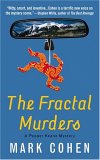
A Pepper Keane Mystery
by Mark Cohen Book Reviewed by:
"Do you know much about mathematics?" she asked. "Not much," I said. "I took calculus twenty-five years ago and it was the low point of my academic career." She forced another smile. "My specialty," she said, "is fractal geometry. Do you know what a fractal is?"
"No."
"A fractal," she said, "is a type of geometric shape." She paused. "I don't know quite how to explain it to you." She tilted her head slightly, paused again, then said, "Picture a coastline." "Okay." I didn't know much about geometry, but I'd been a marine officer for three years and I knew about coastlines.
"If we take a small section of that coastline, we can use a straight line to represent it on a map. But if we look closely at that section, we will see that it is made up of many small inlets and peninsulas, right?"
"Sure, and each inlet and peninsula has its own smaller bays and headlands."
"Yes," she said, "that's exactly right." She sipped her coffee. "And if we continue to look at smaller and smaller sections of the coastline, we'll find that this pattern is always present." "Right down to the last grain of sand."
"Yes. That's the interesting thing about fractal objects: Their pattern remains more or less the same no matter how closely you examine them."
"So a fractal is just a shape with a random pattern?" I took the white handkerchief from my pants pocket, blew my nose, folded it gently, and placed it back in my trousers.
"Not a random pattern," she said, "an irregular pattern. Strictly speaking, there's no such thing as a random pattern. The two words are inconsistent. It's an oxymoron, like military intelligence."
I let that pass without comment, though my high and tight haircut should've suggested I had once served in uniform.
"You're saying the shape of a coastline is not random?" "Not in a mathematical sense," she said. "Each point on a coastline is linked with the points next door. If it were truly random, one point would have no relationship to the next. Instead of gradual curves, you'd see lines going all over the place. One point might be up here, the next might be way down there."
"Okay," I said, "I'll buy that." I waited for her to continue, confident that sooner or later the reason for my presence would become apparent.
"Did you study geometry in high school?" "Tenth grade." I wondered what Mrs. Clagett was doing these days. Probably in the Aspen Siesta nursing home suffering recurring nightmares about McCutcheon and me.
"The problem with traditional geometry," she continued, "is that triangles, squares, and circles are abstract concepts. You can't use them to describe the shape of things like mountains, clouds, or trees."
"Or a coastline."
"Or a coastline," she agreed. She was becoming more animated; she clearly enjoyed the subject. "Traditional geometry-what we call Euclidean geometry-has to ignore the crinkles and swirls of the real world because they are irregular and can't be described by standard mathematical formulas. Then, about twenty years ago, a man named Mandelbrot invented something we call fractal geometry."
"Fractal geometry," I repeated. I sensed the lesson was nearing its conclusion.
"Mandelbrot realized that although many natural phenomena appear to be chaotic, there is frequently a hidden order in them. In fact, he called fractal geometry the geometry of nature." Another sip of coffee. "No two coastlines are identical, yet they all possess the same general shape, so there is a certain order there. Do you follow me?"
"I think so."
"Fractal geometry provides a way to identify patterns where there appears to be disorder. It allows us to model and predict the behavior of complex systems. It's a language," she said. "Once you speak it, you can describe the shape of a coastline as precisely as an architect can describe a house."
Copyright © 2004 by Mark Cohen



There are two kinds of light - the glow that illuminates, and the glare that obscures.
Click Here to find out who said this, as well as discovering other famous literary quotes!

Can you name the title?
Test your book knowledge with our daily trivia challenge!
Your guide toexceptional books
BookBrowse seeks out and recommends the best in contemporary fiction and nonfiction—books that not only engage and entertain but also deepen our understanding of ourselves and the world around us.


