Jasper Fforde
Three separate interviews in which Jasper Fforde discusses the Thursday Next series, his Nursery Crime novels and Shades of Grey, the first in a trilogy set in a future world recognizable as our own - but only just.
Abraham Verghese
An interview with Abraham Verghese about his life and writing and in particular about his extraordinary 2009 novel Cutting for Stone, set in 1960s and '70s Ethiopia and 1980s New York.
Martha A Sandweiss
An interview with Martha Sandweiss in which she discusses her book Passing Strange, a biography of Clarence King who lived a double lifeas the celebrated white explorer, geologist, and writer Clarence King and as a black Pullman porter named James Todd, married to Ada with whom he had five children.
Amy Greene
Amy Greene talks about her first novel, Bloodroot, which brings her native Appalachiaand the faith and fury of its peopleto rich and vivid life.
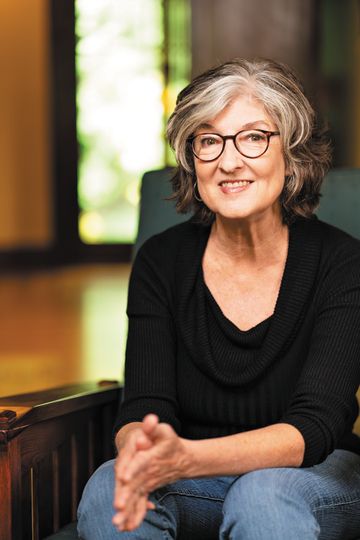
Barbara Kingsolver was born on April 8, 1955. Other than a brief time (1963) spent in a small village in central Congo, she grew up "in the
middle of an alfalfa field," in the part of eastern Kentucky that
lies between the opulent horse farms and the impoverished coal fields.
While her family has deep roots in the region, she never imagined staying
there herself. "The options were limited--grow up to be a farmer or a
farmer's wife."
Kingsolver has always been a storyteller: "I used to beg my mother
to let me tell her a bedtime story." As a child, she wrote stories
and essays and, beginning at the age of eight, kept a journal religiously.
Still, it never occurred to Kingsolver that she could become a
professional writer. Growing up in a rural place, where work centered
mainly on survival, writing didn't seem to be a practical career choice.
Besides, the writers she read, she once explained, "were mostly old,
dead men. It was inconceivable that I might grow up to be one of those
myself . . . "
Kingsolver left Kentucky to attend DePauw University in Indiana, where
she majored in biology. She also took one creative writing course, and
became active in the last anti-Vietnam War protests. After graduating in
1977, Kingsolver lived and worked in widely scattered places. In the early
eighties, she pursued graduate studies in biology and ecology at the
University of Arizona in Tucson, where she received a Masters of Science
degree. She also enrolled in a writing class taught by author Francine
Prose, whose work Kingsolver admires.
Kingsolver's fiction is rich with the language and imagery of her
native Kentucky. But when she first left home, she says, "I lost my
accent . . . [P]eople made terrible fun of me for the way I used to talk,
so I gave it up slowly and became something else." During her years
in school and two years spent living in Greece and France she supported
herself in a variety of jobs: as an archaeologist, copy editor, X-ray
technician, housecleaner, biological researcher and translator of medical
documents. After graduate school, a position as a science writer for the
University of Arizona soon led her into feature writing for journals and
newspapers. Her numerous articles have appeared in a variety of
publications, including The Nation, The New York Times, and Smithsonian,
and many of them are included in the collection, High
Tide in Tucson: Essays from Now or Never. In 1986 she won an
Arizona Press Club award for outstanding feature writing, and in 1995,
after the publication of High Tide in Tucson, Kingsolver was
awarded an Honorary Doctorate of Letters from her alma mater, De Pauw
University.
Kingsolver credits her careers in scientific writing and journalism
with instilling in her a writer's discipline and broadening her
"fictional possibilities." Describing herself as a shy person who
would generally prefer to stay at home with her computer, she explains
that "journalism forces me to meet and talk with people I would never
run across otherwise."
From 1985 through 1987, Kingsolver was a freelance journalist by day,
but she was writing fiction by night. Married to a chemist in 1985, she
suffered from insomnia after becoming pregnant the following year. Instead
of following her doctor's recommendation to scrub the bathroom tiles with
a toothbrush, Kingsolver sat in a closet and began to write The
Bean Trees, a novel about a young woman who leaves rural Kentucky
(accent intact) and finds herself living in urban Tucson.
The Bean Trees, published by HarperCollins in 1988, and reissued
in a special ten-year anniversary hardcover edition in 1998, was
enthusiastically received by critics. But, perhaps more important to
Kingsolver, the novel was read with delight and, even, passion by ordinary
readers. "A novel can educate to some extent," she told Publishers
Weekly. "But first, a novel has to entertain--that's the contract
with the reader: you give me ten hours and I'll give you a reason to turn
every page. I have a commitment to accessibility. I believe in plot. I want
an English professor to understand the symbolism while at the same time I
want the people I grew up with--who may not often read anything but the
Sears catalogue--to read my books."
For Kingsolver, writing is a form of political activism. When she was
in her twenties she discovered Doris Lessing. "I read the Children of
Violence novels and began to understand how a person could write about the
problems of the world in a compelling and beautiful way. And it seemed to
me that was the most important thing I could ever do, if I could ever do
that."
The Bean Trees was followed by the collection, Homeland
and Other Stories (1989), the novels Animal
Dreams (1990), and Pigs
in Heaven (1993), and the bestselling High
Tide in Tucson: Essays from Now and Never (1995). Kingsolver has
also published a collection of poetry, Another
America: Otra America (Seal Press, 1992, 1998), and a nonfiction
book, Holding
the Line: Women in the Great Arizona Mine Strike of l983 (ILR
Press/Cornell University Press, 1989, 1996). In 1998 she published The
Poisonwood Bible, a story of the wife and four daughters of a
fierce, evangelical Baptist who takes his family and mission to the
Belgian Congo in 1959. A tale of one family's tragic undoing and
remarkable reconstruction, over the course of three decades in
post-colonial Africa, The Poisonwood Bible is set against one of
history's most dramatic political parables. It is a compelling exploration
of religion, conscience, imperialist arrogance and the many paths to
redemptionand Barbara Kingsolver's most ambitious work ever.
Barbara Kingsolver used to live outside Tucson but now lives in
Southern Appalachia with her husband
Steven Hopp, and her two daughters, Camille from a previous marriage, and
Lily, who was born in 1996.
Given that Barbara Kingsolver's novels cover the psychic and
geographical territories that she knows firsthand, readers often assume that
they are autobiographical. However, Kingsolver says that this is not the
case. She acknowledges that "there are little things that
people who know me might recognize in my novels ... but my work is not about me. I don't ever write about real people.
That would be stealing, first of all. And second of all, art is supposed
to be better than that. If you want a slice of life, look out the window.
An artist has to look out that window, isolate one or two suggestive
things, and embroider them together with poetry and fabrication, to create
a revelation. If we can't, as artists, improve on real life, we should put
down our pencils and go bake bread."
Partial Bibliography
Animal Dreams (1987)
The Bean Trees (1988)
Pigs in Heaven (1993)
The Poisonwood Bible (1998)
Prodigal Summer (2000)
The Lacuna (2009)
Collections
Homeland: And Other Stories (1989)
Another America (poems) (1992)
Non fiction
Mid-Life Confidential: The Rock Bottom Remainders Tour America With Three
Cords and an Attitude (1994) (with Dave Barry, Stephen King, Tabitha
King and Amy Tan)
High Tide in Tucson: Essays from Now or Never (1995)
Holding the Line: Women in the Great Arizona Mine Strike of 1983
(1996)
Barbara Kingsolver: in Conversation (1998)
Small Wonder: Essays (2002)
Last Stand: America's Virgin Lands (2002)
Animal, Vegetable, Miracle: Our Year of Seasonal Eating (2007)
This biography was last updated on 10/04/2009.
A note about the biographies
We try to keep BookBrowse's biographies both up to date and accurate. However, with over 1,500 lives to keep track of it's inevitable that
some won't be as current or as complete as we would like. So, please help us - if the information about a particular author is out of date,
inaccurate or simply very short, and you know of a more complete source, please let us know. Authors and those connected with authors:
If you wish to make changes to your bio, please send your complete biography as you would like it displayed so that we replace the old with the new.
Named for a flower whose blood-red sap possesses the power both to heal and poison, Bloodroot is a stunning fiction debut about the legaciesof magic and madness, faith and secrets, passion and lossthat haunt one family across the generations, from the Great Depression to today.
Samara Taylor used to believe in miracles. But her mother is in rehab, and her father seems more interested in his congregation than his family. And when a young girl in her small town is kidnapped, her already-worn thread of faith begins to unravel.
When she's not digging up bones or other ancient objects, quirky, tart-tongued archaeologist Ruth Galloway lives happily alone in Norfolk. But when a child's bones are found on a desolate beach nearby, and Detective Chief Inspector Harry Nelson calls Galloway for help, Ruth finds herself in...
Few works of literature are as universally beloved as Alices Adventures in Wonderland. Now, in this spellbinding historical novel, we meet the young girl whose bright spirit sent her on an unforgettable trip down the rabbit hole and the grown woman whose story is no less...
The Coral Thief, as riveting and beautifully rendered as Ghostwalk, Rebecca Stotts first novel, is a provocative and tantalizing mix of history, philosophy, and suspense. It conjures up vividly both the feats of Napoleon and the accomplishments of those working without fame or...
I rarely read anything before this. Years ago I picked this one up and couldn't put it down. It changed me into a book nut. It was a wonderful ...
read more
I can't believe I waited so long to read this book. Shame on me. This book was wonderful, lyrical, entertaining - all the makings of a wonderful ...
read more
The book held so much for the reader but in the end I felt robbed. The evolution of Trudy was disturbing and somewhat insulting. She came across as ...
read more
Justice Department still has issues with Google Settlement(Feb 05 2010) The Department of Justice dealt a serious blow Thursday evening to the chances that the Google Book Search settlement will gain court approval later this...
Full Story
Hachette formally adopts 'agency model'(Feb 05 2010) Hachette Book Group USA became the second major U.S. publisher to officially announce its intention to move to an agency model for the sale of e-books....
Full Story