return to home  
Join   |  Gift   |  Member Login   |  Library Login
BookBrowse Mobile
Follow Us: 
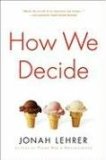
    How We Decide by Jonah Lehrer

How We Decide: Book summary and reviews of How We Decide by Jonah Lehrer

How We Decide

How We Decide
by Jonah Lehrer
Published in USA Feb 2009,
256 pages.

Publication information


Critics' Opinion: 
Readers' Rating: 
About BookBrowse Rankings
Share: 
Buy This Book

How We Decide Summary

From the acclaimed author of Proust Was a Neuroscientist, a fascinating look at the new science of decision-making—and how it can help us make better choices.

Since Plato, philosophers have described the decision making process as either rational or emotional: we carefully deliberate or we "blink" and go with our gut. But as scientists break open the mind's black box with the latest tools of neuroscience, they're discovering that this is not how the mind works. Our best decisions are a finely tuned blend of both feeling and reason—and the precise mix depends on the situation. When buying a house, for example, it's best to let our unconscious mull over the many variables. But when we're picking a stock, intuition often leads us astray. The trick is to determine when to lean on which part of the brain, and to do this, we need to think harder (and smarter) about how we think.

Jonah Lehrer arms us with the tools we need, drawing on cutting-edge research by Daniel Kahneman, Colin Camerer, and others, as well as the real-world experiences of a wide range of "deciders"—from airplane pilots and hedge fund investors to serial killers and poker players. Lehrer shows how people are taking advantage of the new science to make better television shows, win more football games, and improve military intelligence. His goal is to answer two questions that are of interest to just about anyone, from CEOs to firefighters: How does the human mind make decisions? And how can we make those decisions better?

How We Decide Reviews

"Starred Review. Lehrer is a delight to read, and this is a fascinating book (some of which appeared recently, in a slightly different form, in the New Yorker) that will help everyone better understand themselves and their decision making." - Publishers Weekly.

"May not facilitate great improvements in decision-making, but the Cliff Clavins of the world will exult in the factoids and anecdotes." - Kirkus Reviews.

"Over the past two decades, research in neuroscience and behavioral economics has revolutionized our understanding of human decision-making. Jonah Lehrer brings it all together in this insightful and enjoyable book, giving readers the information they need to make the smartest decisions." - Antonio Damasio, author of Descartes' Error and Looking for Spinoza.

"Cash or credit? Punt or go for first down? Deal or no deal? - life is filled with puzzling choices. Reporting from the frontiers of neuroscience, and armed with riveting case studies of how pilots, quarterbacks, and others act under fire, Jonah Lehrer presents a dazzlingly authoritative and accessible account of how we make decisions, what's happening in our heads as we do so, and how we might all become better 'deciders.' Luckily, this one's a no-brainer: Read this book." - Tom Vanderbilt, author of Traffic: Why We Drive the Way We Do (and What It Says About Us)

"An inviting, high-velocity ride through our most treasured mental act-deciding. This is truly one of the most accessible and richly-informed books on human choice. It's a must read for anyone interested in the human mind and how cutting-edge research changes the way we think about ourselves. A marvelous success." - Read Montague, Brown Foundation Professor of Neuroscience, Baylor College of Medicine,

"The human brain has distinct rational and emotional circuits. When making decisions, we don't always know which one is in control, and we can't always influence the balance. With compelling anecdotes and scientific authority, Jonah Lehrer explains it all eloquently." - Daniel J. Levitin, author of This is Your Brain on Music and The World in Six Songs).

The information about How We Decide shown above was first featured in "The BookBrowse Review" - BookBrowse's online-magazine that keeps our members abreast of notable and high-profile books publishing in the coming weeks. In most cases, the reviews are necessarily limited to those that were available to us ahead of publication. If you are the publisher or author of this book and feel that the reviews shown do not properly reflect the range of media opinion now available, please send us a message with the mainstream media reviews that you would like to see added.

How We Decide Reader Reviews

Write your own review

Rated 4 of 5 of 5 by Margaret
How We Decide
By using psychological and neuroscience studies as well as examples about and interviews with people who make decisions, Mr. Lehrer has produced a fascinating book about how we make our own decisions. The book opens with a pilot steering a plane (actually a simulator) to land after an engine catches fire (so timely with the landing in the Hudson). He also includes a study of the pilot of the plane which landed in Iowa a number of years ago. Although at times the science is a bit deep for the casual reader, all in all it is a very accessible and interesting study. Did you, as a reader, ever know what it takes to decide what strawberry jam to purchase or why a poker player folds or holds? The long bibliography and notes add to his study for the reader wanting more details.

Rated 5 of 5 of 5 by Dolena
Who knew emotions can be our best guide in decision making?
I thoroughly enjoyed this book. With a myriad of examples drawn from all walks of life (the quarterack, the credit counselor, the guy protecting a submarine), author Lehrer challenges our common belief that the best decisions are made devoid of emotion. The author, through real examples applied to extensive scientific research and studies, challenges that notion. By example after example, he counters the belief we can make decisions without our emotions, which he defines in terms of specific portions of the brain and their functions. Again, by example, he cautions that while some of our brain functions, which are tied to our emotions, are our best friends in decision-making, other functions of the brain betray us, leading us to disastrous decisions and judgments. I found his examples relating to why we continuously spend more than we have, individually and collectively, fascinating. Who knew that the human brain played a role in the "sub-prime mortgage crisis!"

This is a book to linger over and ponder. The author has rendered what could have been just "cold" science into an intriguing journey through the human mind and its direct role in all human decisions, good and bad.

Rated 4 of 5 of 5 by Sharon
How We Decide by Jonah Lehrer
I found this book very interesting and informative. Lehrer cites scientific experiments which show the part of the brain used when making rational decisions versus emotional decisions as well as the parts affected by dementia, Alzheimer's, autism and trauma, etc. It's written in language that a layperson can understand. I would recommend it for those who want a better understanding of these conditions. We have friends who have autism and dementia in their family. It helped me to better understand the problems that they must face.

Rated 5 of 5 of 5 by Barbara
Making Decisions - heart or mind?
Emotion or rational thought? This book presents an enthralling explanation of the processes that the brain uses to decide what decisions it will make. Full of stories and anecdotes, it kept this reader’s interest throughout. The chapter on psychopaths and why they are so dangerous is chilling. The book is very current and includes information regarding the 2008 presidential election and how emotion and rational thought played out in the selection of candidates. Even the acknowledgments at the end are fun--the book was written because the author couldn't decide which type of Cheerios to buy!

Rated 5 of 5 of 5 by BethD
Decide to check out How We Decide!
I loved this book! While getting ready to host a holiday party, in my mad scramble to stow away odds and ends, I misplaced this book. It took me forever to find where I stashed it. To make matters worse, I thought about it all the time in the interim - the ideas and information really stayed with me. I say "to make matters worse", but really, isn't that the hallmark of a good book?

I'm a big fiction reader, not so much of a non-fiction reader, but I requested this book because I have an interest in the brain and its functioning. I've taken a couple of "just for fun" non-credit college classes about the brain, so I was inclined to like the book from the beginning, but I enjoyed it even more than I thought I would. I don't think readers need to have any particular prior knowledge about the brain, though, because the author does a fantastic job of communicating how the brain processes information in layman's terms. I've always thought of the brain as the last frontier in medicine, but this book really offers an excellent glimpse into something that is still somewhat of a black box.

Two of the most interesting parts of the book occur early on, first when the author discusses how children respond differently depending on whether they're told they're smart or whether they're told they worked hard and second, when the author discusses gambling and Parkinson's medication.

As much as I liked this book, it did take me a while to get through it once I found it again.

Rated 4 of 5 of 5 by Anna
How We Decide
All in all I liked this book but I do have a couple of criticisms. First of all, the author misused the term "negative reinforcement" -- it does NOT mean the same thing as punishment! The other thing that I found annoying was that he used the terms brain and mind as if they were interchangeable, which they are not. The brain is, of course, an anatomical structure, while "mind" is a convenient construct we use when talking about consciousness. These criticisms aside, I find the author's contention that we need to use both rational thought and emotional reaction when we are making decisions a compelling one. I particularly liked his use of real-life anecdotes to illustrate what might otherwise have been dry, textbook-ish examples.

...12 more reader reviews

Jonah Lehrer is editor at large for Seed magazine. A graduate of Columbia University and a Rhodes scholar, Lehrer has worked in the lab of Nobel Prize–winning neuroscientist Eric Kandel and in the kitchens of Le Cirque 2000 and Le Bernardin. He has written for the Boston Globe, Nature, NPR, and NOVA ScienceNow, and writes a highly regarded blog, The Frontal Cortex.

Recently Published History, Science & Current Affairs

more...


Become a Member
Click Here
Editor's Choice
  •  May 25 
  •  May 23 
  •  May 21 
The Shelter Cycle
Peter Rock

The Shelter Cycle Jacket

An American original, Peter Rock brings our strangest beliefs to vivid and sympathetic life in this haunting novel inspired by true events.
And the Mountains Echoed
Khaled Hosseini

And the Mountains Echoed Jacket

Khaled Hosseini has written a new novel about how we love, how we take care of one another, and how the choices we make resonate through generations
Helga's Diary
Helga Weiss

Helga's Diary Jacket

The remarkable diary of a young girl who survived the Holocaust—appearing in English for the first time.
Click Here
   Most Recent Blog Entries
Movies Based on Books: Summer 2013 (May - August)
Jewish Young Adult Books That Are Not About The Holocaust
Books to Give This Mother's Day
rss  RSS   rss  subscribe
Recent Reader Reviews
Bring Up the Bodies by Hilary Mantel
A very large book - in number of pages and in content - and every page worth reading. Thoroughly enjoyed this one and her first book on the... read more
Two Lives by Vikram Seth
Two Lives is a memoir written by international best-selling author, Vikram Seth. In this interesting and engaging book, Seth writes about his great... read more
Z: A Novel of Zelda Fitzgerald by Therese Fowler
Z, the novel about the life of Zelda Sayre Fitzgerald is at points charming and; like another reviewer, I kept thinking of the movie, "Midnight... read more
RSS RSS feed More...  
Most Viewed This Week
1. Telegraph Avenue
Michael Chabon
2. Brick Lane
Monica Ali
3. The Immortal Life of Henrietta Lacks
Rebecca Skloot
4. The Tiger Rising
Kate DiCamillo
5. Who Moved My Cheese
Spencer Johnson
More...
Book Club Recommendations
Why Be Happy When You Could Be Normal?
by Jeanette Winterson
Paperback (Mar/13)
Eleanor & Park
by Rainbow Rowell
Hardback (Feb/13)
The House Girl
by Tara Conklin
Paperback (Oct/13)
The Painted Girls
by Cathy Marie Buchanan
Hardback (Jan/13)
More...
First Impressions
Members read and review books often months before they're published. See what they think in First Impressions!
The Sisterhood
by Helen Bryan
Four Stars            (Apr/13)
Golden Boy
by Abigail Tarttelin
4.5 Stars            (May/13)
The Caretaker
by A .X. Ahmad
Four Stars            (May/13)
The Last Girl
by Jane Casey
Four Stars            (May/13)
More...
  Latest BookBrowse News
News Corp will officially split into two companies June 28 (May 24 2013)
As expected, News Corp has announced it will officially split its publishing and entertainment businesses on 28 June.
br> Its board approved the... Full Story
rss RSS feed More...
 
BookBrowse Poll
Q: Which of these Summer movies based on books would you like to see? (Info on each movie here)
The Great Gatsby
Epic
Man of Steel
World War Z
The Lone Ranger
The Wolverine
R.I.P.D.
Percy Jackson
Paranoia
The Mortal Instruments
Select Any That Apply
Search: Title or Author
Free Newsletters
The Light Between Oceans

Online Book Club
More about
Five Days
Join the discussion!


Win This Book!
On Sal Mal Lane


"Piercingly intelligent and shatter-your-heart profound."

Enter To Win Now!

wordplay
Solve this clue:
"I Y N P O T Solution, Y P O T P"

and be entered
to win....
frame top
New Author
Interviews
Menna van Praag
Erica Brown
Helga Weiss
Kate Morton
frame bottom
HOME Book Submissions | Advertising | Library Subscriptions | Reviewing for BookBrowse | Contact Us