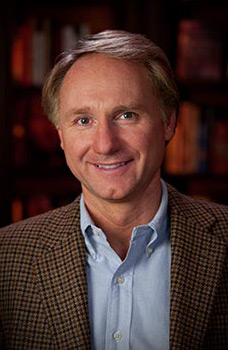
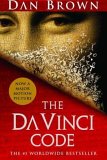
Dan Brown discusses his blockbuster bestseller The Da Vinci Code and talks about his favorite books - to read and to give as gifts. He also reveals his personal writing habits, which include hanging upside-down from a pair of gravity boots!
How would you describe The Da Vinci Code to someone who has not read any of
your previous novels?
The Da Vinci Code is the story of renowned Harvard symbologist Robert
Langdon, who is summoned to the Louvre Museum to examine a series of cryptic
symbols relating to Da Vinci's artwork. In decrypting the code, he uncovers the
key to one of the greatest mysteries of all time…and he becomes a hunted man.
One of the many qualities that makes The Da Vinci Code unique is the factual
nature of the story. All the history, artwork, ancient documents, and secret
rituals in the novel are accurate…as are the hidden codes revealed in some of
Da Vinci's most famous paintings.
Will your next book also feature Robert Langdon?
Indeed. I intend to make Robert Langdon my primary character for years to
come. His expertise in symbology and iconography affords him the luxury of
virtually endless adventures in exotic locales. Currently, I have rough sketches
for almost a dozen Robert Langdon thrillers set in mysterious locations around
the globe.
Currently I'm writing another Robert Langdon thriller - the sequel to The Da
Vinci Code. For the first time, Langdon will find himself embroiled in a
mystery on U.S. soil. This new novel explores the hidden history of our nation's
capital.
Do you expect to explore other numerological cults -- such as the
Pythagoreans, or perhaps the Kabbalists -- in future books?
Aha, the Kabbalists! Yes, they are fascinating…as are the Pythagoreans.
Without a doubt Langdon will be exploring these groups more closely in the
future. In fact, The Da Vinci Code includes a scene in which Langdon reveals
basic Kabbalistic numerology and then uses it to break an enigmatic code. The
book also drops a hint as to the identity of another ultrasecret numerology sect
that fascinates me, but I can't reveal their name here without ruining much of
the surprise of the next book.
Which part of researching The Da Vinci Code was the most personally
interesting to you? Were there any facts, symbols, or themes that you would have
liked to include, but they just didn't make into the story?
For me the most astonishing aspect of researching The Da Vinci Code was the
realization that one of history's greatest "secrets" is not nearly as
secret as we think. Clues to its true nature are all around us…in art, music,
architecture, legend, and history. In the words of Robert Langdon, "The
signs are everywhere."
If readers would like to read up on the history of the Freemasons, are there
any books you would recommend?
There is so much written on the Freemasons that it's difficult to know where
to begin. Having researched the Freemasons in depth (both through books and
interviews with Masons), I will warn readers that the vast majority of books
written about the brotherhood are inaccurate. Many books are written by
non-Masons and are therefore hypothetical and, in many cases, paranoid
conspiracy theory. For accurate information on the brotherhood, you should read
only those titles written by Masons (or former Masons). That is, unless you are
convinced the brotherhood is hiding something….
What are you reading right now? Are there any authors (living or dead) that
you would name as influences?
As strange as this may sound, I very seldom read fiction. Because my novels
require so much research, almost everything I read is non-fiction-histories,
biographies, translations of ancient texts. Those few fiction writers who have
inspired me most would be Ludlum for his plot intricacies, Steinbeck for his
descriptions, and Shakespeare for his wordplay.
What was the book that most influenced your life — and why?
Until I graduated from college, I had read almost no modern commercial fiction
at all (having focused primarily on the "classics" in school). In
1994, while vacationing in Tahiti, I found an old copy of Sydney Sheldon's
Doomsday Conspiracy on the beach. I read the first page… and then the
next…and then the next. Several hours later, I finished the book and thought,
"Hey, I can do that." Upon my return, I began work on my first novel--
Digital Fortress -- which was published in 1996.
What are your 10 favorite books —and why?
Of Mice and Men (John Steinbeck) —Simple, suspenseful, and poignant.
Better yet, the first paragraph of every chapter is a master class in writing
effective description.
Gödel, Escher, Bach (Douglas Hofstadter) —The 3% I actually understood
was fascinating.
Kane and Abel (Jeffrey Archer) —I was amazed how well Archer handled
the long time spans without ever losing the narrative pulse. The ultimate novel
of sibling rivalry.
Plum Island (Nelson DeMille) —He remains the master of substance, wry
humor, and controlled point of view.
The Bourne Identity Series (Ludlum) —Ludlum's early books are complex,
smart, and yet still move at a lightning pace. This series got me interested in
the genre of big-concept, international thrillers.
Much Ado About Nothing (William Shakespeare) —I didn't understand how
funny this play truly was until I became an English teacher and had to teach it.
There is no wittier dialogue anywhere.
Wordplay: Ambigrams and Reflections on the Art of Ambigrams (John Langdon) —Artist
and philosopher John Langdon is one of our true geniuses. His book changed the
way I think about symmetry, symbols, and art.
Codes Ciphers & Other Cryptic & Clandestine Communication (Fred
Wrixon) —A phenomenal encyclopedia of the art, science, history, and
philosophy of cryptology.
The Puzzle Palace (James Bamford) —Although dated, this book is still
one of the most captivating inside looks at the covert world of America's
premier intelligence agency.
The Elements of Style (Strunk and White) —Because who can possibly
remember all the rules of grammar and punctuation?
Favorite films?
My all-time favorites would have to be Fantasia, Life is Beautiful, Annie
Hall, and Zeffirelli's Romeo and Juliet. Of course, if you're looking
for pure popcorn entertainment, you can't beat Indiana Jones or the Pink
Panther series.
Favorite music?
I've recently become hooked on the Spanish singer Franco de Vita. I also listen
to The Gypsy Kings, Enya, Sarah Mclachlan, and (if I'm feeling old) the very
young and talented songwriter Vanessa Carlton.
If you had a book club, what would it be reading — and
why?
The Golden Ratio: The Story Of Phi, The World's Most Astonishing Number
(Mario Livio) — Admittedly, to imply that a book club could get excited
talking about a "number" probably sounds far-fetched, but this book
ties together themes of art history, nature, mathematics, philosophy, and
religion in an accessible and eye-opening way. Sure to spark great discussions.
What are your favorite books to give — and get — as
gifts?
This will sound nerdish, but the all-time best "gift book" has to be a
leather-bound copy of the Oxford English Dictionary. How can you go wrong? Of
course, don't forget a magnifying glass to go with it.
Give us three "Good to Know" facts about you. Be
creative. Tell us about your first job, the inspiration for your writing, any
fun details that would enliven your page.
If I'm not at my desk by 4:00 A.M., I feel like I'm missing my most productive
hours. In addition to starting early, I keep an antique hour glass on my desk
and every hour break briefly to do pushups, sit-ups, and some quick stretches. I
find this helps keep the blood (and ideas) flowing. I'm also a big fan of
gravity boots. Hanging upside down seems to help me solve plot challenges by
shifting my entire perspective.
What else do you want your readers to know? Consider here
your likes and dislikes, your interests and hobbies, your favorite ways to
unwind — whatever comes to mind.
I've recently become fanatical about tennis (and play every afternoon when I
finish writing). If anyone out here has any tips on hitting a consistent
top-spin backhand, please fax them to Doubleday.
3/2003
An interview with Dan Brown about his book 'Angels' & Demons'
Q: Angels & Demons was inspired in a bizarre location. Can you tell us what happened?
A: I was beneath Vatican City touring a tunnel called il passetto--a concealed passageway used by the early Popes to escape in event of enemy attack. According to the scholar giving the tour, one of the Vatican's most feared ancient enemies was a secret brotherhood known as the Illuminati--the "enlightened ones"a cult of early scientists who had vowed revenge against the Vatican for crimes against scientists like Galileo and Copernicus. I was fascinated by images of this cloaked, anti-religious brotherhood lurking in the catacombs of Rome. Then, when the scholar added that many modern historians believe the Illuminati is still active today and is one of most powerful unseen forces in global politics, I knew I was hooked...I had to write an Illuminati thriller.
Q: Why haven't more people heard about the secret brotherhood of the Illuminati?
A: Secret societies like the Illuminati go to enormous lengths to remain covert. Although many classified intelligence reports have been written on the brotherhood, few have been published. Conspiracy theories on the Illuminati include infiltration of the British Parliament and U.S. Treasury, secret involvement with the Masons, affiliation with covert Satanic cults, a plan for a New World Order, and even the resurgence of their ancient pact to destroy Vatican City. Separating Illuminati fact from fiction can be difficult on account of the massive quantities of misinformation that has been generated about the brotherhood. Some theorists claim this plethora of misinformation is actually generated by the Illuminati themselves in an effort to discredit any factual information that may have surfaced. This concealment tactic--known as "data-sowing" is often employed by U.S. intelligence agencies.
Q: Angels & Demons includes an unusual graphical element never before seen in a work of fiction, what can you tell us about that?
A: Ah, the ambigrams. Many people have written to ask how those symbols were created. Ambigrams are words drawn to read identically right side up and upside down. Its an ancient artistic technique that figures prominently in the mysteries of Angels & Demons. Ambigrams can be very unnerving when you first see them, and almost everyone who sees the ambigram on the novel's cover invariably stands there for several minutes rotating the book over and over, perplexed. Whether or not someone is a thriller reader, sneaking a peak at the Angels & Demons book cover is certainly worth a trip to the bookstore's thriller aisle.
Q: Your novel begins inside the real-life Swiss scientific research facility called CERN. Can you tell us more about CERN?
A: CERN--Conseil Européen pour la Recherche Nucléaire--is the world's largest scientific research facility. It is located in Geneva Switzerland and employs over 3,000 of the world's top scientists. CERN houses an underground particle accelerator that is over fourteen miles long and stretches all the way into France. In addition, CERN (much to Americans' surprise!) is the birthplace of the Worldwide Web, whose strange inception I talk about in the novel. CERN's most incredible claim to fame, however, is that they were the first to manufacture something called antimatter...the most volatile substance known to man.
Q: Antimatter plays a startling role in Angels & Demons and sounds utterly terrifying. Is antimatter for real?
A: Absolutely. Antimatter is the ultimate energy source. It releases energy with 100% efficiency (nuclear fission is 1.5% efficient.) Antimatter is 100,000 times more powerful than rocket fuel. A single gram contains the energy of a 20 kiloton atomic bomb--the size of the bomb dropped on Hiroshima. In addition to being highly explosive, antimatter is extremely unstable and ignites when it comes in contact with anything...even air. It can only be stored by suspending it in an electromagnetic field inside a vacuum canister. If the field fails and the antimatter falls, the result is a "perfect" matter/antimatter conversion, which physicists aptly call "annihilation." CERN is now regularly producing small quantities of antimatter in their research for future energy sources. Antimatter holds tremendous promise; it creates no pollution or radiation, and a single droplet could power New York City for a full day. With fossils fuels dwindling, the promise of harnessing antimatter could be an enormous leap for the future of this planet. Of course, mastering antimatter technology brings with it a chilling dilemma. Will this powerful new technology save the world, or will it be used to create the most deadly weapon ever made?
Q: Is it true while researching this book you actually had an audience with the Pope?
A: Yes, although I hasten to say that the term "audience" can be misleading. I did not sit down and have tea with the man. I was fortunate enough to be granted what is known as a "semi-private audience", which takes place in a special room inside Vatican City. The Pope came out and spoke to a group of us for about half an hour. Then he prayed and blessed us. An interesting side note--before we entered the audience room, the Swiss Guard frisked us looking for...not weapons...but concealed containers of water. I later learned that any water present in the room when the Pope said a blessing instantly becomes "holy water," and the church did not want any of us taking holy water outside of Vatican City and trying to sell it.
Q: In the novel, you talk about the bizarre "pyramid and all-seeing-eye" on back of U.S. currency. What do these symbols have to do with the United States?
A: Absolutely nothing, which is what makes their presence on our currency so remarkable. The pyramid is actually an Egyptian occult symbol representing a convergence upward toward the ultimate source of Illumination...in this case, an all-seeing eye known as the trinacria. The eye inside the triangle is a pagan symbol adopted by the Illuminati to signify the brotherhood's ability to infiltrate and watch all things. In addition, the triangle (Greek Delta) is the scientific symbol for change. Many historians feel the Great Seal's "shining delta" is symbolic of the Illuminati's desire to bring about "enlightened change" from the myth of religion to the truth of science. Also supporting the theory that the Great Seal is tied to the Illuminati is the unsettling fact that the seal's inscription "Novus Ordo Seculorum" is a clear call to the secular or non-religious...which stands in startling contrast to In God We Trust.
Q: How could all this Illuminati symbology end up on the most powerful currency in the world?
A: The occult symbology on the back of the U.S. one dollar bill is a source of great consternation for modern symbologists. The design was presented to the U.S. treasury by Charles Thomson in the 1940s when the Illuminati brotherhood was widely accepted to have spread from Europe into American and infiltrated the brotherhood of the Freemasons. At that time, many Masons were upper echelon government officials. Vice President Henry Wallace was one of them, and most academics now believe the design for the Great Seal was lobbied for by Wallace. Whether he made his decisions as a covert Illuminatus or innocently under their influence, nobody will ever know, but it was Wallace who convinced President Roosevelt to use the design. Of course, conspiracy theorists enjoy pointing out that Franklin D. Roosevelt was also a high-ranking Mason.
Q: Both Digital Fortress and Angels & Demons deal with secretive topics--covert spy agencies, conspiracy theories, classified technologies. How do you get your information?
A: I am constantly amazed how much "secret" information is readily available out there if one knows where to dig. The Freedom of Information Act, of course, is a great resource, primarily because it can lead to specific individuals who are knowledgeable in a given field and sometimes are willing to talk about it. In many cases, understandably, these contacts prefer to remain nameless, but sometimes depending on what they've told you, they like being acknowledged in the book. Occasionally, research is simply a matter of finding the proper printed resource. For example, the detailed description in Angels & Demons depicting the intimate ritual of Vatican conclave--the threaded necklace of ballots...the mixing of chemicals...the burning of the ballots--much of that was from a book published on Harvard University Press by a Jesuit scholar who had interviewed more than a hundred cardinals, which is obviously something I never would have had the time or connections to do.
Q: The plot of Angels and Demons is described as "a revenge 400 years in the making." Can you explain what this means?
A: Sure. It is historical fact that the Illuminati vowed vengeance against the Vatican in the 1600's. The early Illuminati--those of Galileo's day--were expelled from Rome by the Vatican and hunted mercilessly. The Illuminati fled and went into hiding in Bavaria where they began mixing with other refugee groups fleeing the Catholic purges--mystics, alchemists, scientists, occultists, Muslims, Jews. From this mixing pot, a new Illuminati emerged. A darker Illuminati. A deeply anti-Christian Illuminati. They grew very powerful, infiltrating power structures, employing mysterious rites, retaining deadly secrecy, and vowing someday to rise again and take revenge on the Catholic Church. Angels & Demons is a thriller about the Illuminati's long-awaited resurgence and vengeance against their oppressors... but most of all, it is a story about Robert Langdon, the Harvard symbologist who gets caught in the middle.
Q: A virtual tour of the novel is offered at the book's website. How does one take a virtual tour of a novel?
A: The Angels & Demons virtual tour is actually a lot of fun. Much of the novel's story is a chase across modern Rome--through catacombs, cathedrals, piazzas, and even the Vatican's subterranean Necropolis (City of the Dead.) Because all the locations and artwork in the novel are factual and can still be seen today, we decided it would be fun to offer a real-life photo tour of all the places in the story. The tour includes plenty of things few people have ever seen--CERN's underground accelerator, the Vatican secret archives, antimatter canisters, even an indoor skydiving facility. It's also a way for readers to confirm some of the novel's more startling information. You can tour the novel at the award-winning website www.danbrown.com
Q: Your novel raises the question of whether technology will save us or destroy us. Which do you believe?
A: I believe science will save us...although I tend to be an optimist. Obviously, science has wonderful potential to control disease, create new fuel supplies, engineer efficient food sources, and even allow us to migrate to new worlds. The problem, of course, is that every technology is a double-edged sword. The rocket engine that carries the space shuttle can also carry warheads. The medical breakthroughs that can eradicate disease--genetic research, for example-if misused, can bring about the end of the human race. The question is not whether or not science will expand to meet man's growing needs, but whether man's philosophy will mature fast enough that we can truly comprehend our new power and the responsibility that comes with it.
Q: You describe some pretty bizarre CERN experiments in the novel. Are these experiments for real?
A: Entirely. And the results are absolutely staggering. In the last few years scientists have found themselves face to face with facts that force them to rethink the world in which we live. Their discoveries have implications not only on the physical realm but the philosophical and spiritual as well. The heroine of Angels & Demons is actually one of these CERN scientists-a brilliant marine biologist whose a specialist is "Entanglement Science." Entanglement science is the study of the interconnectivity of all things. Many of the marine experiments she runs in the novel are real-life experiments that have been run in the last few years. And as anyone who has read Angels & Demons can attest, the results are unnerving. There are those who believe science will someday prove God exists. Either way, scientists are certainly starting to tackle some of life's most profound spiritual questions. Of course, these sacred questions have always been the domain of the clergy. And a new battle is raging over who will be providing answers to life's deepest mysteries... science or religion?
Q: You've written novels about a classified intelligence agency and an ultra-secretive brotherhood. Are secrets something that interest you?
A: Secrets interest us all, I think. For me, writing about clandestine material keeps me engaged in the project. Because a novel can take upwards of a year to write, I need to be constantly learning as I write, or I lose interest. Researching and writing about secretive topics helps remind me how fun it is to "spy" into unseen worlds, and it motivates me to try to give the reader that same experience. Lots of people wrote me after Digital Fortress amazed that the National Security Agency is for real. I've already started getting similar mail from Angels & Demons--people shocked to learn about the Illuminati brotherhood, antimatter technology, or the inner workings of the Vatican election. My goal is always to make the character's and plot be so engaging that readers don't realize how much they are learning along the way.
Q: Angels & Demons reveals a lot of inside information about the Vatican... much of it unflattering. Do you fear any repercussions?
A: I imagine some controversy is unavoidable, yes, although it's important to remember that Angels & Demons is primarily a thriller--a chase and a love story. It's certainly not an anti-Catholic book. It's not even a religious book. Much of the novel's action takes place deep inside the arcane world of the Vatican, and yes, some of the factual information revealed there is startling, but I think most people understand that an organization as old and powerful as the Vatican could not possibly have risen to power without acquiring a few skeletons in their closets. I think the reason Angels & Demons is raising eyebrows right now is that it opens some Vatican closets most people don't even know exist. The final message of the novel, though, without a doubt, is a positive one.
Q: The characters in Angels & Demons battle with some tough moral issues... primarily regarding the battle between science or religion? Which do you think will ultimately win the war?
A: That's a difficult question because in many ways I see science and religion as the same thing. Both are manifestations of man's quest to understand the divine. Religion savors the questions while science savors the quest for answers. Science and religion seem to be two different languages attempting to tell the same story, and yet the battle between them has been raging for centuries and continues today. The war in our schools over whether to teach Creationism or Darwinism is a perfect example. We live in an exciting era, though, because for the first time in human history, the line between science and religion is starting to blur. Particle physicists exploring the subatomic level are suddenly witnessing an interconnectivity of all things and having religious experiences...Buddhist monks are reading physics books and learning about experiments that confirm what they have believed in their hearts for centuries and have been unable to quantify.
Q: What's next after Angels & Demons?
A: I'm already hard at work on the next novel. After writing about the covert National Security Agency and the clandestine brotherhood of the Illuminati, I found myself hard pressed to come up with a more secretive topic. Fortunately, I recently learned of another U.S. intelligence agency, more covert even than the National Security Agency. This new agency will figure prominently in the next novel. Until then, of course, mum's the word.
2001
Unless otherwise stated, this interview was conducted at the time the book was first published, and is reproduced with permission of the publisher. This interview may not be reproduced or reprinted without permission in writing from the copyright holder.

Thomas Leo "Tom" Clancy, Jr. was an American novelist and historian. He is best known for his technically detailed espionage and military science storylines set during and in the aftermath of the Cold War, and for video ... (more)
If you enjoyed:
Deception Point
Try:
Rainbow Six
by Tom Clancy

Nelson Richard DeMille was born in New York City on August 23, 1943 to Huron and Antonia (Panzera) DeMille. He moved as a child with his family to Long Island.
DeMille spent three years at Hofstra University, then joined the ...
(more)
If you enjoyed:
Deception Point
Try:
Night Fall
by Nelson DeMille
We recommend 18 similar authors

The Flower Sisters
by Michelle Collins Anderson
From the new Fannie Flagg of the Ozarks, a richly-woven story of family, forgiveness, and reinvention.
The House on Biscayne Bay
by Chanel Cleeton
As death stalks a gothic mansion in Miami, the lives of two women intertwine as the past and present collide.
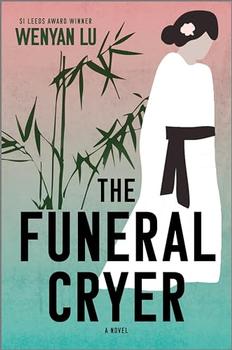
The Funeral Cryer by Wenyan Lu
Debut novelist Wenyan Lu brings us this witty yet profound story about one woman's midlife reawakening in contemporary rural China.
Your guide toexceptional books
BookBrowse seeks out and recommends the best in contemporary fiction and nonfiction—books that not only engage and entertain but also deepen our understanding of ourselves and the world around us.