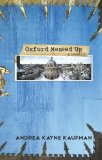
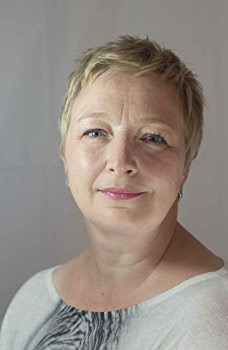
In both an in-depth interview and an author Q&A respectively, Andrea Kayne Kaufman discusses her novel Oxford Messed Up, the portrayal of Obsessive-Compulsive Disorder, her enjoyment of Van Morrison's music, and the hope that comes with transcendent love.
In both an in-depth interview and an author Q&A respectively, Andrea Kayne Kaufman discusses her novel Oxford Messed Up, the portrayal of Obsessive-Compulsive Disorder, her enjoyment of Van Morrison's music, and the hope that comes with transcendent love.
- What draws you to writing?
My fantasy life and real life commingle in my writing in ways that help me reflect and understand what I am feeling and what I believe. Writing makes me feel like I'm stepping into someone's oversize shoes and roaming through their strange new world. There is freedom in writing. You can go anywhere, whether geographical or emotional, be anyone, whether fantastic or realistic, feel anything, whether familiar or new. While my characters and their worlds are different from me and my world, there are key similarities and themes that come from my own experience and reflect many epiphanies I have had. Even though I wrote Oxford Messed Up at 44, I have been writing every day before and every day since. I need to write. It's my morning exercise. My morning meditation. My morning prayer.
- How do you generate your ideas?
My ideas come from so many places inside and outside of my self and life. They can come from intense experiences like dealing with the difficult family illness of Obsessive-Compulsive Disorder to mundane trivial excursions to Starbucks, noticing the barista whose hand is in a cast, wondering how she injured herself and how she will handle the morning rush. My writing is definitely informed by my work in special education law and cyber-bullying as an education professor, as well as my personal experience with OCD. I am always inspired by vivid dreams and record them as soon as I awake. Listening to music (mostly Van Morrison, but also Neil Young, Bob Dylan, The Doors, The Who, Pete Townsend, Led Zeppelin, Tom Petty, Joni Mitchell, Carole King, Patti Smith) as I walk by Lake Michigan in all kinds of weather, I fantasize about the lives of so many characters in so many books (I have five outlines I am currently working on). I cognitively take a step back and let the music and the lake and my imagination go wild. The ideas are plentiful and I often hear the characters speak. Sometimes their dialogue and lives overwhelm me. There are too many ideas. Fortunately, my husband Jacob helps me focus; he's more linear that way. Although I am a divergent thinker, I make sure I capture all the ideas, all the voices, all the people - even the crazy ones. Especially the crazy ones.
- Is the depiction of Obsessive-Compulsive Disorder and the Cognitive Behavior Therapy in Oxford Messed Up accurate?
The depiction of Obsessive-Compulsive Disorder (OCD) and Cognitive Behavior Therapy (CBT) in Oxford Messed Up is absolutely accurate. The writing is entirely research-based, and the final manuscript was vetted by several OCD experts. In addition to having done research on OCD, I also have personal experience with OCD and CBT in my family. Because of this personal experience, it was infinitely important to me to portray it accurately. Most depictions in fiction, movies and on television focus on the eccentric behavior, ignoring the internal torture. I felt like it was important to show OCD in its truest sense.
- This is such a visual book. How accurate is the description of Oxford and Gloria and Henry's living situation?
St. Cross College has only graduate students ("postgraduates," as the English say) so it does have a lot of flexible living arrangements for single students as well as students who are married and in couples. That being said, I do think I took a lot of poetic license with respect to Henry and Gloria sharing a suite divided by a shared bathroom. My husband, a real estate attorney and developer, tells me I took a lot of liberties when it came to the size and contents of their "loo." But in my defense, I have to say that the bathroom is the site of all major plot points and growth that takes place in the novel.
- Why choose Oxford as the book's setting?
I love Oxford as a university and locale. Most of the Oxford locations are real places - St. Cross College, Jesus College, Ashmolean Museum, Bodleian Library, Bird & Baby Pub, Thirst, and Quod Brasserie. Even the sundial in the St. Cross quad is real. Oxford is so rich with history, culture, and beauty. I also love the idea of taking a place like Oxford, which stands for tradition and history, and turning it on its head-messing it up.
- Can someone under treatment for OCD really show improvement as quickly as Gloria does in Oxford Messed Up?
While it can take a long time to fully recover from OCD, Cognitive Behavior Therapy - especially in conjunction with medication - can work very quickly to contain one's compulsions. Gloria's dramatic and relatively quick improvement has been vetted by OCD experts. In the novel, because Gloria takes medication and strictly adheres to her CBT goals, she is able to make a lot of improvement in a short period of time.
- Why Van Morrison? Are you a Van Morrison junkie?
Ever since I found Van Morrison's album Moondance when I was in seventh grade, I have been hooked. For me, he is the ultimate poet, whose lyrics transcend the here-and-now and transport me to a better place. I have been listening to his inspiring music for 33 years and always hear something new.
- What are your favorite Van Morrison songs, and why do you connect with them?
"Brand New Day" - This is what Oxford Messed Up and all my writing is all about. Van makes it clear this is available to everyone. Anyone. Even you.
"Beside You" - I love the New York Sessions version of "Beside You." It's raw and urgent.
"Dweller on the Threshold" - This amazing song is a metaphor for that scary space before you're ready to try something new. Kind of how I felt writing this book.
"Steal My Heart Away" - This Irish waltz reminds me of the endurance that's required of any relationship. The journey may be long, and lots of stuff may get in the way, but in the end it will all be okay.
"Tupelo Honey" - This song captures Van's sensuality in a very deep and profound way. Tupelo blossoms are so sweet so fragile that it really is a miracle when they survive the elements. I really love that fact and I feel that way about my life sometimes.
"Precious Time" - This song has the greatest lyrics and is the motto for my life. Like Henry, I have experienced the early death of loved ones. Precious time is slipping away, don't put anything off, be present for every wonderful moment.
"Real Real Gone" - It is impossible not to be transformed by the joyful trumpet and trombone chorus in this song. It totally reminds me of the euphoria of falling in love.
"Days Like This" - I listened to this day and night after both my children were born. It encapsulates that feeling that all the puzzle pieces fit together.
"Wild Nights" - This is the best getting-ready song. Getting ready to go out. Getting ready for a night alone with my hubby. Getting ready for something wild and exciting.
I also love "Caravan," "Sweet Thing," "Ballerina," "Madame George," "And It Stoned Me," "Glad Tidings," "Bright Side of the Road," "Crazy Love," "Someone Like You," "Have I Told You Lately," and especially "Gloria"!
- Feminist poetry figures prominently in Oxford Messed Up. What are you attracted to in this poetry?
I love poetry and feminist poetry. Also, it is not always depressing. Sylvia Plath, Sara Teasdale, Anne Sexton, Mary Oliver, and other poets featured in Oxford Messed Up have also written joyous love poems. I find all their work, the joyous and the painful, very moving and inspiring. I am intrigued, though, by this notion that some women have a hard time allowing themselves to be happy and/or express their happiness. Moreover, I liked the contrast between Gloria's "dead women poets" and Van Morrison's poetry.
- How did the poetry and song lyrics affect the story? Did you write the story to fit the poetry and song lyrics, or did you pick the verses to match the story?
I honestly cannot say whether the story or lyrics came first. They affected each other symbiotically. My writing process always starts with listening to music as I walk by Lake Michigan, two blocks from my house. I was listening to "Tupelo Honey" when I imagined Gloria taking the first relaxing bath of her life. I guess the poetry/lyrics and my writing feed off of one another; sometimes a verse may inspire my writing, and other times it may be added to accentuate something I've already written.
- The book switches back and forth between the perspective of Gloria and Henry. How did that impact your writing process, including both the male and female perspectives in the book?
I really wanted to show the universe of the novel from both Gloria and Henry's points of view. In many novels I read, I do not feel satisfied about the man's perspective - about just receiving his emotional and sexual feelings. It was, therefore, really important to me to show both Gloria and Henry's perspectives as they go through the trajectory of their courtship and relationship. I also really tried to write differently for each to further project that difference in voice.
Gloria is a poet, so she tends to think in metaphor. Henry is a musician, so it is all about the sensual texture and history of his record collection. Moreover, I changed from American to British spelling when switching points of view. I was inspired to do this after listening to an audiobook of Juliet Naked by Nick Hornby, where British and American actors were used to shift perspectives.
- What's your favorite character in Oxford Messed Up?
I love Gloria and Henry, but my favorite character has to be the clawfoot tub. It really is the place and symbol of so much growth and transformation. It is the site of their worst suffering and greatest joy. As you can tell, I am a bath person...
A video Q&A with Andrea Kayne Kaufman
Unless otherwise stated, this interview was conducted at the time the book was first published, and is reproduced with permission of the publisher.
This interview may not be reproduced or reprinted without permission in writing from the copyright holder.
Membership Advantages
- Reviews
- "Beyond the Book" articles
- Free books to read and review (US only)
- Find books by time period, setting & theme
- Read-alike suggestions by book and author
- Book club discussions
- and much more!
-
Just $60 for 12 months or
$20 for 3 months.
- More about membership!