
-
Your next favorite book
is waiting.

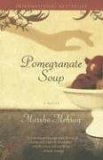
Marsha Mehran, author of Pomegranate Soup (a novel about three Iranian sisters living in Ireland shortly after the Iranian Revolution), discusses the Revolution, Persian cuisine, the Zoroastrian system of balancing, and much more in this fascinating interview.
Pomegranate Soup is your first novel. What inspired you to write this
book?
I was living in Ireland in 1999 with my then husband, who was Irish.
"Multiculturalism" wasn't even in the vernacular; I was one of only a handful of
'foreigners' living in County Mayo. When I walked down the village main street,
people literally came out of shop doors to stare at the "brown girl" passing by!
At the pub, I was often asked if I was Japanese or Chinese (ethnic groups
which I do not remotely resemble). During this time I met a Middle-Eastern
family that ran a deli outside of Castlebar. They sold cans of chickpeas, tahini,
and Mediterranean condiments, which are common in supermarkets today, but were a
rarity back then. This Lebanese family reminded me of my own parents, who had
escaped the Islamic Revolution in Iran and moved to Argentina, where they opened
a Middle Eastern eatery. They carried that same haunted, lonely looks on their
faces that my mother and father had, as they struggled to build a life in a
country so vastly different from their homeland. The image of this family stayed
in my mind, even as I moved back to New York and began writing my first novel, a
story about Iranian women. Nearly two years later, still toiling with the
manuscript, it dawned on me that something was missing from my story -- a sense
of joy. A happiness and vitality that is particular to Iranians, to Persian
culture itself. I wanted to express the beauty of my birthplace; a vision I knew
was incongruous with the dark, violent images Westerners see when they think of
Iran. Above all, I wanted readers to smell and taste one of Iran's greatest
contributions to the world: its delicate, perfumed cuisine. Somehow, all these
memories and emotions came together as I began to write Pomegranate Soup.
Although Pomegranate Soup is not autobiographical, how much of your
protagonists do you see in yourself?
I am a mixture of all three sisters, actually. There is a little of maternal
Marjan, a bit of neurotic Bahar, and even a dash of the free spirit that guides
Layla, in me.
Pomegranate Soup offers not only a fascinating picture of Revolutionary Iran,
but also a buffet of traditional Persian dishes. What inspired you to make food
such a prominent aspect of the story, and is there a specific Persian dish you
love the most?
I'm mad about cooking. Chopping and frying is so relaxing to me; a perfect
expression of love. When you give of yourself through a dish, you aren't just
feeding somebody's physical hunger, but a deeper longing for home, for a safe
place to rest. I have to say that my favorite Persian dish is gheimeh. It's a
delicious stew made from tomatoes, yellow-split peas, lamb, and French-fried
potatoes.
Persian cuisine is still fairly unknown to the greater American population.
Why do you think this is?
Maybe it's a public relations thing - not enough advertising. There are
approximately 1 million Iranian-Americans living in North America, most who
moved here after the revolution. So, it probably is just a matter of time,
really. I'm definitely ready to spread the word!
It is fascinating how many of our Western ingredients and dishes have a
direct connection to Iran. The ancient Silk Road connecting Europe and Asia ran
right through the Iran, isn't that so? How do you think this influenced world
cuisine?
With dishes dating back three millennia, Iranian cuisine has influenced the
eating habits of countless cultures: Ancient Greeks, Romans, Chinese, Indian,
Arabic, medieval Europeans, you name it. Lemons, oranges, pistachios,
barberries, saffron and pomegranates, were instant sensations in ancient Greece
and Rome, flavoring their bland dishes and changing the course of language
forever. Many of our words for foods find their etymological roots in Iran.
Lemon, for example comes from limoo, the word orange from narang, and so on.
Most importantly, Persian cuisine, with its myriad ingredients and balance of
sweet and sour flavors, has endured because it is undeniably tasty. A spoonful
of saffron rice, buttered and sprinkled with dill and lima beans, is pure
heaven.
Persian cuisine, surprisingly enough, has also influenced our own views on
healthy eating. The Surgeon General's daily nutritional recommendation -- the
food pyramid we've been taught to follow for so long --has its genesis in the
Persian Zoroastrian system of balancing. Where does this balancing theory come
from and how is it implemented in Iranian homes today?
Zoroastrianism was founded by the Persian prophet Zoroaster around 600BC and
is now believed to be one of the first, if not the first monotheistic religion.
It's dualistic in nature, and its basic concept concerns opposing forces: good
and evil struggling for supremacy. This theory of opposites extends to every
aspect of life, including diet. Foods, like people, are believed to have
natures, hot or cold, garm or sard. Melancholia or lack of energy can be treated
with Garm foods. Hot-tempers, fevers, and nervous tension will be alleviated by
Sard foods. Good health is obtained when there is a balance. Most modern-day
Iranians, my mother included, still believe in this system of gastronomic
balancing. During my school years, if I had an important exam coming up or
needed to have all my wits about me for an assignment, my mother would insist I
eat ajil: a mixture made from dried fruit such as raisins and figs and walnuts,
almonds and pistachios. She believed that this garm food would raise my energy
levels and help with concentration. (I would always ace a test when I followed
her advice!) To calm me down on hot days, or when I was particularly
temperamental, cucumber and yogurt dip combined with white basmati rice was a
good sard remedy. Likewise, in the book, Marjan keeps a close watch over her
moodier sister Bahar, feeding her dishes according to her state of mind.
In the US we take our meals wherever we can: the dinner table, the couch, in
the car, squeezing them into our busy schedules, almost like an afterthought.
It's completely the opposite in Iranian homes, with their tradition of the
sofreh. How does the sofreh affect the way Iranians eat?
Not until my late teens did I ever use a dining table for something other
than collecting books, errant newspapers and household bills. All my childhood
meals were celebrated on a piece of embroidered cloth called the sofreh. Sitting
cross-legged along its borders, families are able to 'touch base' in the most
fundamental of ways. A picnic three times a day! A typical meal could last up to
two hours, and if the weather was particularly hot, the entire contingent would
move outdoors. Rooftops or any patch of grass would do. In the book Marjan has a
wonderful memory of spending a hot summer's night eating and telling stories on
her childhood home's sunken rooftop. I, too, have distinct memories of dining
around a sofreh on our rooftop in Buenos Aires, while my mother told me
fantastical tales of Scheherazade and the 1001 Nights.
There are some dishes and ingredients that are quintessentially Persian.
Fresh herbs, for instance, aren't just used as seasonings and/or garnishes. What
is it about herbs that Persians love so much?
Nothing, absolutely nothing beats a warm piece of lavash bread folded over
creamy feta cheese and a fat sprig of sweet basil or mint. Herbs reign supreme
in Persian cuisine. Platters piled with bunches of tarragon, marjoram, mint and
basil accompany every meal, as does homemade cheese and just-baked bread.
Persian supermarkets, unlike their Western counterparts, devote long
refrigerated aisles to fresh herbs, which are sold by weight and not sprig.
Stews, salads, rice, egg dishes, ground meat mixtures - all contain at least a
cup, if not more, of chopped herbs. Marjan Aminpour has a special affinity for
herbs, a green thumb for planting them wherever she goes. They give her strength
and hope. I also grow my own herbs. I use small terracotta pots, lining them
along my sunny kitchen windowsill. It was a practice I picked during my time in
Ireland, where the inclement weather made it hard to grow delicate plants
outdoors. I love my little collection of sweet basil, lemon mint, dill, and
cilantro!
I love the image of the bubbling samovar in the novel, which is so central to
the Aminpour sisters' café. Coffee is the caffeine of choice in the US, but in
Iran there is an entire ritual surrounding tea. Can you tell us a bit more about
this?
There was a period in my childhood when samovars seemed to be taking over our
household. My mother had an obsession for them and scoured garage sales and
Persian grocery stores for antique, brass, miniature, and electric versions of
the water boiler used to make tea. No matter what time of day, visitors to our
home were ensured a hot cup of tea thanks to these miraculous machines. Persian
tea is easily obtained at any Middle Eastern grocery store nowadays. However, if
you're looking for an approximation in the general supermarket, an even mixture
of Earl Grey and Darjeeling will do. Persian tea exudes a rich, orangey perfume
and a dark amber color. The thing to remember is that Persian tea is always
meant to be taken with some sort of sweet accompaniment, such as sweetened nuts,
fruit, nougat candy, dried mulberries, or raisins. But beware: Persians never
sweeten their tea beforehand. Rather, cubes of crystallized sugar are clenched
between the teeth, before a sip is taken, allowing for the synthesis to occur
right on the tongue.
Date: 2005
Unless otherwise stated, this interview was conducted at the time the book was first published, and is reproduced with permission of the publisher. This interview may not be reproduced or reprinted without permission in writing from the copyright holder.

Diana Abu-Jaber is the award-winning author of seven books of fiction and nonfiction, including Crescent and The Language of Baklava. She lives in Fort Lauderdale, Florida. (more)
If you enjoyed:
Pomegranate Soup
Try:
Crescent
by Diana Abu-Jaber

Erica Bauermeister is the author of The School of Essential Ingredients (Jan 2009), a novel about eight students and their cooking teacher set in a restaurant kitchen. Her non-fiction work includes 500 Great Books by Women: A... (more)
If you enjoyed:
Pomegranate Soup
Try:
The School of Essential Ingredients
by Erica Bauermeister
We recommend 8 similar authors






In order to become the master, the politician poses as the servant
Click Here to find out who said this, as well as discovering other famous literary quotes!

Can you name the title?
Test your book knowledge with our daily trivia challenge!
Your guide toexceptional books
BookBrowse seeks out and recommends the best in contemporary fiction and nonfiction—books that not only engage and entertain but also deepen our understanding of ourselves and the world around us.
