
-
Your next favorite book
is waiting.
Summary | Excerpt | Reading Guide | Reviews | Beyond the book | Read-Alikes | Genres & Themes | Author Bio
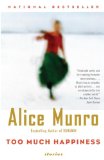
Stories
by Alice Munro Book Reviewed by:
In these ten stories, Alice Munro once again renders complex, difficult events and emotions into stories that shed light on the unpredictable ways in which men and women accommodate and often transcend what happens in their lives.
Ten superb new stories by one of our most beloved and admired writers—the winner of the 2009 Man Booker International Prize.
In the first story a young wife and mother receives release from the unbearable pain of losing her three children from a most surprising source. In another, a young woman, in the aftermath of an unusual and humiliating seduction, reacts in a clever if less-than-admirable fashion. Other stories uncover the “deep-holes” in a marriage, the unsuspected cruelty of children, and how a boy’s disfigured face provides both the good things in his life and the bad. And in the long title story, we accompany Sophia Kovalevsky—a late-nineteenth-century Russian émigré and mathematician—on a winter journey that takes her from the Riviera, where she visits her lover, to Paris, Germany, and, Denmark, where she has a fateful meeting with a local doctor, and finally to Sweden, where she teaches at the only university in Europe willing to employ a female mathematician.
With clarity and ease, Alice Munro once again renders complex, difficult events and emotions into stories that shed light on the unpredictable ways in which men and women accommodate and often transcend what happens in their lives.
i
Many persons who have not studied mathematics confuse it
with arithmetic and consider it a dry and arid science.
Actually, however, this science requires great fantasy.
—Sophia Kovalevsky
On the first day of January, in the year 1891, a small woman and a large man are walking in the Old Cemetery, in Genoa. Both of them are around forty years old. The woman has a childishly large head, with a thicket of dark curls, and her expression is eager, faintly pleading. Her face has begun to look worn. The man is immense. He weighs 285 pounds, distributed over a large frame, and being Russian, he is often referred to as a bear, also as a Cossack. At present he is crouching over tombstones and writing in his notebook, collecting inscriptions and puzzling over abbreviations not immediately clear to him, though he speaks Russian, French, English, Italian and has an understanding of classical and medieval Latin. His knowledge is as expansive as his physique, and though his speciality ...

A remarkable meditation on the themes closest to Munro's heart: hateship, friendship, courtship, loveship, marriage, to quote the title of her 2002 collection. Her stories always take the road less traveled to foster epiphanies in their characters and a subtle yet deep satisfaction in the reader... in her unflinching portrayal of misjudgments, accidents, and serendipitous exchanges, Munro has crafted a dark masterpiece...continued
Full Review
 (662 words)
(Reviewed by Marnie Colton).
Munro's stories often contain mysterious elements that deepen their appeal, leaving the reader with something extra to savor, like a fine mint after an especially flavorful dinner. No story in the collection better exemplifies this than "Too Much Happiness," a tale brimming with sadness that nonetheless ends in ecstasy. The chemical origins of that ecstasy begin when the doctor on the train gives her a pill, saying only "'This will give you a little rest if you find the journey tedious.'" Suffering from a sore throat and nagging cough, Sophia finally takes the pill that not only lessens tedium but also makes her feel "as if her heart could go on expanding, regaining its normal condition, and continuing after that to grow lighter and fresher...
If you liked Too Much Happiness, try these:
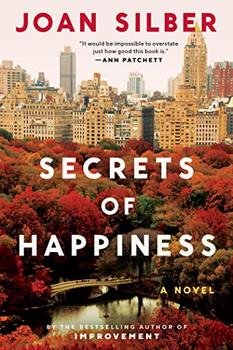
by Joan Silber
Published 2022
When a man discovers his father in New York has long had another, secret, family - a wife and two kids - the interlocking fates of both families lead to surprise loyalties, love triangles, and a reservoir of inner strength.
by Megan Mayhew Bergman
Published 2012
A heartwarming and hugely appealing debut collection that explores the way our choices and relationships are shaped by the menace and beauty of the natural world.
by Thomas Lynch
Published 2011
Heart-rending stories of life and death: a debut fiction collection by the award-winning author of The Undertaking.



The worth of a book is to be measured by what you can carry away from it.
Click Here to find out who said this, as well as discovering other famous literary quotes!

Can you name the title?
Test your book knowledge with our daily trivia challenge!