Summary | Excerpt | Reviews | Beyond the book | Read-Alikes | Genres & Themes | Author Bio
Critics' Opinion:
Readers' Opinion:
First Published:
Jan 2008, 288 pages
Paperback:
Mar 2009, 288 pages
 Book Reviewed by:
Sarah Sacha Dollacker
Buy This Book
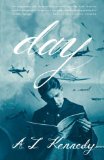
An emotionally charged, deeply affecting drama about the violence of modern life, and the intensity and courage to be found in the closeness of death. Blazing with Kennedy’s characteristic virtuosity, wit and narrative invention. Winner of the 2007 Costa Novel Award.
Alfie Day, RAF airman and former World War II POW, never expected to survive the war. He may not have even wanted to—choosing to be a tail gunner—exposed, alone and watchful for his skipper and his crew through night after night of bombing missions. Now, five years after the end of the war and more alone than ever, Alfie finds himself drawn to unearth those intense, strangely passionate days by working as an extra on a POW film. What he will discover on the set about himself, his loves and the world around him will make the war itself look simple.
Day is a superbly realized, emotionally charged, deeply affecting drama about the violence of modern life, and the intensity and courage to be found in the closeness of death. Blazing with Kennedy’s characteristic virtuosity, wit and narrative invention, Day is funny and moving, wise and sad, a dazzlingly original performance from one of the most gifted writers of our time.
Winner of the 2007 Costa Novel Award.
Alfred was growing a moustache.
An untrained observer might think he was idling, at a loose end in the
countryside, but this wasn't the case. In fact, he was concentrating, thinking
his way through every bristle, making sure they would align and be all right.
His progress so far was quite impressive: a respectable growth which already
suggested reliability and calm. There were disadvantages to him, certain
defects: the shortness, inelegant hands, possible thinning at his crown, habit
of swallowing words before they could leave him, habit of looking mainly at the
ground—and those few extra pounds at his waist, a lack of condition—but he
wasn't so terribly ugly, not such a bad lot.
Mainly his problem was tiredness—or more an irritation with his tiredness—or
more a tiredness that was caused by his irritation—or possibly both. He could no
longer tell.
It wasn't that he was awkward, or peculiar, quite the reverse: he was biddable
and ...

Costa Book Awards
2007
This disorienting prose style is the true strength of Day; in fact, it's the key that makes the entire story work. Without the constant shift of perspective and non-linear story line, we would never stand in Alfie's shoes, and that's the whole point. We must follow Alfie, be Alfie to the end, because learning what Alfie learns is the ultimate lesson of life, a lesson that that may ultimately save us from war...continued
Full Review
(584 words)
This review is available to non-members for a limited time. For full access,
become a member today.
(Reviewed by Sarah Sacha Dollacker).
Alfred Day's attempt to face the disillusionment of war on a film set is similar to what society at the time was doing at the movie theaters. The massive movie hits of the 40s and 50s, like To Hell and Back, allowed moviegoers on both sides of the Atlantic to relive moments of the war, if they had been directly involved, or to understand the nature of war, if they were not.
Since war broke out in 1939, World War II has been a favorite topic with movie studios in the USA and UK, and no doubt in other allied nations, but the vision of the war has changed over the decades. In the 40s and 50s, while Europe and America were rebuilding, the movies were patriotic and laudatory of each nation's triumphs (while occasionally touching on the part ...
This "beyond the book" feature is available to non-members for a limited time. Join today for full access.

If you liked Day, try these:
by David L. Robbins
Published 2010
New York Times bestselling author David L. Robbins presents a riveting novel of war, love, and survival, set against the backdrop of an improbable rescue, the Los Baños prison raid -- one of the most daring episodes of World War II.
by Owen Sheers
Published 2009
Imbued with immense imaginative breadth and confidence, Owen Sheers's debut novel unfolds with the pace and intensity of a thriller. A hymn to the glorious landscape of the Welsh border territories and a portrait of a community under siege.



The House on Biscayne Bay
by Chanel Cleeton
As death stalks a gothic mansion in Miami, the lives of two women intertwine as the past and present collide.

The Flower Sisters
by Michelle Collins Anderson
From the new Fannie Flagg of the Ozarks, a richly-woven story of family, forgiveness, and reinvention.

The Funeral Cryer by Wenyan Lu
Debut novelist Wenyan Lu brings us this witty yet profound story about one woman's midlife reawakening in contemporary rural China.
Your guide toexceptional books
BookBrowse seeks out and recommends the best in contemporary fiction and nonfiction—books that not only engage and entertain but also deepen our understanding of ourselves and the world around us.