-
Your next favorite book
is waiting.
Summary | Excerpt | Reviews | Read-Alikes | Genres & Themes | Author Bio
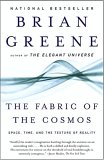
Space and time form the very fabric of the cosmos. Yet they remain among the most mysterious of concepts. Is space an entity? Why does time have a direction? Could the universe exist without space and time? Can we travel to the past?
From Brian Greene, one of the world's leading physicists, comes a grand tour of the universe that makes us look at reality in a completely different way.
Space and time form the very fabric of the cosmos. Yet they remain among the most mysterious of concepts. Is space an entity? Why does time have a direction? Could the universe exist without space and time? Can we travel to the past?
Greene uses these questions to guide us toward modern science's new and deeper understanding of the universe. From Newton's unchanging realm in which space and time are absolute, to Einstein's fluid conception of spacetime, to quantum mechanics' entangled arena where vastly distant objects can bridge their spatial separation to instantaneously coordinate their behavior or even undergo teleportation, Greene reveals our world to be very different from what common experience leads us to believe. Focusing on the enigma of time, Greene establishes that nothing in the laws of physics insists that it run in any particular direction and that "time's arrow" is a relic of the universe's condition at the moment of the big bang. And in explaining the big bang itself, Greene shows how recent cutting-edge developments in superstring and M-theory may reconcile the behavior of everything from the smallest particle to the largest black hole. This startling vision culminates in a vibrant eleven-dimensional "multiverse," pulsating with ever-changing textures, where space and time themselves may dissolve into subtler, more fundamental entities.
Sparked by the trademark wit, humor, and brilliant use of analogy that have made The Elegant Universe a modern classic, Brian Greene takes us all, regardless of our scientific backgrounds, on an irresistible and revelatory journey to the new layers of reality that modern physics has discovered lying just beneath the surface of our everyday world.
Table of Contents
Preface
Part 1: Reality's Arena
Part II: Time and Experience
Part III: Spacetime and Cosmology
Part IV: Origins and Unification
Part V: Reality and Imagination
Notes
Glossary
Suggestions for Further Reading
Index
Chapter 1: Roads to Reality
SPACE, TIME, AND WHY THINGS ARE AS THEY ARE
None of the books in my father's dusty old bookcase were forbidden. Yet while I was growing up, I never saw anyone take one down. Most were massive tomes–a comprehensive history of civilization, matching volumes of the great works of western ...

If you liked The Fabric of the Cosmos, try these:

by Richard Holmes
Published 2010
A riveting history of the men and women whose discoveries and inventions at the end of the eighteenth century gave birth to the Romantic Age of Science.
by Christopher Potter
Published 2010
You Are Here is a dazzling exploration of the universe and our relationship to it, as seen through the lens of today's most cutting-edge scientific thinking.
by Fred Watson
Published 2006
'Provides a fine overview of the 400-year history of the telescope...Watson relates intriguing stories while providing them with a rich cultural context...gathering all of this material in one place and presenting it in such an engaging style is a considerable accomplishment.'
Theo of Golden by Allen Levi
One spring morning, a stranger arrives in the small southern city of Golden. No one knows where he has come from…or why…