return to home  
Join   |  Gift   |  Member Login   |  Library Login
BookBrowse Mobile
Follow Us: 
   Reading Guides

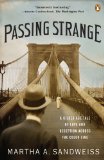
Passing Strange by Martha A Sandweiss: Questions, plus a reading group guide, with links to reviews, excerpt, author interview and author biography at BookBrowse.com.

Passing Strange

Passing Strange
A Gilded Age Tale of Love and Deception Across the Color Line
by Martha A. Sandweiss
Hardcover: Feb 2009,
384 pages.
Paperback: Jan 2010,
384 pages.

Publication information
Author Information
Critics' Opinion:   
Readers' Rating:    Not Yet Rated
About BookBrowse Rankings
Share: 
Buy This Book

Reading Guide Questions

 Printer Friendly Guide

Please be aware that this discussion guide may contain spoilers!

Introduction

Clarence King was one of the most widely admired and talented men of his generation. Friend to Secretary of State John Hay and eminent historian Henry Adams, King was a brilliant conversationalist and spellbinding storyteller, a visionary geologist who did more than anyone to map the American West, and a man who seemed to embody the American ideals of powerful intelligence wedded to manly vigor and adventurous spirit.

But as Martha Sandweiss shows in Passing Strange, King led a double life, passing as a black man in order to marry Ada Copeland, who was very likely born a slave and who was as far outside King's social and intellectual circle as a woman could possibly be. King created an alternate identity as James Todd, pullman porter, and hid a thirteen-year marriage from his family, friends, and the world, a marriage that would produce five children and last until King's death in 1901.

Sandweiss tells this fascinating story—a story that has been overlooked until now—with remarkable insight, providing the historical, social, and political context that illuminate the racial attitudes that dominated Jim Crow and Gilded Age America. She shows that even though King was fair-skinned with sandy blond hair and blue eyes, the nation's racial definitions, which asserted that having even one out of eight great grandparents could make one legally black, enabled King to cross the color line without suspicion. And while many blacks in late nineteenth-century America passed as white, the kind of racial passing that King accomplished was understandably rare. As a prominent scientist and member of the social elite of New York, King risked everything to be with the woman he loved. Had his relationship been discovered during his lifetime, it would have caused a major scandal and brought an end to his public life. Sandweiss explores King's possible motives and methods for carrying out this elaborate deception, revealing the full complexity of a man who both embraced and embodied paradox: a man who exemplified the ideals of the age but in many ways hated "civilization," preferring dark-skinned peoples and the rugged life of the mountains or the tropics to the social elitism of Boston, New York, and Washington; a man who possessed enormous literary promise but wrote little, devoting his powers of fictional invention to creating his alter ego James Todd instead; a man whose was as talented as any but lived most of his life under crushing debt; a man who advocated a racially mixed America, but who would not reveal his own interracial marriage and mixed-race children.

Passing Strange also provides a revealing glimpse into Ada Copeland's life before, during, and after her marriage to King—her rise from slavery to a comfortable middle-class life in New York City, her determined legal battles to recover the trust fund she was sure King had left for her, her devoted family life, and most of all, the passionate love she shared with the man she knew as James Todd.

A truly extraordinary story about an extraordinary man and an extraordinary couple, Passing Strange illuminates, as no other recent book has done, the vexed intersection of race, class, identity, and ambition in America's Gilded Age.

Discussion Questions

  1. Henry Adams observed that for King "it was not the modern woman that interested him; it was the archaic female, with instincts and without intellect" (p. 62). King himself said "Woman, I am ashamed to say, I like best in the primitive state" (p. 124). Why did King feel such disdain for "modern" women? Why did he prefer women who had not been so thoroughly shaped by western civilization?
  2. What does Passing Strange reveal about both the fluidity of racial identities and the rigidities of racial prejudice in late nineteenth-century America?
  3. In what ways does Ada Copeland's life, before, during, and after her marriage to King illuminate both the racial limitations of late nineteenth century America and the new freedom available to someone like Ada?
  4. Sandweiss writes of King: "Acting from a complicated mix of loyalty and self-interest, reckless desire and social conservatism, he deceived his mother, his close friends, his colleagues, and all the people who knew him in his public role. He also deceived the woman he married" (p. 303). How harshly or kindly should we judge King today for the double life he led? What factors— personal, social, historical—might mitigate our judgment of his deceptions?
  5. Was Ada Copeland's marriage to King, and the deceit it entailed, ultimately beneficial or harmful to her? How did marrying King change her life?
  6. What were King's most remarkable and admirable personal characteristics? What made him so well liked and so widely admired during his lifetime?
  7. In what ways were King's racial attitudes progressive for the time he lived in? How did he envision racial equality evolving in America? How might King regard America's current state of race-relations?
  8. Frances Farquhar, in his introduction to King's "The Helmet of Mambrino," argues that King was a tragic hero, "in the sense of Aristotle—‘One highly renowned and prosperous, whose misfortune is brought upon him by some error of judgment or frailty'" (p. 296). Was King a tragic hero? What was the error of judgment or frailty that caused his fall?
  9. Why did King fail to fulfill the promise of a brilliant literary career so many of his friends predicted for him?
  10. In what ways does Passing Strange illuminate the racial complexities—as well as the tensions between public and private life—of our own historical moment?


Unless otherwise stated, this discussion guide is reprinted with the permission of Penguin Books. Any page references refer to a USA edition of the book, usually the trade paperback version, and may vary in other editions.

Become a Member
Click Here
Editor's Choice
  •  May 25 
  •  May 23 
  •  May 21 
The Shelter Cycle
Peter Rock

The Shelter Cycle Jacket

An American original, Peter Rock brings our strangest beliefs to vivid and sympathetic life in this haunting novel inspired by true events.
And the Mountains Echoed
Khaled Hosseini

And the Mountains Echoed Jacket

Khaled Hosseini has written a new novel about how we love, how we take care of one another, and how the choices we make resonate through generations
Helga's Diary
Helga Weiss

Helga's Diary Jacket

The remarkable diary of a young girl who survived the Holocaust—appearing in English for the first time.
Click Here
   Most Recent Blog Entries
Movies Based on Books: Summer 2013 (May - August)
Jewish Young Adult Books That Are Not About The Holocaust
Books to Give This Mother's Day
rss  RSS   rss  subscribe
Recent Reader Reviews
Bring Up the Bodies by Hilary Mantel
A very large book - in number of pages and in content - and every page worth reading. Thoroughly enjoyed this one and her first book on the... read more
Two Lives by Vikram Seth
Two Lives is a memoir written by international best-selling author, Vikram Seth. In this interesting and engaging book, Seth writes about his great... read more
Z: A Novel of Zelda Fitzgerald by Therese Fowler
Z, the novel about the life of Zelda Sayre Fitzgerald is at points charming and; like another reviewer, I kept thinking of the movie, "Midnight... read more
RSS RSS feed More...  
Most Viewed This Week
1. The Boy in the Striped Pajamas
John Boyne
2. And the Mountains Echoed
Khaled Hosseini
3. Telegraph Avenue
Michael Chabon
4. The Glass Castle
Jeannette Walls
5. The Round House
Louise Erdrich
More...
Book Club Recommendations
Why Be Happy When You Could Be Normal?
by Jeanette Winterson
Paperback (Mar/13)
Eleanor & Park
by Rainbow Rowell
Hardback (Feb/13)
The House Girl
by Tara Conklin
Paperback (Oct/13)
The Painted Girls
by Cathy Marie Buchanan
Hardback (Jan/13)
More...
First Impressions
Members read and review books often months before they're published. See what they think in First Impressions!
The Caretaker
by A .X. Ahmad
Four Stars            (May/13)
Golden Boy
by Abigail Tarttelin
4.5 Stars            (May/13)
The Last Girl
by Jane Casey
Four Stars            (May/13)
The Sisterhood
by Helen Bryan
Four Stars            (Apr/13)
More...
  Latest BookBrowse News
News Corp will officially split into two companies June 28 (May 24 2013)
As expected, News Corp has announced it will officially split its publishing and entertainment businesses on 28 June.
br> Its board approved the... Full Story
rss RSS feed More...
 
BookBrowse Poll
Q: Which of these Summer movies based on books would you like to see? (Info on each movie here)
The Great Gatsby
Epic
Man of Steel
World War Z
The Lone Ranger
The Wolverine
R.I.P.D.
Percy Jackson
Paranoia
The Mortal Instruments
Select Any That Apply
Search: Title or Author
Free Newsletters
The Light Between Oceans

Online Book Club
More about
The Comfort of Lies
Join the discussion!


Win This Book!
On Sal Mal Lane


"Piercingly intelligent and shatter-your-heart profound."

Enter To Win Now!

wordplay
Solve this clue:
"I Y N P O T Solution, Y P O T P"

and be entered
to win....
frame top
New Author
Interviews
Menna van Praag
Erica Brown
Helga Weiss
Kate Morton
frame bottom
HOME Book Submissions | Advertising | Library Subscriptions | Reviewing for BookBrowse | Contact Us