Book Club Discussion Questions
Please be aware that this discussion guide will contain spoilers!
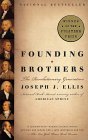
The introduction, discussion questions, suggestions for further reading, and
author biography that follow are intended to enhance your reading group's
discussion of Joseph Ellis's
Founding Brothers: The Revolutionary Generation.
We hope they will enrich your experience of this Pulitzer Prize-winning study of
the intertwined lives of the founders of the American republic--John Adams,
Aaron Burr, Benjamin Franklin, Alexander Hamilton, Thomas Jefferson, James
Madison, and George Washington.
About This Book
In a lively and engaging narrative, Ellis recounts the sometimes
collaborative, sometimes archly antagonistic interactions between these men and
shows us the private characters behind the public personas: Adams, the
ever-combative iconoclast, whose closest political collaborator was his wife,
Abigail; Burr, crafty, smooth, and one of the most despised public figures of
his time; Hamilton, whose audacious manner and deep economic savvy masked his
humble origins; Jefferson, renowned for his eloquence, but so reclusive and
taciturn that he rarely spoke more than a few sentences in public; Madison,
small, sickly, and incredibly shy, yet one of the most effective debaters of his
generation; and the stiffly formal Washington, the ultimate realist,
larger-than-life, and America's only truly indispensable figure.
Ellis argues that the checks and balances that permitted the infant American
republic to endure were not primarily legal, constitutional, or institutional,
but intensely personal, rooted in the dynamic interaction of leaders with quite
different visions and values. Revisiting the old-fashioned idea that character
matters,
Founding Brothers informs our understanding of American
politics--then and now--and gives us a new perspective on the unpredictable
forces that shape history.
>
Reader's Guide
- The anecdote that Benjamin Rush liked to repeat about an overheard
conversation between Benjamin Harrison and Elbridge Gerry on July 4, 1776, makes
clear that the signers of the Declaration of Independence felt some doubt about
their chances of surviving their revolutionary act. As Ellis points out, if the
British commanders had been more aggressive, "The signers of the
Declaration would . . . have been hunted down, tried, and executed for treason,
and American history would have flowed forward in a wholly different
direction" [p. 5]. Why is it so difficult to grasp this notion of the new
nation's utter fragility? How successful is Founding Brothers in taking
the reader back in time, in order to witness the contingencies of a historical
gamble in which "sheer chance, pure luck" [p. 5] were instrumental in
determining the outcome?
- Ellis has said, "We have no mental pictures that make the
revolutionary generation fully human in ways that link up with our own time. . .
. These great patriarchs have become Founding Fathers, and it is psychologically
quite difficult for children to reach a realistic understanding of their
parents, who always loom larger-than-life as icons we either love or hate."
How does Founding Brothers address this problem, and how does it manage
to humanize our image of the founders? How does the book's title relate to this
issue?
- What was really at stake in the disagreement and duel between Aaron
Burr and Alexander Hamilton? If Hamilton felt that the disparaging statements he
had made about Burr were true, should he have lied in order to save his life?
Was this merely a war over words? Did words have more significance then than
they do now? What role did newspapers play in the drama, and how is the media's
role different or similar today?
📖
Get the full reading guide
Join BookBrowse free to unlock all 15 discussion questions, author background, themes, and more for Founding Brothers.
Join free — it takes 30 seconds
Already a member? Log in →
- How does the author develop themes of identity and belonging throughout the narrative?
- What role does the setting play in shaping the characters' decisions and relationships?
- Discuss how the ending reframes the events of the story. Were you surprised?
Unless otherwise stated, this discussion guide is reprinted with the permission of Vintage.
Any page references refer to a USA edition of the book, usually the trade paperback version, and may vary in other editions.