return to home  
Join   |  Gift   |  Member Login   |  Library Login
BookBrowse Mobile
Follow Us: 
   Reading Guides

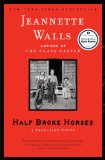
Half Broke Horses by Jeannette Walls: Questions, plus a reading group guide, with links to reviews, excerpt, author interview and author biography at BookBrowse.com.

Half Broke Horses

Half Broke Horses
A True-Life Novel
by Jeannette Walls
Hardcover: Oct 2009,
288 pages.
Paperback: Sep 2010,
288 pages.

Publication information
Author Information
Critics' Opinion:   
Readers' Rating:  
About BookBrowse Rankings
Share: 
Buy This Book

Reading Guide Questions

 Printer Friendly Guide

Please be aware that this discussion guide may contain spoilers!

Introduction
Jeannette Walls’s grandmother Lily Casey Smith is the kind of woman who built this country: resourceful, hardworking, and smart. Full of spunk and with a strong will to do whatever she puts her mind to, she can break a wild horse by the time she is six years old. At age fifteen, she leaves home to teach in a frontier town, riding five hundred miles across New Mexico with nothing but her pony for company and her pearl-handled revolver for protection. She tries living and working in Chicago, where she meets her first husband, but betrayal and loss soon drive her back to ranch life—caring for livestock and respecting the land are what she does best. Together, she and her second husband manage a 180,000-acre ranch and Lily uses her incredible pluck and ingenuity to supplement their meager income. They raise two children, one of whom is Jeannette Walls’s mother, Rosemary Smith Walls. With little more than Lily’s resourcefulness to guide the way, the family will weather tornadoes, droughts, floods, personal tragedy, and the Great Depression. In this tale of extreme hardship emerges a story of one woman whose spirit can’t be broken.

Questions for Discussion

  1. Jeannette Walls has said that she tried writing this book in the third person but that it didn’t work for her. Do you think you are closer to Lily because you get her story in her own voice? Did you “see” Lily Casey Smith as real? What is your response to the first person voice of the book?

  2. When Lily’s father dies, she and Rosemary drive his body from Tucson back to the ranch in West Texas. Rosemary is embarrassed to be seen driving with a corpse and ducks down in the car when they stop at a red light (pg. 198). “Life’s too short, honey,” Lily tells Rosemary, “to worry what other people think of you.” What does Lily’s reaction to this behavior show about her character? Does she give much credence to what other people think of her? What effect do you think her mother’s attitude had on Rosemary?

  3. Following Helen’s suicide, Lily says, “When people kill themselves, they think they’re ending the pain, but all they're doing is passing it on to those they leave behind” (pg. 113). Do you agree with this statement?

  4. Lily seems willing to sacrifice everything to defend her principles and the rights of others. On more than one occasion, she is fired from a teaching position for refusing to back down from what she believes in. Do you applaud Lily’s moral conviction in these instances? Or did you hope that Lily would learn to compromise?

  5. Lily has high expectations for her children, from sending them off to boarding school despite their protests to enforcing strict rules for keeping animals as pets. When Rosemary falls in love with a wild horse and asks her mother if she can keep it, Lily replies, “The last thing we need around here is another half-broke horse” (pg. 190). How might this statement apply to Lily’s children as well? Are Lily’s expectations of her children particularly high or rather a reflection of the times? Why do you think this phrase was chosen as the title of the book?

  6. When a group of Brooklyn ladies visits the ranch, Rosemary and Lily take them for a car ride they’ll never forget. Lily concludes their encounter by saying, “You ride, you got to know how to fall, and you drive, you got to know how to crash” (pg. 175). How does this statement apply to Lily’s life as a whole? What does she mean by knowing “how to fall”?

  7. Discuss Lily’s husband Jim. How does his personality complement her strong nature?

  8. While attempting to prevent the ranch from flooding, Lily tells Rosemary, “Do the best you can...That's all anyone can do.” Her instructions are echoed by Jim's declaration: “We did a good job—good as we could” (pg. 152). Why do you think Lily and Jim have both adopted this philosophy? To which other instances in their lives are they likely to have applied this rationale?

  9. Lily comes off as tough and resilient, but there are moments in this book of vast heartbreak, where you see her façade crack. How does the author handle the death of Lily’s friend in Chicago? Her first husband’s duplicity? Her sister’s suicide? Her suspicions of her husband Jim?

  10. Walls calls Half Broke Horses a “true life novel.” In her author’s note, she explains why. Do you agree with this label? What do you think of the “true life” genre?

  11. “Helen’s beauty, as far as I was concerned, had been a curse, and I resolved that I would never tell Rosemary she was beautiful” (pg. 119). Examine Lily’s relationship with her daughter, Rosemary, and, in The Glass Castle, Rosemary’s relationship with Jeannette. How does each generation try to compensate for the one before? How does each mother try to avoid the mistakes or pain imposed upon her by her own mother?


Questions for readers who have also read The Glass Castle:

  1. In Half Broke Horses, Lily’s father decides to bring her home from school so that he can use her tuition money to breed dogs. This instance of selfishness bears a close resemblance to Rex Walls’s behavior in The Glass Castle when he takes the money Jeannette’s sister has been saving to escape Welch, WV, and goes on a drinking binge. Over and over these men disappoint their children, and yet they are forgiven. Talk about the lack of bitterness in both of these books. How do the children rationalize their parents’ behavior?

  2. “There was a big difference between needing things and wanting things—though a lot of people had trouble telling the two apart—and at the ranch, I could see, we’d have pretty much everything we’d need but precious little else” (pg. 134–5). How might this description refer to Lily’s life as a whole? What effect did growing up without much have on Rosemary Walls, whom we learn more about in The Glass Castle?

  3. Both The Glass Castle and Half Broke Horses open with a climactic event from the main character’s childhood that has left a memorable impression on her. Compare each event and the narrators’ descriptions of the events. How do these retellings set the stage for what’s to come? Why do you think Walls chose to use them as the openings of both books?


Unless otherwise stated, this discussion guide is reprinted with the permission of Scribner. Any page references refer to a USA edition of the book, usually the trade paperback version, and may vary in other editions.

Become a Member
Click Here
Editor's Choice
  •  May 18 
  •  May 16 
  •  May 15 
The Woman Upstairs
Claire Messud

The Woman Upstairs Jacket

The riveting confession of a woman awakened, transformed, and betrayed by passion and desire for a world beyond her own.
How to Create the Perfect Wife
Wendy Moore

How to Create the Perfect Wife Jacket

Stranger than fiction, blending tragedy and farce, How to Create the Perfect Wife is an engrossing tale of the radicalism, and deep contradictions, at the heart of the Enlightenment.
Happier Endings
Erica Brown

Happier Endings Jacket

A wise and affirming meditation on living fully and preparing for death, written by a highly regarded spiritual teacher.
Click Here
   Most Recent Blog Entries
Jewish Young Adult Books That Are Not About The Holocaust
Books to Give This Mother's Day
A Short History of Chechnya
rss  RSS   rss  subscribe
Recent Reader Reviews
Flight Behavior by Barbara Kingsolver
Although heavy on the scientific details, which slowed down the story for me (OK, I admit, I was one of those liberal arts majors who skipped out on... read more
The House at the End of Hope Street by Menna van Praag
Loved this book. Magical, quirky, enchanting I could go on. All books do not have to be literary fiction, sometimes it is just so comforting to read... read more
Ordinary Grace by William Kent Krueger
Can an wiser, older narrator view the past with more wisdom than he might have possessed forty years earlier in the summer he was thirteen? Ordinary... read more
RSS RSS feed More...  
Most Viewed This Week
Book Club Recommendations
The Gods of Gotham
by Lyndsay Faye
Paperback (Mar/13)
Forgotten Country
by Catherine Chung
Paperback (Mar/13)
Philida
by André Brink
Paperback (Feb/13)
Gone Girl
by Gillian Flynn
Hardback (Jun/12)
More...
First Impressions
Members read and review books often months before they're published. See what they think in First Impressions!
The Sisterhood
by Helen Bryan
Four Stars            (Apr/13)
The Laws of Gravity
by Liz Rosenberg
4.5 Stars            (May/13)
A Dual Inheritance
by Joanna Hershon
Four Stars            (May/13)
More...
  Latest BookBrowse News
U.S. ebook sales up in 2012, but rate of growth is slowing (May 16 2013)
In 2012, trade book sales (i.e. non academic book sales) rose 6.9%, to $15.049 billion, and e-book sales continued to grow, although the rate of growth... Full Story
rss RSS feed More...
 
BookBrowse Poll
Q: Do you mainly read newly published or older books?
Mainly newer books
Mainly older books
A mix of new and old books
Search: Title or Author
Free Newsletters
Bring Up the Bodies

Online Book Club
More about
Five Days
Join the discussion!


Win This Book!
The Pigeon Pie Mystery


Enter To Win Now!

wordplay
Solve this clue:
"I I M B T Give T T R"

and be entered
to win....
frame top
New Author
Interviews
Menna van Praag
Erica Brown
Helga Weiss
Kate Morton
frame bottom
HOME Book Submissions | Advertising | Library Subscriptions | Reviewing for BookBrowse | Contact Us