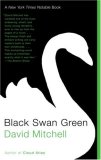
Black Swan Green by David Mitchell: Questions, plus a reading group guide, with links to reviews, excerpt, author interview and author biography at BookBrowse.com.
Black Swan Green
by David Mitchell
Hardcover: Apr 2006,
304 pages.
Paperback: Feb 2007,
304 pages.
Please be aware that this discussion guide may contain spoilers!
Jason has ongoing internal dialogues with Maggot and Unborn Twin.
What roles do Maggot and Unborn Twin play in Jasons life? And what did
Mitchell accomplish by employing this device?
At the beginning of the novel, Jason fears that his stammer defines him.
Why do you think he calls it "Hangman"? How does he learn to adapt to it? In
what ways is the stammer a limitation and in what ways an advantage? Imagine
Jason without a stammerhow would the novel be different?
Mitchell often ends a scene in the middle of the actionfor example,
when Jason is locked in the House in the Woods, or when the fire erupts in
Town Halland leaves readers to surmise for themselves what happened next.
Why do you think he chose to do this?
Throughout the novel, phrases and paragraphs are often repeated,
sometimes with variation and sometimes identically. How does context alter
the meaning of these repeated phrases? And what did Mitchell accomplish by
repeating paragraphs with slight variations, as in the chapter Solarium?
Did you notice the frequent appearances of the moon-gray cat? In what
instances does the cat appear? Why did Mitchell choose to link these
instances using the moon-gray cat?
There is a rich tradition of English novels set in villages like Black
Swan Green. How did the town of Mitchells imagination compare with those of
classic British novels? What characteristics, both of the village and the
villagers, did Mitchell employ to recall this tradition, and how did he
subvert it?
Jason is deeply concerned with the war. How does his budding political
consciousness evolve over the course of the novel? And how did events in the
world reflect the events happening within Jasons home?
Jason successfully completes the test to be admitted into the
ultra-popular, ultra-secret society of the Spooks; but his friend Dean Moran
doesnt have such luck. Why did Jason go back to help Dean? Was it the right
choice?
Many of the male characters in the book have reprehensible traits. Some,
like Dean Morans dad, are alcoholics; others, like Jasons uncle Brian, are
overtly racist and sexist. Jason idolizes his cousin Hugo at first, but by
the end of the novel thinks hes smarmy, and sometimes Jasons father
appears heroic, but at other times, callous and cowardly. Is Mitchell
commenting on the pitfalls of masculinity? Are the female characters
portrayed with fewer faults?
Violence is an ever-present threat in Jasons world, even among adults,
like the bus driver, Norman Bates, who carries a Bowie knife, and Kit
Harris, the Borstal teacher, who sicced his Dobermans on Jason. What role
does violence play in the story?
At the end, Jason says, The worlds a headmaster who works on your
faults. What did he mean? Do you agree?
Unless otherwise stated, this discussion guide is reprinted with the permission of Random House.
Any page references refer to a USA edition of the book, usually the trade paperback version, and may vary in other editions.
Fearless, gripping, at once darkly funny and tender, spanning three continents and numerous lives, Americanah is a richly told story set in today's globalized world.
The story of an American family, middle class in middle America, ordinary in every way but one. But that exception is the beating heart of this extraordinary novel.
The most mature work yet from an incomparable storyteller, TransAtlantic is a profound meditation on identity and history in a wide world that grows somehow smaller and more wondrous with...
First time novelist Vaddey Ratner captured my heart and senses in this novel based on her childhood in Cambodia. Her story transcends any news story...
read more
From the first page, I was drawn in by the lyrical writing of the author and mesmerized as the narrator, eight year old Raami, remembered the years...
read more
Trite but true, all good things must come to an end. I so wanted to keep reading the wonderful prose, the settings that let one think they are part...
read more
Kenn Nesbitt is new Children's Poet Laureate(Jun 12 2013) Kenn Nesbitt has been named the new Children's Poet Laureate: Consultant in Children's Poetry to the Poetry Foundation, which noted that the two-year position...
Full Story