Reading Guide Questions

Please be aware that this discussion guide will contain spoilers!
About This Guide
The introduction, discussion questions, suggested reading list, and author
biography that follow are intended to enhance your group’s conversation about
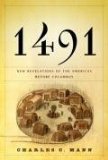
1491, Charles Mann’s compelling and wide-ranging look at the variety,
density, and sophistication of the cultures in the Western Hemisphere before the
arrival of Columbus.
About This Book
1491 is a groundbreaking study that radically alters our understanding
of the Americas before the arrival of the Europeans in 1492, and a necessary
book for understanding the long, remarkable story of the indigenous peoples of
the Western Hemisphere.
Traditionally, Americans have been taught that the ancestors of the people who
inhabited the Western Hemisphere at the time of Columbus’s landing crossed the
Bering Strait thirteen thousand years ago, existed mainly in small, nomadic
bands, and lived so lightly on the land that the Americas were, for all
practical purposes, still a vast wilderness. But in fact, in 1491 there may well
have been more people living in the Americas than in Europe, many of them in
urban complexes bigger and more sophisticated than London or Paris. Older, too:
Indian cities were thriving before the Egyptians built the great
pyramids. Native people of the Americas developed ways of breeding corn and
using the land that were far ahead of other civilizations. In the Amazon,
Indians learned how to farm the rain forest without destroying it–a process
scientists are studying today in the hope of reviving the practice.
1491
is full of new knowledge about the pre-Columbian Americas that will utterly
change readers’ visions of the past.
Reading Guide
- Mann begins the
book with a question about our moral responsibility to the earth’s environment:
Do we have an obligation, as some green activists believe, to restore
environmental conditions to the state in which they were before human
intervention [p. 5]? What does the story of the Beni tell us about what "before
human intervention" might mean?
- What scientists have learned about the early Americas gives the lie to
what Charles C. Mann, and most of us, learned in high school: "that Indians came
to the Americas across the Bering Strait about thirteen thousand years ago, that
they lived for the most part in small, isolated groups, and that they had so
little impact on their environment that even after millennia of habitation the
continents remained mostly wilderness" [p. 4]. What is the effect of learning
that most of what we have assumed about the past is "wrong in almost every
aspect" [p. 4]?
- There are many scholarly disagreements about the research described in
1491. If our knowledge of the past is based on the findings of
scholars, what happens to the past when scholars don’t agree? How convincing is
anthropologist Dean R. Snow’s statement, "you can make the meager evidence from
the ethnohistorical record tell you anything you want" [p. 5]? Are certain
scholars introduced here more believable than others? Why or why not?
- Probably the most devastating impact from the contact between Europeans
and Americans came from the spread of biological agents like smallpox. Of Mann’s
various descriptions of the effects of foreign diseases on the Americas’ native
populations [pp. 96—124], which are most shocking, and why? How do you respond
to his questions on page 123: "In our antibiotic era, how can we imagine what it
means to have entire ways of life hiss away like steam? How can one assay
the total impact of the unprecedented calamity that gave rise to the world
we live in?"
- In the nineteenth century, historian George Bancroft described pre-contact
America as "an unproductive waste. . . . Its only inhabitants were a few
scattered tribes of feeble barbarians, destitute of commerce and of political
connection" [pp. 14—15]. To what degree is the reflexive ethnocentrism of
earlier times responsible for the erroneous history of the Americas we have
inherited?
- When Spanish explorer Hernando De Soto brought pigs along on his
expedition in order to feed himself and his men, the pigs carried microbes that
apparently wiped out the Indian populations in the southeast part of the current
United States [p. 108—09]. While this episode illustrates the haphazard quality
of biological devastation, how does it also connect 1491 to our
contemporary world, in which the media reports daily on scientists’ fear of
diseases like avian flu jumping from animal to human populations? In our present
global environment, are we as vulnerable as the Indian tribes discussed by Mann?
Are there, as he suggests, moral reverberations to be felt as a result of the
European entrance into the Americas five centuries ago [p. 112]?
- Several of the cultures discussed by Mann honored their dead so highly
that, in effect, the dead were treated as if they were still alive. What is most
interesting about the attitudes toward death and the dead found in the Chinchorro [pp. 200—01], the Chimor [p. 264], and the Inka [p. 98] cultures?
- Much of America’s founding mythology is based on the idea of the land as
an untouched wilderness, yet most scholars now agree that this pristine myth [p.
365] was a convenient story that the early settlers told themselves. What kinds
of actions did the myth support, and how did it serve the purposes of the
settlers?
- Because of the lack of documentary and statistical evidence for the mass
death caused by disease in the New World, experts have argued about the size of
the pre-Columbian population. The so-called High Counters, according to their
detractors, "are like people who discover an empty bank account and claim from
its very emptiness that it once contained millions of dollars. Historians who
project large Indian populations, Low Counter critics say, are committing the
intellectual sin of arguing from silence" [p. 112]. Yet those who count low,
Indian activists say, do so in order to diminish not only the mass death
suffered by indigenous peoples, but also the significant achievements of their
pre-contact cultures. Which side does it seem Charles Mann leans toward? Which
side do you find more believable?
- Consider Mann’s remark about what was lost because of the destruction
wrought by Cortés and others: "Here, at last, we begin to appreciate the
enormity of the calamity, for the disintegration of native America was a loss
not just to those societies but to the human enterprise as a whole. . . . The
Americas were a boundless sea of novel ideas, dreams, stories, philosophies,
religions, moralities, discoveries, and all the other products of the mind" [p.
137]. How might the world have been different had the ancient cultures of the
Americas survived into the present?
- Mann writes, "Native Americans were living in balance with
Nature–but they had their thumbs on the scale. . . . The American landscape had
come to fit their lives like comfortable clothing. It was a highly successful
and stable system, if ‘stable’ is the appropriate word for a regime that
involves routinely enshrouding miles of countryside in smoke and ash" [p. 284].
Why did the Indians burn acres of land? Does Mann suggest that there are the
ecological lessons for our own time in the Native Americans’ active manipulation
of their environment?
- Using the words of Harvard biologist Edward O. Wilson, Mann explains that
a "keystone" species is one "that affects the survival and abundance of many
other species"; Mann adds that, "Keystone species have disproportionate impact
on their ecosystems" [p. 352—53]. Indians were a keystone species in most of the
hemisphere before the arrival of Columbus. What force led to their greatly
diminished importance in the evolution of the hemisphere’s ecosystems? If our
species now has an even greater impact on the world ecosystems, does Mann
suggest ways to avoid disasters such as those he delineates in 1491?
- Discussing foreign environmentalists’ opinions about saving the Amazonian
forests, Mann raises a problem with the whole environmental movement: Those in
poverty-stricken areas like Amazonia want development and jobs; wealthy,
well-educated people in the U.S. and Europe tend to want to preserve these
forests [pp. 363—64]. How can this problem be resolved?
- The Gitksan Indians of Canada’s Northwest have argued a case in the
Supreme Court of Canada that "the Gitksan had lived there a long time, had never
left, had never agreed to give their land away, and had thus retained legal
title to about eleven thousand square miles of the province" [p. xi]. What are
the implications of such a claim for the various peoples and tribes that Mann
discusses in 1491, and for the descendants of European settlers?
- What does Mann mean in saying, "Understanding that nature is not
normative does not mean that anything goes. . . . Instead the landscape is an
arena for the interaction of natural and social forces, a kind of display, and
one that like all displays is not fully under the control of its authors" [p.
365—66]?
- People have long believed that being in the wilderness conveys a sense of
the sacred. Mann explains, "The trees closing over my head in the Amazon furo
made me feel the presence of something beyond myself, an intuition shared by
almost everyone who has walked in the woods alone. That something seemed to have
rules and resistances of its own, ones that did not stem from me" [p. 365]. What
happens to this idea of a non-human force in nature if, as Mann concludes, the
concept of nature is a human creation?
- Why does Mann end 1491 with a coda on the Haudenosaunee "Great Law of Peace," and what resonance does it have for the book as a whole?
Suggested Reading
Colin G. Calloway: One Vast Winter Count: The Native American West before
Lewis and Clark; Michael D. Coe, Mexico: From the Olmecs to the Aztecs;
William Cronon, Changes in the Land: Indians, Colonists, and the
Ecology of New England; Alfred W. Crosby, Ecological Imperialism:
The Biological Expansion of Europe, 900—1900; Brian Fagan, The Little Ice
Age: How Climate Made History, 1300—1850; John Hemming, The Conquest of
the Incas; Betty J. Meggers, Amazonia: Man and Culture in a
Counterfeit Paradise; Helen C. Rountree, Pocahontas, Powhatan,
Opechancanough: Three Indian Lives Changed by Jamestown; Neal Salisbury,
Manitou and Providence: Indians, Europeans, and the Making of New England,
1500—1643; Nathaniel Philbrick, Mayflower: A Story of Courage,
Community, and War; Edward O. Wilson, The Diversity of Life;
James Wilson, The Earth Shall Weep: A History of Native America;
Ronald Wright, Stolen Continents: 500 Years of Conquest and Resistance in
the Americas.
Unless otherwise stated, this discussion guide is reprinted with the permission of Vintage.
Any page references refer to a USA edition of the book, usually the trade paperback version, and may vary in other editions.
 Book Reviewed by: