Book Club Discussion Questions
Please be aware that this discussion guide will contain spoilers!
Introduction
In my house, I have a room in which one wall is entirely covered with books
that I used while writing
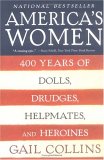
America's Women: 400 Years of Dolls, Drudges,
Helpmates and Heroines. When I look at them I like to remember that there
was a time, not very long ago, when teachers who wanted to offer courses on
women's history were told there wasn't enough information to cover an entire
semester. Some of the books are amazing, full of fascinating stories and little
details I love. In one of them, I found a recipe for a basic cake which told me
all I needed to know about what it was like to be a housewife in the early 19th
century: mix eight eggs and a pound of sugar and "beat it three quarters of
an hour.''
Much as I love this little library, I know that many people -- well,
virtually all people -- don't have the time to get acquainted with everything
that's been written on the history of women in this country. My idea in writing
America's
Women was to go through as many books as possible myself, take out the most
interesting bits and spin one story. It starts in England in 1587 with Eleanor
Dare, who agreed, when she was pregnant with her first child, to get into a
smallish boat and sail across the ocean to settle with her husband and a few
other people on a continent where no woman of her kind had ever been before. She
was obviously either very brave or very easily led. We don't know which, since
she vanished from history, along with her baby daughter and all the other
residents of the lost colony of Roanoke.
America's Women has all the great heroines in our past, but it's
mainly about what it was like to be an average woman, who was supposed to blaze
trails while struggling with corsets and cleanliness issues. (The nation
acquired handguns and repeat rifles before anybody bothered to invent window
screens.) At the end, you'll find a lot of notes that show you where I got my
information. If some part of the story really intrigues you, you can follow the
same trail back through the books and articles I read along the way.
If you happen to belong to a book club, you're following in the path of the
great women's club movement that began right after the Civil War. It was sort of
like a huge, informal junior college system, and some of the clubs were founded
with great expectations. They vowed to read all the Greek philosophers, or to
start with ancient history and make their way all the way to the modern era.
Although these women were very big on keeping minutes, nobody has ever managed
to come up with statistics on how many of them really did get all the way
through Socrates, or Shakespeare, as promised.
In the spirit of those great-intentioned pioneers, let me offer some
suggestions to groups that prefer to give members their reading assignments in
chunks of a hundred or so pages. This is a story that divides itself into parts
pretty easily:
- Chapters 1-4 bring you through the Revolutionary War and up to 1800. I'm
particularly fond of the stories of the early South, when women were in such
short supply they could do just about anything they wanted and still latch onto
a respectable husband. (Or two, or four, or five. Any woman whose constitution
managed to develop immunity to malaria could find herself widowed over and over
again, her estate escalating with every bereavement.) This is also where you
want to go if you're one of the many Salem Witch Trial fans.
- Chapters 5 and 6 are two of my particular favorites, covering what it was
like to be a woman in the very peculiar period before the Civil War, when
families moved to the city and middle class women tended to stick to their
homes. Husbands even took over the shopping chores. Part of this had to do with
the extremely conservative ideology about sexual roles, but I'm absolutely sure
part of it also had to do with the fact that this was an era in which virtually
every American male chewed tobacco and spit all over every public space in the
nation.
- Chapters 7, 8, and 9 are about African American women, the abolition movement
and the Civil War. This may be the most dramatic part of the story. Black women
were staging spontaneous sit-down strikes on segregated streetcars and trains
100 years before Rosa Parks. You have female spies -- one made an early
impression when, as a teenager, she protested being excluded from an adults-only
party by riding her horse into the living room. Harriet Beecher Stowe wrote
"Uncle Tom's Cabin," which changes the way half a nation viewed the
institution of slavery. But when she went on her book tour to England, she
decorously sat in the balcony of a theater while her husband read her speech
from the stage.
- Chapters 9, 10 and 11 get us through the rest of the 19th century. How could
you not love an era when women were being praised for the beauty of their
"huge thighs" and young girls bragged about the amount of weight they
gained on summer vacation? This was also the era of the great westward
expansion, where girls in their teens fought Indians and drove wagon trains.
Meanwhile back East, immigrants were pouring into the country. The life the
women found here, at least for the first generation, depended both on luck and
the nation they came from.
- Chapters 13, 14, and 15 will take you through World War I. Women finally get
the vote, after a nail-biting last minute confrontation in the Tennessee
legislature in which women's chances in the 1920 presidential election hang on
one vote ... (This is one of my all-time favorite stories in the book. You'll
have to read it for yourself.)
- And finally, chapters 16-19 get us to the present. The Depression, World War
II, the Civil Rights movement and Women's Liberation are all in there, along
with the critical roles played by radio soap operas and the invention of the
Twist.
Questions for Discussion
There will be plenty to talk about if everybody comes together to tell their
own piece of the story. But for more ambitious groups who want to read
everything in advance, here are some of my favorite questions for discussion:
- The book says that for American women "the center of our story is the
tension between the yearning to create a home and the urge to get out of
it." Do you agree?
- Were the early colonial women very brave or easily led? If you had lived
in 17th century England, would you have opted to stay home or brave the
journey? Where would you have wanted to end up -- in New England or
Virginia?
- "America's Women" seems to attribute the witch craze in
Salem to "teenage girls in crisis who stumbled on a very bad but very
effective way of trying to take control of their unhappy environment."
Do you agree? The story can be told from any number of perspectives:
economic, religious, social, psychological. Is any one, or combination,
satisfactory?
📖
Get the full reading guide
Join BookBrowse free to unlock all 23 discussion questions, author background, themes, and more for America's Women.
Join free — it takes 30 seconds
Already a member? Log in →
- How does the author develop themes of identity and belonging throughout the narrative?
- What role does the setting play in shaping the characters' decisions and relationships?
- Discuss how the ending reframes the events of the story. Were you surprised?
Unless otherwise stated, this discussion guide is reprinted with the permission of Harper Perennial.
Any page references refer to a USA edition of the book, usually the trade paperback version, and may vary in other editions.