
-
Your next favorite book
is waiting.
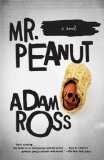
 Book Reviewed by:
The beginning of Adam Ross's first novel, Mr. Peanut, is extraordinarily alluring. He introduces the reader to David Pepin, a man who immediately falls in love with his future wife, Alice, in a college class on Alfred Hitchcock; but over the course of their thirteen-year marriage, David develops the morbid habit of fantasizing about her demise. The reader peers voyeuristically into his thoughts and sees what David never dares to speak out loud: Alice falling on the train tracks, Alice conveniently being struck by lightning, Alice crumpling under a fallen crane…
The elements of suspense are well set up and the hostile yet sexual nature of their relationship contributes to a sense of the bizarre. Alice's painful obesity is David's delight: "She was not his wife but a giant she-creature, an overlarge sex pet: his to screw, groom, and maintain". Tension builds, mean-spirited fights are subdued into sexual acts on a whim, and Ross raises questions about the relationship between love and anger. Are they intrinsically related? What silent and unseen process takes place in a marriage that creates so much hostility? And then Alice does die, found with traces of peanut meat--a food she is highly allergic to--in her mouth, and David is the main suspect.
Ross then introduces the characters of Detective Hastroll and Detective Sheppard, the two men sent to investigate Alice's murder, and begins a major and rather unexpected shift in the focus of the novel. Structured in segments that flash back and forth in time, Ross explores the equally miserable and non-communicative relationships between the detectives and their wives. The plotline of David and Alice all but vanishes for a good portion of the book, which in and of itself isn't a problem; it has the potential to serve as a MacGuffin, which Ross informs us "is what gets the story rolling but then fades in importance after it's introduced". However, in order for this device to be effective, a stronger idea should take the original plotline's place and lead the reader away from what was once so important, which does not seem to happen in Mr. Peanut. Instead, his characters slide into stereotypical gender roles (both the women and the men) that don't serve a larger purpose, and the relationships between all three couples devolve into overly dramatic, reactionary roles. While funny at first, the lack of communication between characters becomes frustrating to the reader, and few of his characters are ever asked to take responsibility for their actions. Ross incorporates the real-life story of Sam Sheppard who in 1954 was convicted of murdering his pregnant wife Marilyn and was later acquitted but, again, the limited character development prevents him from fully tapping the wealth (and the thrill) of that resource.
However, Ross successfully encourages readers to find parallels in the three couples' situations by weaving similar details throughout each story line. His use of description, particularly his sense of place (whether in New York, Hawaii or Ohio) transports readers and allows the setting to contribute to the telling of the story. And his attention to descriptive detail creates vivid images that stay with the reader. The end of Mr. Peanut starts to pick up, and the information given about Alfred Hitchcock explains some of the structural choices that the author makes, though it feels like the reader is waiting alongside him to figure out the ending. However, once he gets there, it is quite stirring, and motivates readers to start the book all over again.
Though I don't think that Mr. Peanut is a thorough examination of the nature of marriage or relationships, I do believe that Ross is attempting something deeper with this novel. The underlying themes are engaging (if not a little controversial), and his work invites discussion. I waiver between recommending this book and not, but I think that if you take the time to consider it, especially if you have the commitment to read it a second time, there are many interesting conversations to be had.
 This review was originally published in July 2010, and has been updated for the
April 2011 paperback release.
Click here to go to this issue.
This review was originally published in July 2010, and has been updated for the
April 2011 paperback release.
Click here to go to this issue.
When asked in an interview if there was any particular event that inspired Mr. Peanut, Adam Ross responded that: "In 1995, my father told me the strangest, most suspicious story about my cousin, who had severe peanut allergies and was also morbidly obese. According to her husband, he arrived home to find her sitting at the kitchen table with a plate of peanuts in front of her, and upon seeing him she stuffed a handful into her mouth and then went into anaphylatic shock. Her last words to him were, 'Call 911.'" (read the interview)
It may seem strange that eating something as tiny as a peanut could cause a violent allergic reaction strong enough to kill a person, however, Ross does not exaggerate the severity of what is known as anaphylaxis. According to the Mayo Clinic, "Anaphylaxis is a severe, potentially life-threatening allergic reaction. It can occur within seconds or minutes of exposure to something you're allergic to, such as the venom from a bee sting or a peanut. The flood of chemicals released by your immune system during anaphylaxis can cause you to go into shock; your blood pressure drops suddenly and your airways narrow, blocking normal breathing." Simply stated, it is an allergic reaction that affects the whole body and, if left untreated, can cause hives, itchiness, confusion, dizziness, cardiac arrest and even failure of the respiratory system. When mixed with the dark creativity of Adam Ross, the symptoms can be particularly gruesome: "Her skin was discolored – a violet hue of thundercloud, of fresh bruise—and her lips were grossly swollen, pink as intestine and distended as slugs".
Under normal circumstances, when a foreign substance (like a virus or bacterium) is introduced into a healthy body, the immune system produces antibodies that attack that substance. This is usually a good thing. But sometimes after an initial, "sensitizing" exposure to an allergen, the immune system can "overreact to substances that shouldn't cause an allergic reaction. When this occurs, your immune system sets off a chemical chain reaction" leading to even more allergy symptoms.
In order to suspend the potentially fatal symptoms, a shot of epinephrine can be injected into the person's thigh (as prescribed by doctors). Epinephrine (commonly found in the form of an EpiPen® and better known as adrenaline, the "fight or flight" hormone) is "the principal blood-pressure raising hormone secreted by the adrenal medulla and is used medicinally especially as a heart stimulant." The hormone causes the heart to pump faster, which increases blood pressure, opens airways and in many fortunate cases, saves lives.
Interesting link: The Children's Hospital Boston answers the much asked questions: Are allergies, especially to peanuts, on the rise? If so, why?
This review was originally published in July 2010, and has been updated for the
April 2011 paperback release.
Click here to go to this issue.
Your guide toexceptional books
BookBrowse seeks out and recommends the best in contemporary fiction and nonfiction—books that not only engage and entertain but also deepen our understanding of ourselves and the world around us.
