
-
Your next favorite book
is waiting.
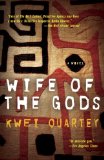
A Novel
by Kwei Quartey Book Reviewed by:
Kwei Quartey's first novel, Wife of the Gods, is a
dark, edgy mystery that's almost gritty enough to be considered noir. The book
is a marvelous detective procedural; its complex plot includes a plethora of
suspects and clues that will keep readers guessing the murderer's identity until
the inevitable confrontation at the book's climax. The main character,
Detective Inspector Darko Dawson, relies on deduction and observation to solve
the crime at the heart of the book. There's no room for guesswork or
coincidence in this novel; it remains eminently logical until its very
satisfying conclusion.
Ghana is a country in the midst of rapid change, and Quartey takes full
advantage of the friction caused by this change to add another, deeper layer to
Wife of the Gods. The conflict between the old and the new is a constant
theme running throughout the book and a source of dramatic tension between its
characters. Social commentary is added to the basic mystery format of the novel
with great success, resulting in a book that is more than your run-of-the-mill
whodunit.
The author also creates a perfect sense of place, whether the action is in
Ghana's capital city Accra or in its countryside. Instead of establishing this
ambiance with long paragraphs of description he weaves the
surroundings into the narrative's action and dialog. The exotic locale functions
as a colorful backdrop, adding interest without allowing the atmosphere to
overwhelm or drag down the plot.
There are aspects of the book that will keep many readers from fully enjoying
it. Its major failing is its relatively unlikable main character. Sometimes
you can encounter a figure in literature who breaks all the rules, and you find
yourself rooting for him in spite of it (or even because of it). Such is not
the case with Darko Dawson. Throughout the narrative he comes off as an
arrogant bully who uses his position to intimidate or harass others. He's also
an unrepentant marijuana smoker who knows the drug is illegal yet chooses to
disregard the law. His almost preternatural investigative ability is not quite
adequate to mitigate all the bad behavior that goes along with it.
Quartey's ability to create three-dimensional characters is also somewhat
inconsistent. Dawson is very richly drawn, and Quartey has gone to great
lengths to help his readers understand this multi-faceted character. There are
others here who are also nicely realized, but there are just as many who are
utterly unremarkable, unnecessarily falling into a banal, formulaic mold. In
addition, there are a number of excessively violent scenes scattered throughout
the novel. While I'm not generally disturbed by brutality, there does have to
be a reason for it; it has to make sense within the context of the plot - but at
times, these scenes come across as overly gratuitous.
Wife of the Gods is an excellent debut, and the series shows a lot of
promise; however, the comparison that some have made to The No. 1
Ladies' Detective series is misleading. Other than that they're both
character-driven mysteries set in Africa, the books have very little in common.
Wife of the Gods is a fine novel but it lacks the charm of the Alexander
McCall Smith books (think Dashiell Hammett as opposed to Agatha Christie).
Fans of the hardboiled mystery genre will undoubtedly want to add this one to
their lists. In addition, book groups that can overlook the novel's flaws will
find ample topics for conversation beyond its basic plot.
 This review was originally published in August 2009, and has been updated for the
August 2010 paperback release.
Click here to go to this issue.
This review was originally published in August 2009, and has been updated for the
August 2010 paperback release.
Click here to go to this issue.
Wife of the Gods refers to a practice in Ghana known as trokosi. A trokosi is a young girl who is given to the village priest, also known as a fetish priest, to atone for a perceived sin committed by a family member; the custom is basically a form of sanctioned slavery. It is practiced primarily in the Volta region of southeast Ghana by members of the Ewe tribe, but also in parts of Benin, Nigeria and Togo, where it is known as voodoosi or vudusi. It is believed the practice began in Togo and Benin as a war ritual in the 1600s. Before combat, warriors
would offer women to the war gods in exchange for victory and a safe homecoming.
The trokosi tradition is part of the traditional fetish belief system, in which gods or spirits reside in ritual objects and in the shrine priests. The priests are considered very powerful, able to communicate directly with the gods and spirits, and even capable of determining life and death. Followers believe that the gods will punish sin by killing members of the offender's family. To avoid the wrath of the spirits, the fetish priest may instruct the family to provide a very young virgin girl (generally eight to fifteen years old, but sometimes younger) to the shrine as a slave to the gods. The girl, whose consent is not sought, will then serve the priest and shrine for three to five years or, if the crime is considered severe enough, for life.
Trokosis are considered brides of the shrine's god, but in practice they are concubines and domestic slaves of the priest, and have no rights. They
generally work long hours of manual labor, such as farming or weaving and
selling mats, with all proceeds going to support the priest and the shrine.
Most trokosis are systematically abused, both physically and sexually, and are generally denied education and basic health services. The families of the trokosis are required to pay for the upkeep of their enslaved children and provide maintenance for any children born to them; the children, in turn, belong to the priest as
slaves and are known as trokosiviwo. A trokosi who is caught trying to escape is forcibly returned to the shrine from which she fled. In most cases, if she successfully escapes, or dies, another female child from the same family must replace her. If the priest dies, the trokosi is passed on to his successor. Those girls who are released are shunned, as it is believed they will bring misfortune on those who harbor them.
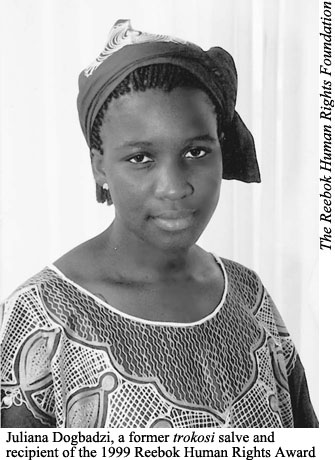 The practice was outlawed in Ghana in 1998, with a minimum sentence of three years in prison, and, due to the law and the work of advocates such as Juliana Dogbadzi, it is believed that the number of trokosi is declining. Still, it continues without much opposition from law enforcement, with approximately 5000 trokosi still enslaved in Ghana. Defenders of the practice see it as an effective means of
keeping people from committing crimes. The greatest resistance to its
abolishment comes from those who view the change as an attack on their religious
beliefs and traditional way of life. Aid groups such as International Needs Ghana (who freed Juliana Dogbadzi) are helping to free and rehabilitate trokosi, providing education and vocational training. ING has freed several thousand trokosi since the group was formed in 1995.
The practice was outlawed in Ghana in 1998, with a minimum sentence of three years in prison, and, due to the law and the work of advocates such as Juliana Dogbadzi, it is believed that the number of trokosi is declining. Still, it continues without much opposition from law enforcement, with approximately 5000 trokosi still enslaved in Ghana. Defenders of the practice see it as an effective means of
keeping people from committing crimes. The greatest resistance to its
abolishment comes from those who view the change as an attack on their religious
beliefs and traditional way of life. Aid groups such as International Needs Ghana (who freed Juliana Dogbadzi) are helping to free and rehabilitate trokosi, providing education and vocational training. ING has freed several thousand trokosi since the group was formed in 1995.
More information:
United Nations
World Wide Religious News
Washington College of Law
Photo detail: Juliana Dogbadzi, a former trokosi slave and recipient of the 1999 Reebok Human Rights Award.
This review was originally published in August 2009, and has been updated for the
August 2010 paperback release.
Click here to go to this issue.
Your guide toexceptional books
BookBrowse seeks out and recommends the best in contemporary fiction and nonfiction—books that not only engage and entertain but also deepen our understanding of ourselves and the world around us.
