
-
Your next favorite book
is waiting.
 Book Reviewed by:
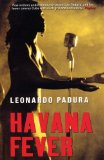
Leonardo Padura's latest novel, Havana Fever, is a cold-case
investigation into the disappearance of a beautiful bolero singer forty-seven
years prior to current events. Padura does a wonderful job of crafting the
mystery. Clues are revealed gradually, building suspense and ultimately leading
the reader to its dark but satisfying conclusion. Purely as a mystery novel,
Havana Fever is top-notch and a terrific example of modern noir.
The real highlight of the book, though, is Padura's rich and evocative
writing style. He brilliantly conjures up both the smoky nightclubs of Batista's
Havana in the 1950s and the city's present poverty, comparing and contrasting
the two different eras. Both are dark, gritty and rife with corruption. The
modern scenes in particular are cloaked in an oppressive, unrelenting gloom that
doesn't begin to lift until the book's final pages. The writing is almost poetic
at times. This is one of those novels that one simply can't rush through; it
must be savored.
"Not worried why he was doing so – and not really interested in finding out - perhaps driven by a mixture of alcohol and the persistent allure of certain phantoms and fascinations, Conde hailed a taxi going in the opposite direction to his house and asked the driver to take him to the corner of Twenty-Third and L, or any other street corner that might encompass the same evocative ciphers. He was pleased to see that even at that late, late, hour of the night, the fast-beating heart of the city was still packed with spaced-out youths and adults trawling for illicit offerings … Gays of every tendency and category, rockers with no stage or music, savage hunters and huntresses of foreigners and dollars, bored birds of the night with one, two and even three hidden agendas seemed anchored to that spot, not fearing the imminent dawn, as if hoping something out of the blue might drag them down the street, perhaps out to sea, or maybe up into the sky."
Havana Fever is the fifth novel to feature Mario Conde, a now-retired
police inspector. Often, even sequels that stand well on their own leave the
reader feeling like they've missed something, that they'd understand the novel
better had they read the previous books first. This is not the case with
Havana Fever, which is self-contained and relatively independent of the
previous entries in the series.
Padura's only misstep is the story's pacing. The mystery and its
investigation don't really get rolling until the novel's second half. While much
of the narrative is necessary to really envelope the reader in the book's
atmosphere, there's a lot here that feels superfluous and the exceptionally slow
beginning may be enough to keep some readers from progressing beyond
the first few chapters. In spite of this, I still rate Havana Fever a "5"
out of 5 stars - readers who persist to the book's end will find it well
worth their time. It's sure to appeal both to those who enjoy high-quality
mysteries and those who are interested in reading about life in the steamy
barrios of Havana past and present.
 This review is from the May 21, 2009 issue of BookBrowse Recommends.
Click here to go to this issue.
This review is from the May 21, 2009 issue of BookBrowse Recommends.
Click here to go to this issue.
The Cuban bolero is the first internationally recognized music form to originate in Cuba. Closely related to trovador songs and habaneras, boleros are songs of romance, featuring themes of love and heartbreak. The music is most often slow, sensual and deeply romantic.
The Cuban bolero
is often confused with the Spanish bolero. The two forms arose independently,
apparently neither influencing the other. Whereas the Spanish bolero is always in 3/4 time, the Cuban version is in 2/4 or 4/4. In addition, the Cuban version is heavily influenced by African-based rhythms. The two styles are danced differently, as well; the Spanish bolero has couples dancing apart, while the Cuban bolero is danced by couples who are touching.
It is believed that the first Cuban bolero was composed by Jose Pepe Sanchez, a natural musician with no training or ability to read music. Much of what he wrote is lost, but some of his compositions were fortunately recorded for posterity by others who recognized the songs as revolutionary. The first known bolero is Sanchez's
Tristezas
("Sadness")
composed in 1883.
The form evolved over time as others adopted it. Miguel Matamoros became one
of the first internationally known bolero composers. He toured with his group,
Trio Matamoros, throughout Latin America and Europe during the 1940s. His
Lágrimas negras
("Black Tears")
is still widely performed. Another important figure, lyricist Adolfo Utrera,
started the trend of adapting well-known poetry for the bolero. His
Aquellos
Ojos Verdes ("Green Eyes") with music composed by Nilo Menéndez,
was recorded by Nat King Cole, a
testament to its popularity (lyrics with translation).
The bolero disappeared from Cuba after the Cuban Revolution in 1959, as the
clubs where the bolero was sung were closed down. Cuban music has enjoyed a
revival in recent years, however, in part due to the Academy Award-nominated documentary
Buena Vista Social Club (1999)
which featured music and
interviews with once-famous musicians, some of whom were in their 90s at the
time of the taping. The Grammy-winning soundtrack includes music from
Ibrahim
Ferrer, considered the last of the great bolero singers from pre-Castro
Cuba. Ferrer continued to tour until his
death in 2005 at the age of 78. His posthumously-released album, Mi Sueño, was devoted entirely to the Cuban bolero.
This review is from the May 21, 2009 issue of BookBrowse Recommends.
Click here to go to this issue.
Your guide toexceptional books
BookBrowse seeks out and recommends the best in contemporary fiction and nonfiction—books that not only engage and entertain but also deepen our understanding of ourselves and the world around us.
