
-
Your next favorite book
is waiting.
 Book Reviewed by:
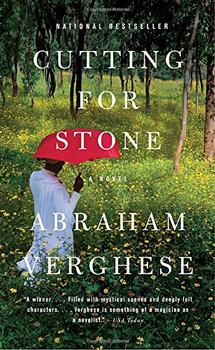
As a bookseller, I live for novels like Cutting for Stone - big, fat,
beautiful novels as beguiling and enchanting as babies, as wise and as generous
as old sages. They are the bread-and-butter novels I can't wait to sell, the
books people talk about all year long, the books they buy for their sisters and
fathers, the book they press into the hands of friends with insistent, almost
violent exhortations. Read this. You will love it. You HAVE to read this
book. I talk about these books in the plural, as if there are scores of
them, but while their iconic status is great, their numbers are few. They don't
come along every season, or even every year, but I wait for them, hoping every
third book I read will be the one, that one single book that makes my heart leap
every time I know someone else is going to get to read it, too. And so, let me
be the first, but certainly not the last to tell you: Read this book. You
will love it.
Abraham Verghese's gorgeous prose forms an intoxicating synergy with his
sweeping, twining plot, and I was hooked from the very first page. I raced
through the remaining 500, and then couldn't bear to turn the last few. The
story begins like a sudden storm and channels into a swift current that's
difficult to emerge from: I stayed up through the wee hours, and polished off
this hefty book in just two long nights.
Cutting for Stone is about all the giant things: family, love, war, home,
land, life, death, exile, brotherhood, betrayal, and faith. There are lovable
mothers and fathers, telepathic twins, mysterious priests, brave nuns,
despicable generals, weak giants, miracles, rock and roll, sex, food, dusty dirt
roads and city streets, and countless operating rooms. Verghese's reach is vast,
but the intimacy of his characters keeps the novel close, writing about the big
things through tiny, intimate, emotional moments that drive to the heart of all
that we find most impossible to describe.
When I originally reviewed this book last year, a few weeks before it published, I was bold enough to claim that it would go on to be named one of the best novels of 2009, not just by myself, but possibly by every book review's top-ten list, shortlisted for all of the major book awards, and decorated with Oprah's book club sticker. I may have failed at the prediction game, but I'll surely stick to the recommending game: Literally dozens of readers have returned to my bookstore (some just two days later!) to thank me for recommending Cutting for Stone, and to buy copies for their friends. And it was voted by our very own BookBrowse readers one of the top 3 books of 2009. I'll take those votes over Oprah's any day!
 This review was originally published in February 2009, and has been updated for the
January 2010 paperback release.
Click here to go to this issue.
This review was originally published in February 2009, and has been updated for the
January 2010 paperback release.
Click here to go to this issue.
The title, Cutting for Stone, refers to a line in the Hippocratic Oath,
and to the last name of the three main characters, all of them surgeons. As
Abraham Verghese quotes it, the line from the Oath reads "I will not cut for
stone, even for patients in whom the disease is manifest. I will leave this
operation to be performed by practitioners, specialists in this art." While this
line refers specifically to surgery for bladder stones (which were quite
prevalent in the 4th century BC), it's also a directive against surgery of all
kinds. Ancient Greek physicians did not practice surgery, instead referring
their patients to trained surgeons. Surgery was then considered a secondary
skill, and surgeons were not trained in theoretical medicine as physicians were.
Dissection was forbidden, and without precautions against contamination or the
ability to anaesthetize, surgery was almost always deadly and certainly
unbearably painful.
It's believed that The Hippocratic Oath was written in the 4th century BC,
influenced by the doctrines of Pythagorean philosophy. It probably has several
authors, one of which may or may not be Hippocrates. Considered the father of
modern medicine, Hippocrates is credited with separating medicine from magic,
religion and superstition, and planting it firmly in a systematic and rational
school of thought. His thoughts and writings still form the basis of modern
medicine's ethical tenets, and continue to be adapted and debated as science and
medicine progress.
First do no harm is probably the most famous tenet most often quoted from
The Hippocratic Oath - but erroneously so. The phrase doesn't appear in any of
the many translations or adaptations of the Oath, and is likely adapted from a
phrase in Hippocrates'
Epidemics, though its exact origins are often debated.
Medical schools around the world recite oaths upon graduation, most of them
based on The Hippocratic Oath. Over time, schools have adapted and modernized
the oath, but the idea remains the same: to bind physicians to the art and moral
responsibilities of their practice and their patients, and to affirm a
commitment that the care of their patients is their first consideration.
Abraham Verghese is a surgeon, and Professor for the Theory and
Practice of Medicine at Stanford, and every year he joins his graduates as they
stand and take the oath. In an interview he remarks, "When the new graduates
take stand and take the oath, all the physicians in the room are invited to rise
and retake the oath. You see many physician parents and physician siblings
standing as their son or daughter or brother or sister takes the oath. It chokes
me up every time. Not only am I renewing my faith, but I am bursting with pride
in seeing my students graduate."
This review was originally published in February 2009, and has been updated for the
January 2010 paperback release.
Click here to go to this issue.
Your guide toexceptional books
BookBrowse seeks out and recommends the best in contemporary fiction and nonfiction—books that not only engage and entertain but also deepen our understanding of ourselves and the world around us.
