Summary | Excerpt | Reading Guide | Reviews | Readalikes | Genres & Themes | Author Bio
Critics' Opinion:
Readers' Opinion:
First Published:
May 2000, 400 pages
Paperback:
Oct 2001, 384 pages

IT BEGAN EERILY, IN THE NIGHT
A dark Pacific sky cut by hellish red comets, rising and descending in clusters of three, each descent followed by a distant explosion. Sleepless young Marines stood watching atop their LST's, thirteen miles offshore.
The date was February 19, 1945.
Over 70,000 Marines-the 3rd, 4th, and 5th Divisions-massed in the ships that had finally arrived at Island X, ready to hit the narrow two-mile beach in successive phases. Awaiting them, dug into the island and out of sight, 22,000 elite Japanese-the Rising Sun-who understood that they were to die.
The first wave of Marines and armored vehicles hit the shores. The vehicles bogged down immediately in the absorbent maw. The troops moved around them and began their cautious climb, unshielded, up the terraces.
It was all so quiet at first.
Smoke and earsplitting noise suddenly filled the universe. The almost unnoticed blockhouses on the flat ground facing the ocean began raking the exposed troops with machine-gun bullets. But the real firestorm erupted from the mountain, from Suribachi: mortars, heavy artillery shells, and machine-gun rounds ripped into the stunned Americans. Two thousand hidden Japanese were gunning them down with everything from rifles to coastal defense guns.
There was no protection. Now the mortars and bullets were tearing in from all over the island: General Kuribayashi had designed an elaborate cross fire from other units to the north. Entire platoons were engulfed in fireballs. Boys clawed frantically at the soft ash, trying to dig holes, but the ash filled in each swipe of the hand or shovel. Heavy rounds sent jeeps and armored tractors spinning into the air in fragments. Some Marines hit by these rounds were not just killed; their bodies ceased to exist.
More than Marines. "I was watching an amtrac to the side of us as we went in," Robert Leader remembers. "Then there was this enormous blast and it disappeared. I looked for wreckage and survivors, but nothing. I couldn't believe it. Everything just vaporized."
The boys on the beach scrambled forward. It was like walking through a pile of shell corn, said one. Like climbing in talcum powder said another. Like a bin of wheat. Like deep snow.
Advancing tanks crushed those of the wounded who could not get out of the way. Others, unwounded, were shoved to their deaths by those behind them. "More and more boats kept landing on with more boys coming onto the beach," said Guy Castorini. "You just had to push the guy in front of you. It was like pushing him to his death."
The shock of actual combat triggered bizarre thoughts and behavior. Jim Buchanan, who had hoped there would be some Japanese left for him, became indignant when he realized what was happening. "Did you see those Japanese firing at us?" he screamed to the guy next to him. "No," the leatherneck answered, deadpan. "Did you shoot them?" "Gee, no," Buchanan replied. "That didn't occur to me. I've never been shot at before."
Phil Ward, leaping out of the amtrac that also contained my father, had a similar epiphany: "We'd had live ammo training in Hawaii, so I was used to the sound of bullets, but suddenly I realized why this was different. 'God-damn!' I said. 'These people are shooting at me!'"
Annihilation seemed possible in the hideous first minutes. Radio transmissions back to command quarters aboard the ship raised that specter: "Catching all hell from the quarry! Heavy mortar and machine-gun fire!" "Taking heavy casualties and can't move for the moment!" "Mortars killing us!" "All units pinned down by artillery and mortars!" "Casualties heavy! Need tank support fast to move anywhere!" "Taking heavy fire and forward movement stopped! Machine-gun and artillery fire heaviest ever seen!"
But it was even worse than the transmissions indicated. No one was out of danger. A five-foot-three Associated Press photographer named Joe Rosenthal, landing with the 4th Division, ran for his life through the hail of bullets. Later he would declare that "not getting hit was like running through rain and not getting wet." Corpsman Greg Emory, crawling on all fours, glanced back at a landing craft coming in; the ramp dropped down; machine-gun fire ripped the interior. Boys fell dead atop each other as they stumbled off the ramp.
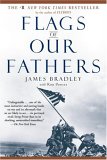
Excerpted from Flags of Our Fathers by James Bradley with Ron Powers Copyright© 2000 by James Bradley with Ron Powers. Excerpted by permission of Bantam, a division of Random House, Inc. All rights reserved. No part of this excerpt may be reproduced or reprinted without permission in writing from the publisher.





The House on Biscayne Bay
by Chanel Cleeton
As death stalks a gothic mansion in Miami, the lives of two women intertwine as the past and present collide.

The Flower Sisters
by Michelle Collins Anderson
From the new Fannie Flagg of the Ozarks, a richly-woven story of family, forgiveness, and reinvention.

The Funeral Cryer by Wenyan Lu
Debut novelist Wenyan Lu brings us this witty yet profound story about one woman's midlife reawakening in contemporary rural China.
Your guide toexceptional books
BookBrowse seeks out and recommends the best in contemporary fiction and nonfiction—books that not only engage and entertain but also deepen our understanding of ourselves and the world around us.