
-
Your next favorite book
is waiting.
Summary | Excerpt | Reviews | Readalikes | Genres & Themes | Author Bio
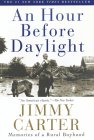
Memories of A Rural Boyhood
by Jimmy Carter
Like their father, the bishop's children were quite successful. His daughter, Fannie Hill, lived in Oklahoma, and her husband was the first black legislator in the state. (They supported me strongly when I ran for president.) One of his sons, Alvan, was a special friend of my mother, and attended one of the Ivy League universities -- Harvard, I think. In any case, on his visits home he always came to call on Mama. Representing a younger and more liberated generation, Alvan came to our front door, where Mother would welcome him and invite him onto the front porch or into the living room. Since it was not possible for my father to acknowledge this breach of Southern etiquette, he would just ignore the event altogether. So far as I know, he never confronted Mama about it.
Even before I was an adult and able to understand the difficulty of overcoming racial barriers, I looked on Bishop Johnson as an extraordinary example of success in life. He had come from a tiny rural place, set his sights high, obtained a good education, and then risen to the top of his chosen profession. Of no less importance to me, he retained his close ties with Archery and the people who lived there. I still go by his relatively modest grave on occasion, and wonder how much my own ambitions were kindled by these early impressions.
There were gross abuses of the "separate but equal" principles laid down by the U.S. Supreme Court in 1896 that prevailed at the time, but most people chose to ignore them. In the mid-1950s, almost two decades after I left home, the Atlanta newspapers and civil-rights leaders began to challenge these discriminatory practices, but most of the distinguished lawyers and respected religious leaders in the South defended them as justified under the U.S. Constitution and the mandates of God Almighty.
Despite some early New Deal efforts to provide "farm relief," the Depression years were marked by a sense of frustration and even despair in our region. Cotton sales were slow, even at the government-supported price of eight cents a pound. Uncertainties about the impending war in Europe had reduced this most important export market for our basic cash crop, and there was at least a full year's carryover stored in Southern warehouses. Furthermore, cotton production was moving to the Western states, where boll weevils were less prevalent, yields were greater, and mechanization and irrigation were much more advanced.
There was a rapid shift toward dependence on peanuts while I was growing up, and this was the crop that made the greatest impact on my life, both when I was a child and much later, when I returned home with a wife and family. At first, we had to depend for cash income on the small Spanish varieties, used as salted nuts and in candy bars, while growing the more prolific Runner type for hog feed on the farm. But the demand for both kinds increased when a third of all peanuts began to go into peanut butter as a popular food for urban consumers. This took place because of the innovative work of George Washington Carver, a black agricultural scientist who taught at Tuskegee Institute in Alabama and began a career with the U.S. Department of Agriculture in 1935.
Some basic and unalterable circumstances perpetuated our farm problems. From the time of the Civil War until after I became an adult, too many people struggled to make a living on the limited amount of productive farmland in our region. Despite the extreme rural poverty that prevailed at the time, Southern farm population increased by 1.3 million between 1930 and 1935, as desperate people lost their jobs in failing factories, left their urban homes, and eventually wound up in places like our community. The farm families I knew had to divide the available cropland into ever-smaller plots on which a husband, a wife, and their children could barely subsist, then averaging about thirty-five acres. (With more advanced machinery, grain farms in Kansas were then four times as large.)
Copyright © 2001 by Jimmy Carter





There are two kinds of light - the glow that illuminates, and the glare that obscures.
Click Here to find out who said this, as well as discovering other famous literary quotes!

Can you name the title?
Test your book knowledge with our daily trivia challenge!
Your guide toexceptional books
BookBrowse seeks out and recommends the best in contemporary fiction and nonfiction—books that not only engage and entertain but also deepen our understanding of ourselves and the world around us.


