Summary | Excerpt | Reviews | Beyond the Book | Readalikes | Genres & Themes | Author Bio

Critics' Opinion:
Readers' Opinion:
First Published:
Mar 2007, 408 pages
Paperback:
Dec 2008, 408 pages
 Book Reviewed by:
BookBrowse Review Team
Buy This Book

Another, less famous example of false causality occurred in New
York in 1956. A young physicist, Chen Ning Yang, and his colleague,
Tsung-Dao Lee, were in the habit of discussing apparent inconsistencies
involving newly recognized particles coming out of accelerators
while relaxing over a meal at a Chinese restaurant on 125th Street in
Manhattan frequented by faculty and students from Columbia University.
One day the solution that explained one of the basic forces in
the atom suddenly struck Yang, and within a year the two shared one
of the quickest Nobel Prizes (in Physics) ever awarded. After the
award was announced, the restaurant placed a notice in the window
proclaiming “Eat here, get Nobel Prize.”
Pathways of Creative Thought
Researchers and creative thinkers themselves generally describe three
pathways of thought that lead to creative insight: reason, intuition,
and imagination.
|
|||||||||
While reason governs most research endeavors, the most productive
of the three pathways is intuition. Even many logicians admit that
logic, concerned as it is with correctness and validity, does not foster
productive thinking. Einstein said, “The really valuable factor is intuition.
. . . There is no logical way to the discovery of these elemental
laws. There is only the way of intuition, which is helped by a feeling
for the order lying behind the appearance.”
The order lying behind the appearance: this is what so many of
the great discoveries in medicine have in common. Such intuition requires
asking questions that no one has asked before. Isidor Rabi, the
Nobel Prize–winning physicist, told of an early influence on his sense
of inquiry. When he returned home from grade school each day, his
mother would ask not “Did you learn anything today?” but “Did you
ask a good question today?”18 Gerald Edelman, a Nobel laureate in
medicine, affirms that “the asking of the question is the important
thing. . . . The idea is: can you ask the question in such a way as to
facilitate the answer? And I think really great scientists do that.” Intuition is not a vague impulse, not just a “hunch.” Rather, it is
a cognitive skill, a capability that involves making judgments based on
very little information. An understanding of the biological basis of
intuition — one of the most important new fields in psychology —
has been elaborated by recent brain-imaging studies. In young people
who are in the early stages of acquiring a new cognitive skill, the right
hemisphere of the brain is activated. But as efficient pattern-recognition
synthesis is acquired with increasing age, activation shifts to the left
hemisphere. Intuition, based upon long experience, results from the
development in the brain of neural networks upon which efficient pattern
recognition relies.20 The experience may come from deep in what
has been termed the “adaptive unconscious” and may be central to
creative thinking.
As for imagination, it incorporates, even within its linguistic
root, the concept of visual imagery; indeed, such words and phrases as
“insight” and “in the mind’s eye” are derived from it. Paul Ehrlich,
who won the Nobel Prize in Medicine in 1908 for his work on immunity,
had a special gift for mentally visualizing the three-dimensional
chemical structure of substances. “Benzene rings and structural formulae
disport themselves in space before my eyes. . . . Sometimes I am able
to foresee things recognized only much later by the disciples of systemic
chemistry.”22 Other scientists have displayed a similar sort of talent
leading to breakthroughs in understanding structures.
Excerpted from Happy Accidents by Morton Meyers, M.D. Copyright © 2007 by Morton Meyers, M.D. Excerpted by permission of Arcade Publishing. All rights reserved. No part of this excerpt may be reproduced or reprinted without permission in writing from the publisher.
The Flower Sisters
by Michelle Collins Anderson
From the new Fannie Flagg of the Ozarks, a richly-woven story of family, forgiveness, and reinvention.
The House on Biscayne Bay
by Chanel Cleeton
As death stalks a gothic mansion in Miami, the lives of two women intertwine as the past and present collide.
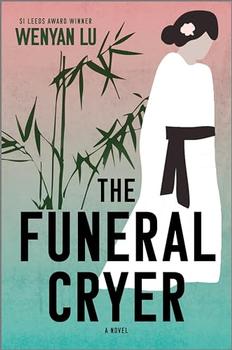
The Funeral Cryer by Wenyan Lu
Debut novelist Wenyan Lu brings us this witty yet profound story about one woman's midlife reawakening in contemporary rural China.
Your guide toexceptional books
BookBrowse seeks out and recommends the best in contemporary fiction and nonfiction—books that not only engage and entertain but also deepen our understanding of ourselves and the world around us.