Summary | Excerpt | Reviews | Beyond the Book | Readalikes | Genres & Themes | Author Bio
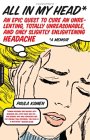
An Epic Quest to Cure an Unrelenting, Totally Unreasonable, and Only Slightly Enlightening Headache
by Paula Kamen
Critics' Opinion:
Readers' Opinion:
First Published:
Feb 2005, 351 pages
Paperback:
Apr 2006, 320 pages
 Book Reviewed by:
BookBrowse Review Team
Buy This Book

Telling our stories can also raise awareness of how far we-both
men and women-haven't come in actually treating chronic pain, especially the
most severe and frequent forms, despite significant strides in understanding its
neurochemistry and triggers. Popular media reports on pain, often in the form of
news-magazine cover stories, are often devoted to overpraising the latest
so-called wonder drug (read: "It's so new that we don't know its side
effects yet") as pain patients' savior of the day. Providing testimonials
are a carefully selected group of patients, very often fed to journalists by
pharmaceutical companies and the doctors interviewed. As a result, pain patients
who aren't cured by the latest "miracle discovery" or who can't solve
their pain through sheer gumption and force of will feel their already
debilitating sense of isolation and self-doubt compounded.
In 1979, in that poster board display, I summarized the major
treatments of pain of that era: acupuncture, drugs, and biofeedback. Today, more
than twenty-five years later, despite some notable gains, this is still the
case. Although modern medicine allows us to replace severed limbs and excise the
most precariously placed brain tumors, our effectiveness in treating chronic
pain and many other disabling invisible illnesses has not significantly
advanced. In fact, in reality, we are hardly better off than in 1979 B.C.-when
the people whom we know today as the leather-faced mummies in museums walked the
earth, all too conscious of their humanity because of their crushing toothaches,
their shingles, their labor pains, their cluster headaches.
When I was twelve and unburdened by chronic pain, I couldn't yet
describe the full experience, neither physically, emotionally, nor spiritually.
This wasn't possible until years later, when I was twice that age and one
continuous headache gradually started to define itself and then take nonstop
residence behind my left eye and in my left temple, like a bad, inconsiderate
roommate who never leaves the apartment to give you peace. I then found myself
starting a trial, as well as going on trial, as a chronic pain patient. I was in
the odd position of playing for real that board game that I had devised so many
years ago, following another circuitous, unpredictable, and ultimately
(somewhat) enlightening path.
BookBrowse Note:
The statistics below are not from a particular chapter of All In My Head,
but were provided by the publisher as background information for potential
interviewers. The information is included here because, firstly, it
contains a lot of interesting facts and stats, and secondly it provides a useful
overview of the book itself.
The Numbers
Headaches
Chronic Daily Headache (headache at least 15 days/month
lasting at least 4 hours per episode)
From the preface to All In My Head, pages ix - xvi. Copyright Paula Kamen 2005. All rights reserved. No part of this book maybe reproduced without written permission from the publisher, Da Capo Press.




The Flower Sisters
by Michelle Collins Anderson
From the new Fannie Flagg of the Ozarks, a richly-woven story of family, forgiveness, and reinvention.

The House on Biscayne Bay
by Chanel Cleeton
As death stalks a gothic mansion in Miami, the lives of two women intertwine as the past and present collide.

The Funeral Cryer by Wenyan Lu
Debut novelist Wenyan Lu brings us this witty yet profound story about one woman's midlife reawakening in contemporary rural China.
Your guide toexceptional books
BookBrowse seeks out and recommends the best in contemporary fiction and nonfiction—books that not only engage and entertain but also deepen our understanding of ourselves and the world around us.