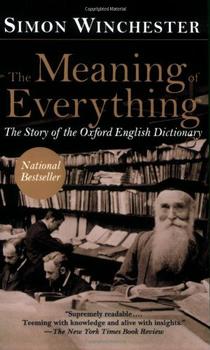
Summary | Excerpt | Reviews | Readalikes | Genres & Themes | Author Bio
Critics' Opinion:
Readers' Opinion:
First Published:
Sep 2003, 256 pages
Paperback:
Oct 2004, 286 pages

Chapter I
Taking the Measure of It All
The English Dictionary, like the English Constitution, is the creation of no one man, and of no one age; it is a growth that has slowly developed itself adown the ages; its beginnings lie far back in times almost pre-historic. And these beginnings themselves, although the English Dictionary of today is lineally developed from them, were neither Dictionaries, nor even English.
- (James Murray, 'The Evolution of English Lexicography', 1900)
I. The Making
The English language - so vast, so sprawling, so wonderfully unwieldy, so subtle, and now in its never-ending fullness so undeniably magnificent - is in its essence the language of invasion. It was always bound to be so: geology and oceanography saw to it that the British Isles, since long before their populated time, were indeed almost always islands, and the ancestors of all who ever lived there first arrived by sea from beyond, bringing with them their customs, their looks - and their languages.
Of the gigantic amassment of words that make up the stock of the English language - the 44,825 that were discerned and discovered and catalogued in time for publication in 1928 of the first edition of the great Dictionary that is the subject of this story, the hundreds of thousands that had already been listed in Webster's wildly successful American dictionary, together with the scores of thousands that have been found or created in the decades since - the huge majority were conceived or otherwise made whole through the good offices of outsiders, visitors, or invaders.
Of those settlers about whose language we know something, the Celts - who came from gloomy forests and swamps in the upper valleys of the Danube - are generally counted as the first. They swarmed westwards across Europe some time during the Bronze Age; about 500 years before the birth of Christ they settled themselves, among other places, on the cliff-protected fortress of the rainy and foggy islands that lay off the continent's north-western shores. Those that settled in the generally more climatically benign southern half of the islands called themselves Britons--a name from which in time was to come the British Isles, and, indeed, Britain.
Here they created for themselves some kind of home and civilization, and they spoke languages that have left precious little trace on modern English, but which are preserved as the basis of such Welsh, Cornish, Scots Gaelic, and Irish as is still spoken today. There are a very few words - brock, for badger being one, combe, meaning a deep valley, and which appears in some English village names and in contemporary Welsh, another, torr, a mountain peak - which seem to have survived, at least among those who speak preciously or somewhat pedantically today. Some Celtic place names - London, Dover, and Kent, the rivers Thames, Exe, and Wye - exist today as well. Late in their history the Celts borrowed - probably; there is still debate among etymologists - a small number of words, such as assen for ass and maybe the word cross, from visiting Christian missionaries. But generally their linguistic role in the speech and writings of future English generations was fairly minimal; shortly after the beginning of the Christian era any idea that Celtic British might have a long-term linguistic influence was brushed aside: thousands of well-armoured and tactically adept legionnaires swept ashore and, before the language had the chance properly to take hold, promptly placed all south Britain under the colonial suzerainty of Rome.
The Romans remained in Britain for the next 400 years. By the time they left in AD 409, to attend (in vain) to the fate of their fast-crumbling Western Empire in Europe (Rome would be sacked by the Huns a year later, and the Empire would die after only seventy more), Britain had been under their military and cultural influence for very nearly the same amount of time as separates us today from the Renaissance. The Romans did leave something of an imperial linguistic legacy: by the time the next flotilla of invaders reached the shingle beaches of what is now East Anglia, a language had already taken root in the southern isles of the British archipelago that was a mixture, on the one hand, of the early Celtic dialects (or British, as some might call it) and, on the other, of that language which many English schoolchildren would recognize all too glumly as that still used today in texts like Caesar's Civil War, Book Two.
Copyright Simon Winchester 2003. All rights reserved. No part of this book may be reproduced without written permission from the publisher, Oxford University Press.



The Flower Sisters
by Michelle Collins Anderson
From the new Fannie Flagg of the Ozarks, a richly-woven story of family, forgiveness, and reinvention.

The House on Biscayne Bay
by Chanel Cleeton
As death stalks a gothic mansion in Miami, the lives of two women intertwine as the past and present collide.

The Funeral Cryer by Wenyan Lu
Debut novelist Wenyan Lu brings us this witty yet profound story about one woman's midlife reawakening in contemporary rural China.
Your guide toexceptional books
BookBrowse seeks out and recommends the best in contemporary fiction and nonfiction—books that not only engage and entertain but also deepen our understanding of ourselves and the world around us.