return to home  
Join   |  Gift   |  Member Login   |  Library Login
BookBrowse Mobile
Follow Us: 
    Book Summary and Reviews

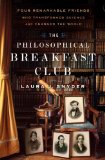
The Philosophical Breakfast Club: Book summary and reviews of The Philosophical Breakfast Club by Laura J. Snyder

The Philosophical Breakfast Club

The Philosophical Breakfast Club
Four Remarkable Friends Who Transformed Science and Changed the World
by Laura J. Snyder
Published in USA Feb 2011,
448 pages.

Publication information


Critics' Opinion: 
Readers' Rating: 
About BookBrowse Rankings
Share: 
Buy This Book

The Philosophical Breakfast Club Summary

The Philosophical Breakfast Club is a rich work of biography and history in the tradition of Richard Holmes's bestselling The Age of Wonder.  Laura Snyder, an expert on Victorian science and culture, has written what is, in a sense, a sequel to Holmes's book, showing how a small group of men working in the early nineteenth century made a number of significant discoveries and, together, brought about a scientific revolution.

The four principles--Charles Babbage, John Herschel, William Whewell, and Richard Jones--are relatively unknown today though their signal achievements are remembered. Charles Babbage was a mathematical genius who invented the modern computer; John Herschel mapped the Southern Hemisphere and contributed to the invention of photography; William Whewell not only invented the word "scientist" but also found the fields of crystallography, mathematical economics and the science of tides; Richard Jones shaped the science of economics. The four principals of the "Breakfast Club" met as undergraduates at the University of Cambridge in 1812. The Philosophical Breakfast Club tells the story of these extraordinary men, exposing the political passions, religious impulses, friendships, rivalries, and love of knowledge—and power—that drove them.

Drawing upon the voluminous correspondence between the four men over the fifty years of their campaign, the book shows how friendship worked to spur the men on to greater accomplishments, and how it enabled them to help create the modern world, in which science plays a starring role. 

The Philosophical Breakfast Club Reviews

"Each of the four figures is a worthy subject in his own right, and by combining their stories Snyder provides the right balance of biography and science." - Publishers Weekly

"The author skillfully weaves together the lives of her four principals with the science of their day." - Kirkus Reviews

"Snyder weaves a compelling, if occasionally meandering, tale of the transformation of science in the Victorian era....she leaves the reader with an inspiring sense of just how influential these men were in shaping our world and laying the foundation for major science and technological changes, especially in three different areas." - The Daily Beast

"In The Philosophical Breakfast Club she draws an endearing - almost domestic - picture of four scientific titans, and shows how - through their very 'clubbability' - they created the scientific basis on which the modern world stands." - Judith Flanders, author of Inside the Victorian Home

"The four busy geniuses who inhabit Laura Snyder's wonderfully engaging book did not invent friendship or science, but by combining those pastimes in their 'philosophical breakfasts,' they managed to invent much else, from the very word 'scientist' to versions of the computer and the camera." - Joyce E. Chaplin, James Duncan Phillips Professor of History, Harvard University

"By tracing the careers of the four members of the Philosophical Breakfast Club, Laura Snyder has found a wonderful way not just to tell the great stories of 19th-century science, but to bring them vividly to life." - Tom Standage, author of A History of the World in 6 Glasses

"In this elegantly written book, Snyder has brought to life four of the most important British scientists of the first half of the nineteenth century…[She] tracks the intertwined lives of these four figures...while casting light on every facet of British science during their lifetime." - Bernard Lightman, Professor of Humanities and Director, Institute of Science and Technology Studies, York University

"Who would not want to be invited to breakfast with the young philosophers and scientists that Laura Snyder portrays so vividly and with searching imagination?... Science and the personalities who created it spring to life in Snyder's compelling biographical depictions." - Robert J. Richards, Morris Fishbein Professor of the History of Science, University of Chicago

The information about The Philosophical Breakfast Club shown above was first featured in "The BookBrowse Review" - BookBrowse's online-magazine that keeps our members abreast of notable and high-profile books publishing in the coming weeks. In most cases, the reviews are necessarily limited to those that were available to us ahead of publication. If you are the publisher or author of this book and feel that the reviews shown do not properly reflect the range of media opinion now available, please send us a message with the mainstream media reviews that you would like to see added.

The Philosophical Breakfast Club Reader Reviews

Write your own review

Rated 3 of 5 of 5 by Karen S. (Minneapolis, MN)
The Philosophical Breakfast Club
This was a tough read for me, and that is disappointing because at first glance, it seems it would be a fascinating read. A bit too academic for my tastes.

Rated 5 of 5 of 5 by Therese X. (CALERA, AL)
A Great Visit with the Philosophical Breakfast Club
In June, 1833, the British Association for the Advancement of Science met at Cambridge University in England with members from all over the world. William Whewell of Lancashire addressed the gathering and spoke out especially for astronomy as the”Queen of the Sciences” promoting “facts and theory” calling those who pursued these as philosophers of which he was pleased to be a member. A
strident voice from the audience, none other than the Romantic poet, Coleridge, called Whewell and his “philosophers” to task for using a term to which they were not entitled. They were doing experiments,so to speak “getting their hands dirty”. As a “real metaphysician” Coleridge no longer permitted them this noble term. Whewell, with respect, genially accepted that the word having being taken by a loftier group, his men would by analogy with the "artist", form the word "scientist". Thus a new word, and profession, was coined which would catch on in decades to come.

Along with William Whewell, who came from humble beginnings, were three other “scientists”, Charles Babbage, John Herschel and Richard Jones, a burst of discoveries and knowledge would change the nineteenth century to such a degree that
these four very different men from varied backgrounds would remain friends for over fifty years as a result of their friendships formed at Cambridge. John Herschel, son of a famous astronomer father, was also a musician who composed symphonies and discovered a new planet! The first mechanical computer, invented by Charles Babbage, described ingeniously by the author lead the way to our modern computer technology. Richard Jones ,a Welshman with language skills studied law but
became a minister instead and contributed more to raise what was called “political
economy” to the more legitimate science of Economics. These and many other inventions surrounded the four inquiring minds who were part of the fifty year surge of progress of their time that parallels the past fifty years of our own modern age. This multi-biography is well-researched and many-layered but remains a
fascinating read beyond the discoveries hinted at in this mere review. Especially on a cold winter’s night, it’s a pleasure to be transported back to a time that was thought to be slower and quieter but was real and dynamic, a great bedside companion or group discussion book for those who like their history and science blended with zest and humanity.

Rated 2 of 5 of 5 by Karen M. (Great Falls, VA)
The Philosophical Breakfast Club
Make no mistake about this book, it is a scholarly work, heavily footnoted, and in my opinion reads more like a dissertation than a nonfiction book for the public. The subject matter is the birth of the profession of the "scientist," formerly known as the "philosopher." In the early 1800's, four young men, William Whewell, Charles Babbage, John Herschel and Richard Jones, met as students at Cambridge and decided it was time to change the world. They arranged for regular "breakfasts" to address the importance of Blaise Pascal and Francis Bacon's discoveries, to carry out reforms in science and math seen in the last two centuries, and to create a role for both observation and reasoning in science.

The author, Laura Snyder fills the book with the lives and accomplishments of all the key players at the time, including Samuel Coleridge, Ada Lovelace, and Lord Byron, and how their paths continued to intersect. But the story is dry and requires an attention span that I do not possess. I am accustomed to reading dry material (I'm a lawyer), I've studied the society and writings of the 1900's, and I'm fascinated by the history of science. And yet, the writing did not catch fire at any point in the book. As an example of the writing style, under the promising chapter title of "Mechanical Toys," we learn that the "obstacle for Schikard's machine was that the force required to execute a ripple carry tended to be so much as to destroy the gear wheels. If a 1 is added to 999,999, then the force of the initial movement of the rightmost wheel had to be enough to turn all the other wheels up to the last one. Babbage realized that there had to be a way of allowing the carry in a different way, without the transmission of the initial force, in order to enable a calculating device to work on numbers twenty, thirty, forty, or even fifty digits long."

The author, Ms. Snyder, writes in a very detailed, serious, scientific style. There are no highs, no lows, no character development, no pacing, no descriptive phrases, no tension, no resolution, and no narrative voice that carries us through this very slow book. Most important, there is no sufficient levity to brighten the bleak process of plodding through the chapters. If you are hoping for user-friendly writing present in the writings of Brian Greene, Stephen Hawkings, or Dana Sovel, this is not the book for you.

Rated 4 of 5 of 5 by WDH (New Port Richey, FL)
Well Researched, A Bit Dry
This book is well-researched and it's obvious the author was interested in her subjects and has a great vocabulary. The book provides a look at four influential men and covers brief information about their upbringing, places in society and their families. The heart of their story begins when they meet in college and discover they have 'like minds' then follows them as they formulate and promote the idea of what the 'art of science' and being a 'scientist' means. (The idea for the word 'scientist' stuck with me and is probably what I'll remember about this book.) They were brave, adventurous, ambitious men who were full of ideas and willing to take risks in the name of progress. While I'm glad I read this because I learned about early science/scientists and four people that I didn't know much about, this was not an easy read by any means - you really have to stay focused and follow the details in order to remain connected the storyline.

Rated 5 of 5 of 5 by Marsha S. (Nags Head, NC)
The Philosophical Breakfast Club
This extremely well-researched and written book goes beyond just an account of four extraordinary men and their accomplishments. It provides rich descriptions of their personal lives and the events that affected them emotionally and personally. Since I spent my career in the Information Technology industry, I was particularly fascinated by the sections dealing with Charles Babbage, but the lives of all are intertwined and each of their ideas influenced the others.

This is not a book for everyone, and I found that I had to read it in small sections. Like a great meal as opposed to fast food, sipped and savored.

Rated 5 of 5 of 5 by Lesley F. (San Diego, CA)
Our history book club will definitely read this
I loved "The Philosophical Breakfast Club" and our social history book club will definitely be reading it! It is right up our alley both because of our interest in science of the modern era and the social connections the author draws.

...29 more reader reviews

An expert on Victorian science and culture, Fulbright scholar Laura J. Snyder is also the president of the International Society for the History of Philosophy of Science. She is an associate professor of philosophy at St. John's University and the author of Reforming Philosophy: A Victorian Debate on Science and Society. Visit Laura on Facebook.


Recently Published History, Science & Current Affairs

more...


Become a Member
Golden Boy
Editor's Choice
  •  May 23 
  •  May 21 
  •  May 20 
And the Mountains Echoed
Khaled Hosseini

And the Mountains Echoed Jacket

Khaled Hosseini has written a new novel about how we love, how we take care of one another, and how the choices we make resonate through generations
Helga's Diary
Helga Weiss

Helga's Diary Jacket

The remarkable diary of a young girl who survived the Holocaust—appearing in English for the first time.
Fever
Mary Beth Keane

Fever Jacket

A bold, mesmerizing novel about the woman known as "Typhoid Mary," the first known healthy carrier of typhoid fever in the burgeoning metropolis of early twentieth century New York.
Click Here
   Most Recent Blog Entries
Movies Based on Books: Summer 2013 (May - August)
Jewish Young Adult Books That Are Not About The Holocaust
Books to Give This Mother's Day
rss  RSS   rss  subscribe
Recent Reader Reviews
Two Lives by Vikram Seth
Two Lives is a memoir written by international best-selling author, Vikram Seth. In this interesting and engaging book, Seth writes about his great... read more
Z: A Novel of Zelda Fitzgerald by Therese Fowler
Z, the novel about the life of Zelda Sayre Fitzgerald is at points charming and; like another reviewer, I kept thinking of the movie, "Midnight... read more
Flight Behavior by Barbara Kingsolver
Although heavy on the scientific details, which slowed down the story for me (OK, I admit, I was one of those liberal arts majors who skipped out on... read more
RSS RSS feed More...  
Most Viewed This Week
1. Wonder
R.J. Palacio
2. A Child Called It
Dave Pelzer
3. The Glass Castle
Jeannette Walls
4. The Notebook
Nicholas Sparks
5. The Boy in the Striped Pajamas
John Boyne
More...
Book Club Recommendations
Why Be Happy When You Could Be Normal?
by Jeanette Winterson
Paperback (Mar/13)
Eleanor & Park
by Rainbow Rowell
Hardback (Feb/13)
The House Girl
by Tara Conklin
Paperback (Oct/13)
The Painted Girls
by Cathy Marie Buchanan
Hardback (Jan/13)
More...
First Impressions
Members read and review books often months before they're published. See what they think in First Impressions!
The Caretaker
by A .X. Ahmad
Four Stars            (May/13)
The Sisterhood
by Helen Bryan
Four Stars            (Apr/13)
Golden Boy
by Abigail Tarttelin
4.5 Stars            (May/13)
The Last Girl
by Jane Casey
Four Stars            (May/13)
More...
  Latest BookBrowse News
Judge rules unused Borders gift cards to be worthless (May 23 2013)
Borders owes nothing to holders of roughly $210.5 million of gift cards that had not been used by the time the bookstore chain shut down, a Manhattan federal... Full Story
rss RSS feed More...
 
BookBrowse Poll
Q: Which of these Summer movies based on books would you like to see? (Info on each movie here)
The Great Gatsby
Epic
Man of Steel
World War Z
The Lone Ranger
The Wolverine
R.I.P.D.
Percy Jackson
Paranoia
The Mortal Instruments
Select Any That Apply
Search: Title or Author
Free Newsletters
The Light Between Oceans

Online Book Club
More about
The Comfort of Lies
Join the discussion!


Win This Book!
On Sal Mal Lane


"Piercingly intelligent and shatter-your-heart profound."

Enter To Win Now!

wordplay
Solve this clue:
"I Y N P O T Solution, Y P O T P"

and be entered
to win....
frame top
New Author
Interviews
Menna van Praag
Erica Brown
Helga Weiss
Kate Morton
frame bottom
HOME Book Submissions | Advertising | Library Subscriptions | Reviewing for BookBrowse | Contact Us