
-
Your next favorite book
is waiting.
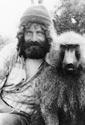
Robert Sapolsky discusses A Primate's Memoir, Africa, and the primates he observed and studied.
In the book you touch on some of the cultural and societal changes you have
witnessed in your over twenty years of summers in Africa. What aspect of bush
life has changed the most during the years you've spent there? What the least?
I am taking "bush life" to mean Masai life, rather than that of
the more westernized, agricultural tribes. Probably most broadly, there has been
one big shift; when I got there, ambition, hope for one's kids, goals were built
around being a more successful Masai -- figuring out a way to have more cows,
more wives, more children. And what has shifted is that ambition now takes the
form of wanting outside things: a watch, a pair of pants, a cassette player or
even of wanting to be someone else (without having much of a sense of what
anyone else's life is like). The Masai have realized that they are not the
center of the universe, and thus not even of the Masai universe. In terms of
what has changed the least, I keep thinking of the phrase, "Despite the new
goals, the Masai still go about trying to achieve them with the same Masai rules
and values." But I'm having trouble sorting out what exactly I mean by
that.
The stories you relate reach back to your very first visit to Kenya. How did
you go about writing the memoir? Did you use journals from your visits, or were
all these stories etched into your memory?
I wrote the memoirs over the last ten years, working primarily from two
sources. The first were journals I've kept in Kenya for these 23 years. This
turned out to be less useful than anticipated, however, in that they usually
were either mildewed and unreadable from some flood in my camp, or so
interminably boring in details of day-to-day life that I couldn't force myself
to read through them. Far more useful was getting letters of mine returned from
friends. For all those summers, I'd sit around in camp with no telephone, no
radio, minimal access to the outside world. You get mighty obsessed about the
occasional mail deliveries, and thus you get highly motivated to write to
everyone on earth, in the hopes of prompting a reply. So anytime something
interesting would happen, I'd write 25 or so one-page-aerogram versions of it
over the next few days, all on a clunky, museum-piece manual typewriter. This
turns out to be pretty good training for story-telling, I suspect.
As far as primates go, are baboons easy or difficult to observe and study?
What traits make them accessible, and what traits make your job tricky?
Actually, they're among the easiest to observe, and one of the few that I
could have done my physiology studies on. They live in these big social groups
out in the open; you're not craning your neck to watch someone up in the trees,
or trying to shoot him with a blowgun dart. They're not endangered, there's a
lot known about their physiology, they're big, which means there's a lot of meat
on them to aim for when you're darting and they have lots of blood. The social
groups remain reasonably intact year after year, and they're easy to recognize.
Some of the drawbacks, which came through in Chapter 3, are that they're so
damned smart -- once they figure out that you're up to something with the dart
gun -- and so potentially aggressive.
You write about how excited you were each summer to rejoin the troop. Did the
baboons recognize you after your absence? Did you every have trouble
differentiating them?
As far as I can tell, they would recognize me. For one thing, the first
day back after a year away, I'd be able to get far closer to them than would
some stranger. Potentially, though, that might not be because they'd recognize
me, but because I simply walked towards them in a more comfortable, less
unnerving way. However, the thing that suggests there really was recognition was
that individuals who seemed to like me would sit next to me. Benjamin, for
example, would have those behaviors year after year, while males who weren't
thrilled about me -- Solomon, for one -- would have consistent responses over
the years as well. In terms of recognizing them after a year away, it would be
hard the first week; last year's kid is now some muscular adolescent, someone
else suddenly looks decrepit. But it would come back pretty quickly.
You tell many stories of scams and government corruption. Why is this sort of
dishonesty so rampant in Kenya? Has it changed?
My sense is that it is worse than ever, although it may not be to my
advantage, in terms of future research permits there, to admit to this. As for
why the corruption, all the obvious reasons: a) the country's made up of a
zillion different historically hostile tribes arbitrarily thrown together as a
country by the Brits; b) life is short, there are few official safety nets
(e.g., unemployment insurance, pensions), so there are few moral qualms about
taking care of your own, no matter what; c) there's not yet any sort of history
of democracy, of regulation of profiteering -- this is a very young, very
capitalist country; d) the outside world and all its wealth provides tremendous
incentives for corruption -- the amount and indiscriminate nature of foreign
aid, the fact that the amount of money that would eventually be paid for, say, a
rhino horn dagger will trickle down to paying the poacher enough money to cover
his kids' school fees for years; e) the fact that the west encourages the
illicitly wealthy in the developing world to hide their loot in western
institutions (e.g., Swiss banks). All this has to be evaluated, though, in the
context that the rest of the world is just as corrupt (including ourselves with,
say, a couple of procedural problems with presidential polling in Florida), and
this is the only place I've ever been in where I wasn't living in some hermetic
academic cloister.
Often your African neighbors beheld you and your customs with as much
curiosity and wonderment as you beheld them and theirs. What Western custom most
surprised or confused your neighbors?
A number of them. Contact lenses. Adults liking milk. Laws against bigamy.
People voluntarily eating fish. The fact that the wealthiest man in America
(say, Bill Gates) probably owns very few cows. We westerners getting upset over
animals dying. Any public signs of physical affection between
spouses/significant others, parents and children.
How does living in urban America compare with remote Africa, in terms of your
personal level of stress, ease of living, emotional health, etc? Do you feel
more at home in either place? Is it difficult to go back and forth between the
two?
In the early years, the transitions were horrible. I'd leave for the field
and squeeze half the year's emotional intimacy in the final weeks. I'd come back
from the field and be a dysfunctional recluse for weeks afterward. By now, the
transition is simple. Somehow, I hardly even get jet-lagged. In terms of
comparing my life in the two places, basically, I can do more useful work here
with my research, but I'm happier there. When I'm there, 95% of the time I can
relax in a way that I never can here. And the other 5%, I am stressed because of
some horrific, shit-in-your-pants piece of reality that evaporates all the
neuroses and angst for weeks afterward, which is heavenly.
Can you explain the differences between your research on baboons in the wild
and research that is conducted in the lab?
Twenty years ago or so, the two threads of research were very related. In
the lab I was studying why an excess of stress hormones had adverse consequences
for health (in particular, damaging neurons), while with the baboons, I wanted
to understand what social factors predicted who secreted more or less of those
stress hormones. The lab work, meanwhile, has gotten more and more reductive
over the years, as my lab now does gene therapy to try to save neurons from
neurological diseases. The field work, in contrast, has become larger in scale.
These days, I study things like differences in "cultures" between
troops of baboons, how the cultures are propagated, the consequences of the
differing cultures for the health of individuals.
What path is your research taking now? Do you continue to go to Africa?
I continue to oscillate between the lab and the field, although far less
of the latter than in the past. My most recent season there was only 3 weeks,
and I'll be lucky to spend that much time there this coming summer.
Interview reproduced with the permission of the publisher, Scribner.
Unless otherwise stated, this interview was conducted at the time the book was first published, and is reproduced with permission of the publisher. This interview may not be reproduced or reprinted without permission in writing from the copyright holder.




Russell Banks was raised in New Hampshire and eastern Massachusetts. The
eldest of four children, he grew up in a working-class environment, which has
played a major role in his writing.
Mr. Banks (who was the first in his...
(more)
If you enjoyed:
A Primate's Memoir
Try:
The Darling
by Russell Banks

Marla Cone is one of the nation's premier environmental journalists. She has nineteen years of experience covering environmental issues, including fifteen years at the Los Angeles Times. She is the author of Silent ... (more)
If you enjoyed:
A Primate's Memoir
Try:
Silent Snow
by Marla Cone
We recommend 9 similar authors

L.A. Women by Ella Berman
Two ambitious writers in 1960s LA face betrayal when one writes a novel based on the other's life.






Your guide toexceptional books
BookBrowse seeks out and recommends the best in contemporary fiction and nonfiction—books that not only engage and entertain but also deepen our understanding of ourselves and the world around us.

