
-
Your next favorite book
is waiting.

How to pronounce Wiley Cash: WHY-lee
Wiley Cash talks about his novels, A Land More Kind Than Home and The Last Ballad
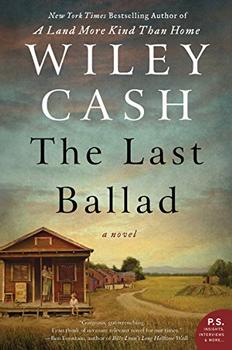
A Conversation with Wiley Cash about The Last Ballad
The irony that the Loray Mill, where scenes in the book are set, is now home to luxury condos is not lost on you. Why is writing about the history of the mill so important to you now?
I grew up in Gastonia, North Carolina, completely unaware of the history of the mill. Firestone purchased the mill not long after the 1929 strike, which was one of the only communist led strikes in American history. It turned the city upside down, people died, and families were run out of town. But by the time I was born in 1977, Gastonia had completely buried the story of the Loray Mill strike. It wasn't until I went to grad school in 2003 that one of my professors learned that I was from Gastonia and mentioned the Loray Mill strike. I researched the name Loray Mill and was shocked to learn that the place I'd always known as the Firestone Plant was the epicenter of one of the most important moments in American history. It had all occurred in my hometown, and I had grown up knowing nothing about it. My parents, who were born in the 1940s and came of age under Joseph McCarthy and the Red Scare, had also never heard of it. It made me realize that history is not a fixed thing, and it made me understand that politics and public sentiment can dictate what is retained and what is lost.
Writing from varying character perspectives is something you excel in—what was the significance of writing this story from the eyes of eight different characters?
I hoped to give the reader a sense of the historical moment and the many competing forces that collided in a storm of race, class, and gender that gave rise to this violent upheaval. The most important perspective is obviously Ella May's, an impoverished working mother who's given birth to five children, one of whom has already died by the time the novel begins. Her struggle to earn a living wage and her decision to join the labor union is what drives the novel. But the other perspectives—a progressive mill owner and his wife, an African-American labor organizer from New York, a religious zealot, and Ella's grown daughter who is looking back on these events—are the forces that bring tension to the novel. I didn't want anything in the novel to be too easy. I didn't want anyone to be 100% saint, victim, or villain. I wanted to create and rely on characters that felt real and complicated because this event was complicated.
The protagonist of The Last Ballad, Ella May Wiggins is based on an historic figure. What was it about her story that inspired you to write about her and that period in history?
It was her absence from history and her absence from the story of my hometown that made me want to learn about her. But it was her bravery and her strength that made me want to write about her. From a personal perspective, my mother's maiden name was Wiggins. Her father, my grandfather, was twenty-two and, like Ella, working at a textile mill just a few miles away from Loray at the time of the strike, and he never mentioned a word of Ella's story or shared any memories of a strike with which he would have been very familiar. Ella May Wiggins, a woman who shared my grandfather's last name, became the international face of a labor movement that was making headlines around the world, yet my grandfather buried the story and his feelings about it for the rest of his life. My hometown did the same.
You've placed your novels in North Carolina Appalachia before, in A Land More Kind Than Home and This Dark Road To Mercy. As a North Carolinian, how meaningful is it for you to keep your writing close to home?
Writing about North Carolina is meaningful to me. It also speaks to my strength as a writer, I think—portraying places and people that I know and have great affection for. Every novel that I've written comes from an experience I've had or from a story I know. My hope is that I always perceive the larger world through the lens of the place I know best.
The Last Ballad is set in 1929, almost 90 years ago. Are there current issues in American life today that stimulated your interest? How can fiction serve to illuminate social injustice while not being polemic?
The Loray Mill strike, which was about equal pay for equal work, racial inequality, and corporate greed, touches on issues that are still driving our contemporary political moment. Women are paid $.80 on the dollar in 2017. I find that shameful. People in poor and oftentimes minority communities don't have access to the same quality of education and employment opportunities that people who live in middle class communicates do. These aren't issues of people needing to work harder to overcome the misfortune of their birth, these are issues for which government and communities need to step in and take some measure of responsibility for the pervasiveness of historical inequality. As far as the polemics of issues like these, I always think about the Elizabethan writer, Sir Philip Sidney, who said that the aim of literature should be to teach and delight. I am not necessarily trying to teach someone something new, but perhaps I am asking readers to view an issue in a way they've never considered it before. Sure, everyone has thought about issues of poverty, but have we ever been inside the home of someone who has lost a child to a poverty-related illness? We've all thought about issues of race, but have we ever had a conversation with someone who's been the victim of racial violence? In The Last Ballad, I'm hoping to tell an interesting story and I'm hoping to interest readers, but in telling what I believe to be an important story, I'm also hoping to reach them.
A Letter to Readers
In a letter to readers, debut author Wiley Cash explains why writes about North Carolina, and in a video Q&A, he talks about A Land More Kind Than Home, his literary inspiration, and the origin of the novel's title.
"Why I Write About North Carolina" by Wiley Cash
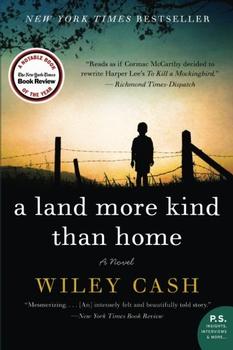
I deeply love my native state of North Carolina, especially its mountains. I hope my love for this region is evident in A Land More Kind Than Home's portrayal of western North Carolina's people, culture, and religious faith. While A Land More Kind Than Home revolves around a young autistic boy who is smothered during a church healing service, the novel's three narrators all represent my experience of growing up in North Carolina and being raised in an evangelical church.
Like Jess Hall, the younger brother who secretly witnesses the tragedy that befalls his brother, I often found myself sitting in church and waiting for something to happen. As a boy I was promised that I would recognize my salvation when I felt Jesus move inside my heart; however, like Jess, I attempted to rationalize the mysteries of Christianity, and I soon realized that we often use faith to fill the empty spaces in our lives. Like Adelaide Lyle, the church matriarch who straddles the divide between religious faith and old-time folk belief, my own religious beliefs are rounded out with a healthy dose of skepticism. While I'm always suspicious of those who pray the loudest, I can't help but acknowledge the tug on my heart when I witness a baptism, and I can't account for the inexplicable peace that comes from humming an old-time gospel. But I most identify with the character Clem Barefield, the local sheriff who must sift through his own tragic past to solve the mystery of the healing gone wrong, because, like Clem, I'm guided only by what I can perceive of this world, and I'm hesitant to get lost in following those who claim to be led by a spirit from the next.
I began writing A Land More Kind Than Home while working on my Ph.D. at the University of Louisiana, where I spent five long years sweating, celebrating Mardi Gras, and missing the mountains of North Carolina. While living in Lafayette, I took a fiction workshop with Ernest J. Gaines, who taught me that by writing about home I could recreate that place no matter where I lived. Gaines made this clear to me one afternoon while we were visiting an old cemetery near the plantation where he was born. He pointed to a grave marker and said, "You remember Snookum from A Gathering of Old Men? He's buried right over there." While none of the characters in A Land More Kind Than Home are based on people who actually existed, they're all amalgams of the types of people I knew growing up. In creating these people and the place they live I got to watch the sun split the mist on the ridges above the French Broad River. From my desk in Louisiana I pondered the silence of snow covered fields. While living in a place that experiences only summer and fall, I watched the green buds sprout on the red maples, and I was there when their leaves began to shrivel before giving way to the wind. I lived in two places at once, and it was wonderful.
I became a Southern writer because I wanted to recreate the South that I know, and I learned to write about the South from the writers I loved. Because of this, I knew it was important to garner support for A Land More Kind Than Home from authors like Gail Godwin, Fred Chappell, Bobbie Ann Mason, and Clyde Edgerton. These writers wield an enormous influence on my work, and I have no doubt that they can say the same for the writers who came before them. Gaines often recalls William Faulkner's invocation of Oxford, Mississippi as a little postage stamp of earth that he continually mined throughout his career. Gaines did the same thing in his Louisiana fiction. That's what I tried to do in A Land More Kind Than Home. My next novel is set in the same region of North Carolina. Fortunately, this part of the country is much larger than Oxford, and I can't imagine ever running out of stories to tell about it.
Letter taken from Wiley Cash's website: www.wileycash.com/bio
Unless otherwise stated, this interview was conducted at the time the book was first published, and is reproduced with permission of the publisher. This interview may not be reproduced or reprinted without permission in writing from the copyright holder.

Therese Anne Fowler is the third child and only daughter of a couple who raised their children in Milan, Illinois. An avowed tomboy as a child, Therese protested her grandmother's determined attempts to dress her in ... (more)
If you enjoyed:
The Last Ballad
Try:
Z: A Novel of Zelda Fitzgerald
by Therese Anne Fowler

Amy Greene was born and raised in the foothills of the Smoky Mountains, where she lives with her husband and two children. Her second novel Long Man will be published by Alfred A. Knopf February 25, 2014. Her first novel ... (more)
If you enjoyed:
A Land More Kind Than Home
Try:
Bloodroot
by Amy Greene
We recommend 14 similar authors



Beliefs are what divide people. Doubt unites them
Click Here to find out who said this, as well as discovering other famous literary quotes!

Can you name the title?
Test your book knowledge with our daily trivia challenge!
Your guide toexceptional books
BookBrowse seeks out and recommends the best in contemporary fiction and nonfiction—books that not only engage and entertain but also deepen our understanding of ourselves and the world around us.
