Book Club Discussion Questions
In a book club? Subscribe to our Book Club Newsletter and get our best book club books of 2025!
Please be aware that this discussion guide will contain spoilers!
- Have you or someone close to you ever adhered to a religious group
that Karen Armstrong would define as fundamentalist? Does her view of
fundamentalism "ring true" for you?
- Karen Armstrong uses the terms mythos and logos to describe "two ways of
thinking, speaking, and acquiring knowledge." Mythos is concerned with
"the eternal and the universal," she writes, and logos is concerned
with "rational, pragmatic, and scientific thought." How do these
terms apply to your own experience of religious and secular life?
- Armstrong points out that the first Grand Inquisitor, whose mission was to
stamp out Judaism in Spain, was himself a Jew who converted to Catholicism. Do
you believe that a convert is more likely to be zealous in his or her new faith
than someone who was born into the same faith?
- Were you surprised to learn that Islam treated Christians and Jews as a
"protected minority" (dhimmi)? Did Armstrong's description of the
history of Islam change the way you view the Islamic world as it is depicted in
news media and popular entertainment today?
- According to Armstrong, the events in Spain of 1492--the expulsion of Jews
and Muslims--marked the beginning of "a new order" in world history.
She also finds history-changing significance in the rise of Napoleon, the
industrial revolution, and World War I. Do you agree that these events changed
the world as we know it?
- In writing about modernization in the Western world, Armstrong points out
that some scientists and scholars came to embrace the principle that "the
only information upon which we could safely rely came from our five
senses," and "anything else was pure fantasy." In their view, she
writes, "[p]hilosophy, metaphysics, theology, art, imagination, mysticism,
and mythology were all dismissed as irrelevant and superstitious because they
could not be verified empirically." Does your own experience of life prompt
you to agree or disagree with this point of view?
- Armstrong insists that modernism, despite all of the material benefits that
it bestowed upon humanity, was not a complete replacement for religion and
spirituality. "Human beings find it almost impossible to live without a
sense that, despite the distressing evidence to the contrary, life has ultimate
meaning and value," she writes. What is your own view of the "ultimate
meaning and value" of life in the modern world? Do you find meaning and
value in life through religious observance?
- "In their way, fundamentalists were ardent modernists," writes
Armstrong. Do you agree that fundamentalism, as Armstrong defines and explains
it, is a feature of the modern world and could not have existed in an earlier
era?
- "The death camp and the mushroom cloud," writes Armstrong,
"are icons that we must contemplate and take to heart so that we do not
become chauvinistic about the modern scientific culture that so many of us in
the developed world enjoy." Do you believe that the benefits of the modern
world outweigh such horrors as the Holocaust and the threat of nuclear
destruction?
- Armstrong argues that there is "a void at the heart of modern
culture," which French existential philosopher Jean-Paul Sartre described
as "a God-shaped hole." Do you experience such a void in your own
life? If so, how have you tried to fill the "God-shaped hole"?
- Armstrong holds out the hope that fundamentalists and modern secular
societies can come to understand and live in peace with each other. "If
fundamentalists must evolve a more compassionate assessment of their enemies
in order to be true to their religious traditions," she writes,
"secularists must also be more faithful to the benevolence, tolerance, and
respect for humanity which characterizes modern culture at its best." Do
you see any specific ways in which "secularists" can express these
qualities in a way that fundamentalists can understand them?
- How do the conflicts between Jews and Muslims in the Middle East differ from
the conflicts between Catholics and Protestants in Northern Ireland? Do the
ideas that Armstrong explores in The Battle for God apply to both of these
"hot spots" of the modern world?
- Has The Battle for God changed the way you understand the role of religion
in defining and encouraging morality in public and private life? Has religion
played a positive or a negative role in shaping the world we live in today?
- Does The Battle for God change how you feel about fundamentalism in
religion? In what way? Are you more or less sympathetic toward fundamentalists
than you were when you first picked up the book?
Unless otherwise stated, this discussion guide is reprinted with the permission of Ballantine Books.
Any page references refer to a USA edition of the book, usually the trade paperback version, and may vary in other editions.

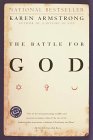
.png)


