return to home  
Join   |  Gift   |  Member Login   |  Library Login
BookBrowse Mobile
Follow Us: 
   Reading Guides

Too Much Happiness by Alice Munro: Questions, plus a reading group guide, with links to reviews, excerpt, author interview and author biography at BookBrowse.com.

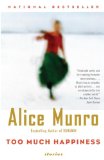
Too Much Happiness

Too Much Happiness
Stories
by Alice Munro
Hardcover: Nov 2009,
320 pages.
Paperback: Nov 2010,
320 pages.

Publication information
Author Information
Critics' Opinion:   
Readers' Rating:    Not Yet Rated
About BookBrowse Rankings
Share: 
Buy This Book

Reading Guide Questions

 Printer Friendly Guide

Please be aware that this discussion guide may contain spoilers!

  1. Dimensions
    As in her earlier story "Runaway," Munro examines the effects of the psychological domination of one person by another. Why does Doree visit her husband in jail? Lloyd's letters are a central part of the story: why does his notion that he has seen the children in another "dimension" (page 29) bring a kind of comfort to Doree? Does her thought that Lloyd, "of all people, might be the person she should be with now" (page 30) seem sensible, or dangerous? When she is on her way to the prison once again, Doree miraculously resuscitates a young man: how does this act connect to the title, and what does the final scene suggest about her future?

  2. Fiction
    From whose point of view is this story told, and how does this shape our understanding of events? Edie has "a mind that plods inexorably from one cliché or foolishness to the next . . ." (pages 40–41). How might it be possible for Jon to prefer Edie to Joyce? In part two, how does Joyce feel when she reads about herself in Christie's story? What is revealed by the child's perspective? What does Joyce learn about herself that she hadn't known, or had forgotten? Is it fitting that Christie doesn't remember Joyce?

  3. Wenlock Edge
    Hearing Nina's life story, the narrator says, "Her life made me feel like a simpleton" (page 72). Does this explain the narrator's willingness to comply with Mr. Purvis's requests? Why do you think Munro has chosen "On Wenlock Edge" (from A. E. Housman's A Shropshire Lad) for the narrator to read to Mr. Purvis? How are the narrator's feelings about literature, poetry, and the university library changed by her encounters with Nina and Mr. Purvis? Why does she send Ernie's address to Mr. Purvis, and what does she gain by doing so? What details or events are most troubling in this story, and why?


  4. Deep-Holes
    As the family picnic begins, Sally finds herself in a dangerous place, "nearly crying with exhaustion and alarm and some familiar sort of seeping rage" (page 96). How would you describe Sally's husband, and her marriage? Why does Kent leave home and refuse contact with his family? Why does he choose to live as he does (pages 109–17)? What effect does her meeting with Kent have upon Sally (pages 116–17)? What does the story's title signify?

  5. Free Radicals
    Like "Dimensions," this story presents an intimate view of someone who is capable of murdering his family. But it's also a story about ordinary mortality: Nita's husband has died of a heart attack, and she is suffering from liver cancer and may not have long to live. How does Nita cope with the idea of her own impending death? What story does the young man tell Nita when he shows her the photograph (pages 129–32), and what story does Nita tell him in return (pages 134–36)? What is the effect of this reciprocal response on Nita's part? Compare this story's ending with that of "Dimensions."

  6. Face
    What is the web of familial and extrafamilial relations that determines the plot of this story? Discuss how the narrator and his friend Nancy create their own freedom and happiness within close range of a deeply unhappy ménage à trois. Who is the cause of the rupture that occurs on pages 155–57? Are Nancy's attempts to mirror the flawed face of the narrator—first by painting, later by cutting—the clearest expressions of love he experiences in his lifetime? The narrator decides to settle in his childhood home because "in your life there are a few places, or maybe only the one place, where something happened, and then there are all the other places" (page 164). Why is this insight so profound? He goes on to suggest that the past is irreversible; do you agree or disagree?

  7. Some Women
    Who are the women referred to in the title? The story is narrated from a young girl's
    point of view. What does she understand—--and what does she not understand—--about what is going on in Mrs. Crozier's house (page 188)? Who is the main actor in the story, the one who is trying hardest to manipulate others? What is the motive for this manipulation?

  8. Child's Play
    The story opens with references to an event that is not yet explained. Why does Munro frame the story in this way? Explaining why she feels "persecuted" by Verna, Marlene says, "Only adults would be so stupid as to believe she had no power. A power, moreover, that was specifically directed at me" (page 204, 201). How does this idea of power ricochet through the story? Why does Marlene become an anthropologist, and why does she shun intimacy (pages 211, 2–12)? What does Charlene do to Marlene in asking her to go in search of Father Hofstrader? Compare this story with "Face," with which it shares the idea that the action of a moment can be the determining event in a person's life.

  9. Wood
    Why is Roy obsessed with cutting wood, an interest which is "private but not secret" (page 226)?  How has Lea's illness affected their marriage? What is being repressed or unexpressed by Roy in this story? What is the transformation that takes place in Lea? What is the loss referred to at the bottom of page 245, and what does Roy mean when he retrieves from his mind the phrase, "the Deserted Forest" (page 246)?

  10. Too Much Happiness
    Outwardly this story diverges from the rest, but what concerns or questions connect it with others? What is the relationship between Sophia's love for Maksim, her ideas about womanhood, and her joy in mathematical thought? Are they in conflict? How does Munro present female intellectual ambition and its frustrations, even its tragedy? What do you think is meant by Sophia's last words, "too much happiness" (page 302)?

  11. General questions
  • In several of these stories, Munro sets out the dynamics of love and hate, desire and frustration in marriages, but does not interpret for the reader the actions that result. There is no facile sign-posting of causes and effects. In what stories do you find Munro's presentation of the unstated mood or tensions of a marriage most effective?    

  • Discuss the following observation on Too Much Happiness by Leah Hager Cohen: "The collection's ten stories take on some sensational subjects. In fact, a quick tally yields all the elements of pulp fiction: violence, adultery, extreme cruelty, duplicity, theft, suicide, murder. But while in pulp fiction the emotional climax coincides with the height of external drama, a Munro story works according to a different scheme. Here the nominally momentous event is little more than an anteroom to an echo chamber filled with subtle and far-reaching thematic reverberations" (The New York Times Book Review, 27 November  27, 2009).

  • In "Fiction," Joyce hasn't yet read Christie's book, but thinks: "How Are We to Live is a collection of short stories, not a novel. This in itself is a disappointment. It seems to diminish the book's authority, making the author seem like somebody who is just hanging on to the gates of Literature, rather than safely settled inside" (page 52). Is this an ironic comment on Munro's own work, reflecting the general opinion of short stories as opposed to the novel? How do these stories prove that opinion misguided?


Suggested Reading

A.  E. Housman, A Shropshire Lad;
John McGahern, All Will Be Well;
Ian McEwan, Atonement;
Lorrie Moore, A Gate at The Stairs;
Vladimir Nabokov, "Signs and Symbols";
Flannery O'Connor, "A Good Man Is Hard to Find";
Carol Shields, Unless;
Ivan Turgenev, Fathers and Sons


For a complete list of available reading group guides, and to sign up for the Reading Group Center enewsletter, visit www.readinggroupcenter.com


Unless otherwise stated, this discussion guide is reprinted with the permission of Vintage. Any page references refer to a USA edition of the book, usually the trade paperback version, and may vary in other editions.

Become a Member
Click Here
Editor's Choice
  •  Jun 19 
  •  Jun 17 
  •  Jun 15 
If You Find Me
Emily Murdoch

If You Find Me Jacket

There are some things you can't leave behind…
Americanah
Chimamanda Ngozi Adichie

Americanah Jacket

Fearless, gripping, at once darkly funny and tender, spanning three continents and numerous lives, Americanah is a richly told story set in today's globalized world.
We Are All Completely Beside Ourselves
Karen Joy Fowler

We Are All Completely Beside Ourselves Jacket

The story of an American family, middle class in middle America, ordinary in every way but one. But that exception is the beating heart of this extraordinary novel.
The Expats by Chris Pavone
   Most Recent Blog Entries
Top Ten Guidelines For How to Behave in a Book Club
Movies Based on Books: Summer 2013 (May - August)
Jewish Themed Young Adult Books, Not About The Holocaust
rss  RSS   rss  subscribe
Recent Reader Reviews
In the Shadow of the Banyan by Vaddey Ratner
First time novelist Vaddey Ratner captured my heart and senses in this novel based on her childhood in Cambodia. Her story transcends any news story... read more
In the Shadow of the Banyan by Vaddey Ratner
From the first page, I was drawn in by the lyrical writing of the author and mesmerized as the narrator, eight year old Raami, remembered the years... read more
TransAtlantic by Colum McCann
Trite but true, all good things must come to an end. I so wanted to keep reading the wonderful prose, the settings that let one think they are part... read more
RSS RSS feed More...  
Most Viewed This Week
1. Coraline
Neil Gaiman
2. Memoirs of a Geisha
Arthur Golden
3. The Glass Castle
Jeannette Walls
4. The Immortal Life of Henrietta Lacks
Rebecca Skloot
5. Behind the Beautiful Forevers
Katherine Boo
More...
Book Club Recommendations
Where'd You Go, Bernadette
by Maria Semple
Paperback (Apr/13)
The Unlikely Pilgrimage of Harold Fry
by Rachel Joyce
Paperback (Mar/13)
The Unchangeable Spots of Leopards
by Kristopher Jansma
Hardback (Mar/13)
How to Get Filthy Rich in Rising Asia
by Mohsin Hamid
Hardback (Mar/13)
More...
First Impressions
Members read and review books often months before they're published. See what they think in First Impressions!
Crime of Privilege
by Walter Walker
Four Stars            (Jun/13)
Children of the Jacaranda Tree
by Sahar Delijani
4.5 Stars            (Jun/13)
Her Last Breath
by Linda Castillo
4.5 Stars            (Jun/13)
More...
  Latest BookBrowse News
Kenn Nesbitt is new Children's Poet Laureate (Jun 12 2013)
Kenn Nesbitt has been named the new Children's Poet Laureate: Consultant in Children's Poetry to the Poetry Foundation, which noted that the two-year position... Full Story
rss RSS feed More...
 
BookBrowse Poll
Q: We've been discussing guidelines for book club etiquette. Which of these do you think are important?
Read the book
Listen thoughtfully to all members
Take notes while you're reading
Stay on topic when you're speaking
Enjoy yourself
Don’t get drunk
Bring chocolate, everyone likes chocolate!
Eat before you come so you don’t devour the snacks
Compliment others sincerely
Have a good sense of humor
Don’t fret the small stuff
Search: Title or Author
Free Newsletters

Online Book Club
More about
The Execution of Noa P. Singleton
Join the discussion!


Win This Book!
You Only Get Letters From Jail


one of the finest and truest collections of 'American' short stories I have ever read

Enter To Win Now!

wordplay
Solve this clue:
"T M T C, T M T Stay T S"

and be entered
to win....
frame top
New Author
Interviews
Carol Rifka Brunt
Kent Wascom
Jennifer McVeigh
Elizabeth Becker
frame bottom
HOME Book Submissions | Advertising | Library Subscriptions | Reviewing for BookBrowse | Contact Us