return to home  
Join   |  Gift   |  Member Login   |  Library Login
BookBrowse Mobile
Follow Us: 
   Reading Guides

Soldier's Heart by Elizabeth D Samet: Questions, plus a reading group guide, with links to reviews, excerpt, author interview and author biography at BookBrowse.com.

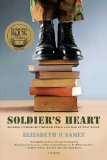
Soldier's Heart

Soldier's Heart
Reading Literature Through Peace and War at West Point
by Elizabeth D. Samet
Hardcover: Oct 2007,
272 pages.
Paperback: Sep 2008,
272 pages.

Publication information
Author Information
Critics' Opinion:   
Readers' Rating:  
About BookBrowse Rankings
Share: 
Buy This Book

Reading Guide Questions

 Printer Friendly Guide

Please be aware that this discussion guide may contain spoilers!

About This Guide

The questions and discussion topics that follow are designed to enhance your reading of Soldier's Heart. We hope they will enrich your experience as you explore Elizabeth D. Samet's inspiring reflections on literature and the education of America's future warriors.

About This Book


A decade ago, Elizabeth D. Samet began teaching English at the United States Military Academy at West Point after completing her doctorate at Yale University.  She encountered stark contrasts and surprising similarities between the two campuses, but nothing fully prepared her for the experience of watching her students and colleagues deploy to Iraq, Afghanistan, and other turbulent corners of the world. What does literature—particularly the literature of war—mean to a student who is likely to encounter its reality? What is the best way to stir uninhibited classroom discussions in a setting that is designed to train students to follow orders, respect authority, and survive grueling physical and mental experiences? This is the terrain Samet traverses each semester, a challenge beautifully captured in Soldier's Heart.

Taking its name from a World War I–era term for a condition akin to post-traumatic stress disorder (PTSD), Samet's memoir offers insights into America's newest generation of cadets. In each chapter she reflects on a rich trove of literature, from Homer's ancient epics to the work of modern and contemporary authors such as Wilfred Owen, Virginia Woolf, Randall Jarrell, E. L. Doctorow, and Tim O'Brien. For many of her students, reading brings solace and inspiration. For others, it sparks an examination of doubts or fears. In all cases, Samet's courses provide exhilarating arenas for the young men and women of West Point to explore life and language.

  1. Discuss the book's title. What are the different meanings of  "soldier's heart"? In what ways does literature address the ailments of what Wilfred Owen calls, in his poem "Insensibility" (epigraph), a heart "small drawn"?
  2. Although much has been written about West Point and military life in America, an English professor's point of view on the subject is rare. What specific insights on this world does Samet offer as a civilian and a humanities professor at a military academy? How is her portrait of military life different from others you have read?
  3. How does Samet's description of her students and former students compare to your stereotypes of soldiers? What are those stereotypes? How does Soldier's Heart confirm or challenge them?
  4. Chapter 1, "Not Your Father's Army," touches on the myths and traditions that define West Point, and military life more generally, by alluding to the literature that shaped the experiences of past cadets. Which aspects of the past remain vibrant on campus? Which aspects are radically different in the twenty-first century?
  5. Samet writes that she hears the term relevance more and more in informal conversations about the education and training of cadets. How are humanities courses different from military training at West Point? What do such courses contribute to the preparation of cadets? What is the difference between education and training? How do you view the purpose of higher education in general, and the role of literature and the arts within it?
  6. How has teaching at West Point changed Samet's experience of literature? How might her relationship to literature and teaching have been different if she had taken a position at a liberal-arts college instead of at West Point? How does her teaching style compare to that of English teachers from your past?
  7. Samet's deployed colleagues and former students write to her with rich observations about their favorite literary works. In what ways does literature help them understand their experience of war? What do their reading choices reveal about that experience?
  8. The author's previous book explores the tension between liberty and obedience in nineteenth-century America, a dynamic she also explores in Soldier's Heart. How do soldiers reconcile the military's demand for conformity with the need for innovative minds—in an all-volunteer military, no less? How do literature and creative writing serve or undermine the need for obedience and innovative thinking? What role does literature play in forging what West Point alumnus Ulysses S. Grant called moral courage?
  9. Why is writing about war one of the oldest forms of literature? What was the significance of epic poems such as Homer's Iliad or Beowulf to the warriors of earlier ages? What will characterize the artistic legacy of war in the twentieth and twentyfirst centuries? What is the relationship between writing and film when it comes to describing the contemporary war experience? Is your own understanding of war shaped more by literature or by film?
  10. Some of Samet's students gravitate toward war literature, while others prefer to read about nonmilitary topics. Does their reading seem more specialized than that of their counterparts at civilian colleges? What works would you include on a syllabus of assignments for cadets? Which classics would you like to see distributed today in an Armed Services Edition?
  11. How is the experience of a West Point cadet different from that of a college student at a typical liberal-arts college?
  12. What surprised you the most about the culture of West Point? How does military hierarchy influence educational practice? Do other American college campuses have comparable hierarchies? Should civilian colleges do more to emphasize the self-discipline of students?
  13. Chapter 3, "Becoming Penelope, the Only Woman in the Room," describes the ways in which gender is sometimes a factor in Samet's teaching experience. What advantages and disadvantages come with being a woman at a male-dominated institution? What specific challenges do women at West Point face? To what degree does West Point's recent history as a coed institution reflect the changing nature of the American military and American society? What are the effects of the stereotype associated with Penelope, a woman waiting for a warrior's return? What role does literature play in helping the cadets think about these issues?
  14. How was the author's worldview shaped by her upbringing—by a father who enlisted in the Army Air Corps during World War II, as well as by her years at the Winsor School? How did these experiences influence her teaching?
  15. Chapter 5, "Bibles, Lots of Bibles," explores the blend of religion and politics that permeates some segments of military life. How would you describe religion's role in the personal experiences of soldiers—at West Point and elsewhere—and its influence on national political decisions about war and peace?
  16. How did 9/11 change the role of Samet and other professors at West Point? What were your reactions to the scenes in the closing pages, which capture the difficult debates about the United States' current and future military responsibilities?
  17. How would you describe the impact of the Iraq war on life at West Point and on the ways in which the cadets and faculty understand their missions? Has the impact of war evolved over time?
  18. How would you define heroism? How does the Army define heroism? What is the role of literature in the process of turning soldiers into heroes? In your view, does the national emphasis on heroism honor or diminish the humanity of soldiers?


Unless otherwise stated, this discussion guide is reprinted with the permission of Picador. Any page references refer to a USA edition of the book, usually the trade paperback version, and may vary in other editions.

Become a Member
Click Here
Editor's Choice
  •  Jun 19 
  •  Jun 17 
  •  Jun 15 
If You Find Me
Emily Murdoch

If You Find Me Jacket

There are some things you can't leave behind…
Americanah
Chimamanda Ngozi Adichie

Americanah Jacket

Fearless, gripping, at once darkly funny and tender, spanning three continents and numerous lives, Americanah is a richly told story set in today's globalized world.
We Are All Completely Beside Ourselves
Karen Joy Fowler

We Are All Completely Beside Ourselves Jacket

The story of an American family, middle class in middle America, ordinary in every way but one. But that exception is the beating heart of this extraordinary novel.
The Expats by Chris Pavone
   Most Recent Blog Entries
Top Ten Guidelines For How to Behave in a Book Club
Movies Based on Books: Summer 2013 (May - August)
Jewish Themed Young Adult Books, Not About The Holocaust
rss  RSS   rss  subscribe
Recent Reader Reviews
In the Shadow of the Banyan by Vaddey Ratner
First time novelist Vaddey Ratner captured my heart and senses in this novel based on her childhood in Cambodia. Her story transcends any news story... read more
In the Shadow of the Banyan by Vaddey Ratner
From the first page, I was drawn in by the lyrical writing of the author and mesmerized as the narrator, eight year old Raami, remembered the years... read more
TransAtlantic by Colum McCann
Trite but true, all good things must come to an end. I so wanted to keep reading the wonderful prose, the settings that let one think they are part... read more
RSS RSS feed More...  
Most Viewed This Week
1. Coraline
Neil Gaiman
2. Memoirs of a Geisha
Arthur Golden
3. The Glass Castle
Jeannette Walls
4. The Immortal Life of Henrietta Lacks
Rebecca Skloot
5. Behind the Beautiful Forevers
Katherine Boo
More...
Book Club Recommendations
Where'd You Go, Bernadette
by Maria Semple
Paperback (Apr/13)
The Unlikely Pilgrimage of Harold Fry
by Rachel Joyce
Paperback (Mar/13)
The Unchangeable Spots of Leopards
by Kristopher Jansma
Hardback (Mar/13)
How to Get Filthy Rich in Rising Asia
by Mohsin Hamid
Hardback (Mar/13)
More...
First Impressions
Members read and review books often months before they're published. See what they think in First Impressions!
Crime of Privilege
by Walter Walker
Four Stars            (Jun/13)
Her Last Breath
by Linda Castillo
4.5 Stars            (Jun/13)
Children of the Jacaranda Tree
by Sahar Delijani
4.5 Stars            (Jun/13)
More...
  Latest BookBrowse News
Kenn Nesbitt is new Children's Poet Laureate (Jun 12 2013)
Kenn Nesbitt has been named the new Children's Poet Laureate: Consultant in Children's Poetry to the Poetry Foundation, which noted that the two-year position... Full Story
rss RSS feed More...
 
BookBrowse Poll
Q: We've been discussing guidelines for book club etiquette. Which of these do you think are important?
Read the book
Listen thoughtfully to all members
Take notes while you're reading
Stay on topic when you're speaking
Enjoy yourself
Don’t get drunk
Bring chocolate, everyone likes chocolate!
Eat before you come so you don’t devour the snacks
Compliment others sincerely
Have a good sense of humor
Don’t fret the small stuff
Search: Title or Author
Free Newsletters

Online Book Club
More about
The Execution of Noa P. Singleton
Join the discussion!


Win This Book!
You Only Get Letters From Jail


one of the finest and truest collections of 'American' short stories I have ever read

Enter To Win Now!

wordplay
Solve this clue:
"T M T C, T M T Stay T S"

and be entered
to win....
frame top
New Author
Interviews
Carol Rifka Brunt
Kent Wascom
Jennifer McVeigh
Elizabeth Becker
frame bottom
HOME Book Submissions | Advertising | Library Subscriptions | Reviewing for BookBrowse | Contact Us