Book Club Discussion Questions
In a book club? Subscribe to our Book Club Newsletter and get our best book club books of 2025!
Please be aware that this discussion guide will contain spoilers!
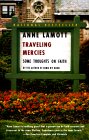
The questions, discussion topics, and author biography that follow are designed to enhance your reading of Anne Lamott's Traveling Mercies. We hope that they will suggest a variety of ways to talk about this delightful and moving story of one woman's journey in faith.
When Anne Lamott was twenty-five, her father died after a long struggle with brain cancer. Over the next few years she herself began to suffer from an overwhelming sense of desperation and fear, which she tried to suppress with alcohol and pills. Although she was managing to write and publish successful novels at the time, it was clear that her life was spinning out of control. In Traveling Mercies, a memoir that sparkles with wry wit and compassion, she now writes about this dark period of her life, and of her turn--to her own great surprise--to the community of Christian faith and love she found in a neighborhood church called St. Andrew's.
In a book that will be cherished by anyone who has pursued a spiritual search down all sorts of unlikely paths, grieved at the death of friends, or felt bewildered at the challenges that daily life presents to love and courage, Anne Lamott gives us a wise and often humorous account of living in faith.
For discussion
- Lamott quotes a Leonard Cohen song that goes, "There are cracks, cracks in everything, that's how the light gets in" (p. 39-40). Are people who are more "cracked"--more troubled or in pain--more likely to make the leap of faith than those who are outwardly more secure, more in control of their lives?
- Lamott explains, "My coming to faith did not start with a leap but rather a series of staggers from what seemed like one safe place to another. . . . Yet each step brought me closer to the ample verdant pad of faith on which I somehow stay afloat today" (p. 3). Yet on page 50 she notes that there was actually a moment of "conversion." How would you describe the process by which she came to religion? Is there necessarily a spiritual component to emerging from an addiction?
- Lamott writes of her parents and their friends: "They were fifties Cheever people, with their cocktails and affairs" (p. 10). Is this the reason for Anne's powerful girlhood desire to escape from her family and to be "adopted" by the mothers of her friends? Judging from the evidence she offers in the section called "Lily Pads," what was lacking in her own home that she needed?
- In her earlier book Operating Instructions, Lamott explored the enormous changes that the birth of a child brings to a woman's life. What do you think of her decision, after terminating an earlier pregnancy, to have this baby on her own, and what do you think of the response of the people at St. Andrew's? What does Traveling Mercies tell us about the role of of community in raising children? How does it expand our notions of what a family is?
- What particular challenges does raising a child bring to Lamott's life as a Christian? How does she handle some of the crises of maternal decision-making, such as the episode of Sam's desire to go paragliding on his seventh birthday?
- Lamott says: "At some point you pardon the people in your family for being stuck together in all their weirdness, and when you can do that, you can learn to pardon everyone." Do you agree with Lamott's position on forgiveness?
- If Lamott had not been an alcoholic, do you think she would eventually have found faith anyway? Is coming to faith a matter of fate for certain people, or is there a large element of chance involved?
- At several moments in this story Anne Lamott speaks of the events she is describing as miraculous. What is a miracle? How does she take the miraculous out of the realm of the extraordinary and return it to common life? What is the effect, for you, of her doing so?
- Of her spirituality before becoming a Christian, Lamott writes, "Mine was a patchwork God, sewn together from bits of rag and ribbon, Eastern and Western, pagan and Hebrew, everything but the kitchen sink and Jesus" (p. 42). Do you find that, even after her conversion and formal baptism, her approach to Christianity is unorthodox? What do you think of her continued unwillingness to exclude the wisdom of other religions?
- What rituals, celebrations, and memorial occasions are most significant in this story? Why are such occasions necessary in our lives?
- Consider the structure of this memoir. What decisions has Lamott made in consciously shaping the story of her own life? What does she leave out? Are the choices a writer makes in writing a memoir different from those made in writing fiction?
- Anne Lamott gives the work of other writers an important role in Traveling Mercies. Verses of poetry or excerpts of prose are placed at the beginning of each of the book's seven parts, and the book as a whole opens with a poem by W. S. Merwin. How do these other voices contribute to what Lamott is trying to share with her readers? Which of these additional voices did you find most moving, most resonant?
- Lamott is often preoccupied with her aging body and the cultural expectations of beauty. When she is worrying about whether a certain dress makes her hips look too big, her dying friend Pammy remarks, "Annie, you really don't have that kind of time" (p. 239). Why is this such an important insight for Lamott? What sort of sense is necessary to step away from an obsession with physical beauty in contemporary American culture?
- What role does Pammy play in Lamott's life? How does one adjust to losing a friend to cancer? How does Lamott arrive at the crucial insight that we should live joyfully in the face of death?
- What is amusing about Lamott's efforts to impress upon her son, Sam, the importance of Ash Wednesday? Do you think that she was right in taking Sam to the ceremony upon the death of their friends' baby? How and when should we try to teach children about the painful reality of death?
- What do you find most appealing about Anne Lamott's voice as a writer? Which aspects of her character do you most and least identify with?
- What is the relationship between humor and faith in Anne Lamott's life? Is humor a necessary component of faith?
- Why is community so important in Anne Lamott's life as a Christian? Is there a qualitative difference in a spirituality that is primarily private, and one that is part of an ongoing commitment to a group of fellow believers?
Suggestions for further reading
St. Augustine, Confessions;
Susan Cheever, Treetops;
Dorothy Day, The Long Loneliness;
Steven Dubner, Turbulent Souls;
Doris Grumbach, The Presence of Absence;
William James, The Varieties of Religious Experience;
Jon Kabat-Zinn, Wherever You Go, There You Are; Søren Kierkegaard, Fear and Trembling;
Caroline Knapp, Drinking: A Love Story;
Martha Manning, Undercurrents;
Thomas Merton, The Seven Storey Mountain;
Kathleen Norris, Cloister Walk;
Iyanla Vanzant, One Day My Soul Just Opened Up;
Philip Zaleski (ed.), The Best Spiritual Writing 1998.
Page numbers refer to the Vintage paperback edition.
Reading group guide and suggested reading list reproduced with the permission of the publisher, Vintage.
Unless otherwise stated, this discussion guide is reprinted with the permission of Anchor Books.
Any page references refer to a USA edition of the book, usually the trade paperback version, and may vary in other editions.

.png)


