return to home  
Join   |  Gift   |  Member Login   |  Library Login
BookBrowse Mobile
Follow Us: 
   Reading Guides

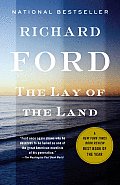
The Lay of the Land by Richard Ford: Questions, plus a reading group guide, with links to reviews, excerpt, author interview and author biography at BookBrowse.com.

The Lay of the Land

The Lay of the Land
by Richard Ford
Hardcover: Nov 2006,
496 pages.
Paperback: Jul 2007,
496 pages.

Publication information
Author Information
Critics' Opinion:   
Readers' Rating:  
About BookBrowse Rankings
Share: 
Buy This Book

Reading Guide Questions

 Printer Friendly Guide

Please be aware that this discussion guide may contain spoilers!

The introduction, discussion questions, suggestions for further reading, and author biography that follow are meant to enliven your group's discussion of Richard Ford's abundant, funny, sorrowful, and miraculously observed new novel, The Lay of the Land.


About This Book
In The Lay of the Land, the author reintroduces readers to Frank Bascombe, the protagonist of his earlier novels The Sportswriter and the Pulitzer Prize–winning Independence Day. He is a man of mild aspect and strong, sometimes violent feelings, capable of kindnesses both diligent and spontaneous but also of flashes of cruelty and contempt. A native Southerner transplanted to Michigan, the New Jersey suburbs, and lately the beach town of Sea-Clift ("NEW JERSEY'S BEST-KEPT SECRET"); a one-time novelist turned sportswriter and then realtor; a survivor of a divorce, the father of a dead son: Frank is living testimony to the infinite renewability of American life (just as his career speaks of the infinite renewability of American real estate). But Frank doesn't want any more renewal. At 55, he's entered the Permanent Period, the "end to perpetual becoming, to thinking that life schemed wonderful changes for me, even if it didn't. It portended a blunt break with the past and provided a license to think of the past only indistinctly (who wouldn't pay plenty for that?)" [p. 54].

But as he prepares for the Thanksgiving weekend of the year 2000 and braces himself for the aftershocks of an inconclusive presidential election, Frank worries that his Permanent Period may be coming to an end. His wife Sally has left him for her first husband, who was supposed to be dead; his first wife, Ann, has decided that she's in love with him, again or still; his prostate has sprouted cancer, which is being treated with radioactive BBs, and even his daughter Clarissa, who faithfully shepherded him through his procedure and recovery, is switching sexual preference. Add the ill-considered business plans of his Tibetan business partner, the imminent arrival of his eccentric surviving son, and a bomb going off at the hospital where he likes to eat lunch, and you can understand why Frank would rather skip Thanksgiving, why he might rather skip everything.

The fact that he doesn't—that he shows up for every painful and absurd event of this dizzyingly eventful novel and reports them all in a voice as confiding, expansive, and laugh-out-loud funny as any in American fiction—is something to be grateful for. Happy Thanksgiving.


Reader's Guide

  1. What do you make of the story that opens the novel: that of the community college teacher who, before being gunned down by one of her disgruntled students, was asked if she was ready to meet her maker and replied "Yes. Yes, I think I am" [p. 3]. Why is Frank so riveted by this question? How does he think he might answer in similar circumstances? What does he mean when he says that "It's not a question . . . that suburban life regularly poses to us. Suburban life, in fact, pretty much does the opposite" [p. 4]? Is he right? How do the themes of death, self-accounting, and the terrifying randomness of the American berserker recur throughout The Lay of the Land?
  2. What does Bascombe mean by the "Permanent Period?" When does he seem to have entered it, and what events threaten to evict him from it? How serious is he when he speaks of its pleasures? In the scheme of this novel, is permanence the same thing as happiness? As resignation?
  3. The Lay of the Land is set during Thanksgiving, as The Sportswriter takes place at Easter and Independence Day over a July 4th weekend. How does the holiday figure in the novel? How does Frank feel about it, and how do the other characters appear to be celebrating it? Discuss the novel's exploration of themes like gratitude, family, and abundance—as well as the ambiguous meaning of "pilgrim."
  4. What role does politics play in this novel, which occurs during the long, inconclusive hangover of the 2000 presidential election? How does Frank feel about the nation's current state of affairs? How do the other characters feel, and to what extent are they characterized by their politics? How does the outcome (or non-outcome) of the vote mirror events in Frank's personal life?
  5. What has prompted Frank to become a Sponsor, a member of a group "whose goal is nothing more than to help people" [p. 12]? What sort of help does he have in mind, and how does that correspond to what is actually asked of him on his one Sponsorial visit? What does he get from his voluntarism, and how do the services he performs as a Sponsor compare to his kindnesses as a friend, business partner, father, or husband? How do they highlight his failings and deficiencies? What does the very existence of an organization like Sponsors suggest about
    American—or at least New Jerseyan—society in the year 2000?
  6. What is the significance of Frank's career as a realtor? Which of his character traits does it bring into relief? How does it cause him to see the landscape and houses around him, and how does it cause other characters to see him? What does "home" mean to a realtor, who makes his living selling them? What might "home" mean to Frank's partner Mike Mahoney (né Lobsang Dhargey), whose original one was in Tibet? Is home, as Frank can't keep from going back to, though the air there's grown less breathable, the future's over, where they really don't want you back, and where you once left on a breeze without a rearward glance" [p. 14]?
  7. Mike Mahoney's name, career-track, and politics suggest a core sample of the American bedrock, except that, as previously mentioned, he happens to be a Buddhist from Tibet. Has the American archetype become someone who was once somebody (or something) else? In what ways are Mike and Frank similar? Are Ford's characters constantly becoming new people or simply building additions onto an original structure? And, if Mike represents a paradigm in this novel, what do you make of Ann's statement, "We just have to be who we are" [p. 377]?
  8. Frank is a cancer survivor, a category whose ambiguity may be surpassed only by the "suicide survivors" that so confuse Mike. How does Frank feel about his condition, and particularly about where it has chosen to turn up in his body?
  9. What sort of father is Frank? Which of his surviving children does he favor and for what reasons? To what extent is he still haunted by the death of his first son? Why is he so unnerved when Clarissa, who only yesterday was a straightforward lesbian, brings home a male "friend"? What might account for Frank's embarrassment and irritation toward his son Paul and Paul's occasional fury at him? Is Paul right when he accuses his father of "hold[ing] everything . . . down" [p. 396]?
  10. How does Frank relate to the women in his life? What sort of husband has he been? How does he react to Ann's admission that she still loves him? How has he dealt with his desertion by Sally, and to what extent may he have been complicit in it? (What might it mean when your wife leaves you for a dead man?) What do you make of his Sponsorial call to Marguerite Purcell and of the fact that it transpires without either person alluding to their long-ago sexual fling?
  11. For all his relationships, Bascombe seems to be a fundamentally solitary figure. Is this because Ford embeds us so deeply in his consciousness that we experience the essential aloneness that is the hallmark of all consciousness or because Frank really is solitary? What traits or circumstances might make him so?
  12. As its title suggests, The Lay of the Land is very much a novel about place. How does Bascombe view his neck of New Jersey? How do his observations about strip malls, McMansions, road houses, and human tissue banks illuminate Bascombe's character? How do they comment on the novel's action? Does Bascombe loathe the uniformity and ugliness of this environment, or are his feelings about them more complex? Are the author's? What is the significance of the fox that appears in one of the book's final scenes?
  13. E. M. Forster famously summed up the difference between story and plot as follows: "‘The King died, then the Queen died' is the story. ‘The King died, then the Queen died of grief' is the plot" [Aspects of the Novel, chapter 5]. What is it that makes the seemingly haphazard events in this novel cohere into a plot? What is the relation between that plot's hinges (Frank's cancer, Sally's departure, Ann's confession, Clarissa's disappearance, and Paul's arrival, not to mention the shattering denouement) and its seemingly incidental moments?
  14. Frank is both the novel's protagonist and its narrator. Every perception and event is filtered through his voice. How would you characterize Frank's voice? In what ways does it combine the casual and the literary, the comic and the tragic?
  15. Because The Lay of the Land deals with ordinary people engaged in ordinary life in an environment that most readers will find familiar, it is tempting to see it as a miniaturist novel. But its length, its eventfulness, and the sheer, exuberant density of its observations suggest that it is also a work of fictional maximalism like Bellow's Herzog or Joyce's Ulysses (to which it sometimes alludes). Discuss these approaches to fiction and the ways that Ford reconciles, or navigates, between them.


Suggested Reading
Saul Bellow, The Adventures of Augie March, Herzog; John Cheever, Collected Stories, O What a Paradise It Seems; James Joyce, Ulysses; Vladimir Nabokov, Lolita; Philip Roth, American Pastoral; Mark Twain, Huckleberry Finn; John Updike, the Rabbit novels; Sloan Wilson, The Man in the Gray Flannel Suit; Richard Yates, Revolutionary Road.


Unless otherwise stated, this discussion guide is reprinted with the permission of Vintage. Any page references refer to a USA edition of the book, usually the trade paperback version, and may vary in other editions.

Become a Member
Click Here
Editor's Choice
  •  May 25 
  •  May 23 
  •  May 21 
The Shelter Cycle
Peter Rock

The Shelter Cycle Jacket

An American original, Peter Rock brings our strangest beliefs to vivid and sympathetic life in this haunting novel inspired by true events.
And the Mountains Echoed
Khaled Hosseini

And the Mountains Echoed Jacket

Khaled Hosseini has written a new novel about how we love, how we take care of one another, and how the choices we make resonate through generations
Helga's Diary
Helga Weiss

Helga's Diary Jacket

The remarkable diary of a young girl who survived the Holocaust—appearing in English for the first time.
Click Here
   Most Recent Blog Entries
Movies Based on Books: Summer 2013 (May - August)
Jewish Young Adult Books That Are Not About The Holocaust
Books to Give This Mother's Day
rss  RSS   rss  subscribe
Recent Reader Reviews
Bring Up the Bodies by Hilary Mantel
A very large book - in number of pages and in content - and every page worth reading. Thoroughly enjoyed this one and her first book on the... read more
Two Lives by Vikram Seth
Two Lives is a memoir written by international best-selling author, Vikram Seth. In this interesting and engaging book, Seth writes about his great... read more
Z: A Novel of Zelda Fitzgerald by Therese Fowler
Z, the novel about the life of Zelda Sayre Fitzgerald is at points charming and; like another reviewer, I kept thinking of the movie, "Midnight... read more
RSS RSS feed More...  
Most Viewed This Week
1. The Boy in the Striped Pajamas
John Boyne
2. And the Mountains Echoed
Khaled Hosseini
3. Telegraph Avenue
Michael Chabon
4. The Glass Castle
Jeannette Walls
5. The Round House
Louise Erdrich
More...
Book Club Recommendations
Why Be Happy When You Could Be Normal?
by Jeanette Winterson
Paperback (Mar/13)
Eleanor & Park
by Rainbow Rowell
Hardback (Feb/13)
The House Girl
by Tara Conklin
Paperback (Oct/13)
The Painted Girls
by Cathy Marie Buchanan
Hardback (Jan/13)
More...
First Impressions
Members read and review books often months before they're published. See what they think in First Impressions!
The Caretaker
by A .X. Ahmad
Four Stars            (May/13)
The Last Girl
by Jane Casey
Four Stars            (May/13)
Golden Boy
by Abigail Tarttelin
4.5 Stars            (May/13)
The Sisterhood
by Helen Bryan
Four Stars            (Apr/13)
More...
  Latest BookBrowse News
Judge rules unused Borders gift cards to be worthless (May 23 2013)
Borders owes nothing to holders of roughly $210.5 million of gift cards that had not been used by the time the bookstore chain shut down, a Manhattan federal... Full Story
rss RSS feed More...
 
BookBrowse Poll
Q: Which of these Summer movies based on books would you like to see? (Info on each movie here)
The Great Gatsby
Epic
Man of Steel
World War Z
The Lone Ranger
The Wolverine
R.I.P.D.
Percy Jackson
Paranoia
The Mortal Instruments
Select Any That Apply
Search: Title or Author
Free Newsletters
The Light Between Oceans

Online Book Club
More about
Five Days
Join the discussion!


Win This Book!
On Sal Mal Lane


"Piercingly intelligent and shatter-your-heart profound."

Enter To Win Now!

wordplay
Solve this clue:
"I Y N P O T Solution, Y P O T P"

and be entered
to win....
frame top
New Author
Interviews
Menna van Praag
Erica Brown
Helga Weiss
Kate Morton
frame bottom
HOME Book Submissions | Advertising | Library Subscriptions | Reviewing for BookBrowse | Contact Us