Book Club Discussion Questions
In a book club? Subscribe to our Book Club Newsletter and get our best book club books of 2025!
Please be aware that this discussion guide will contain spoilers!
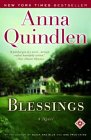
- Blessings is a title that holds a great deal of meaning for this
book, as the name of the Blessings’ house, but also in the metaphysical
sense of the word. Before reading the book, what did the title Blessings suggest
to you? Did it create any expectations or shape the way you reflected on the
book as you read? When you finished the book, what meaning did you take away
from the title Blessings?
- The Washington Post has said of Anna Quindlen’s work, "Quindlen
knows that all the things we ever will be can be found in some forgotten
fragment of family." Family seems to be connected to many of the
fundamental and important themes of the novel. How might this tribute be
applied to Blessings?
- The formation and preservation of family, traditional or not, is one of
the prominent, underlying themes of the novel, and Quindlen introduces us to
several families throughout. Describe some of these families, their
relationships, and the ways in which these families function as such. How
are they similar? Different? What effect do these similarities or
differences have on the characters and the story as a whole? Is one
individual important in each group, if so, how?
- How does Quindlen show the evolution of what is typically considered
"family" over the course of the book? Do you think that Skip, Lydia, and
Faith have formed a genuine family? If so, why, and if not, why not?
- At the heart of Blessings is the issue of legitimacy. By
traditional standards, both Meredith, Lydia’s own daughter, and Faith
would be deemed "illegitimate" children. When Faith’s mother emerges,
and seeks custody of her child, issues of the legitimacy of Faith’s life
with Skip are raised. What makes a person legitimate, or illegitimate today,
or for you? Who decides, or who should decide?
- In a society and a world that is constantly changing, is there such a
thing as a "normal" family? What makes the "family" of Blessings–Skip,
Lydia, and Faith–either normal or unusual, and what allows them to
function as a family unit?
- Love as a natural process is a prevalent theme in Blessings, and
Quindlen shows it to be both instinctual and learned. Where do we see love
as a natural instinct, and where do we see it as a learned quality? How do
these differences in abilities and capacities for love shed light on the
various characters? What do these emotional variations ultimately say about
the nature of love and loyalty?
- All of the main characters, including Faith, have histories that haunt
them. Lydia harbors the memory of her brother, and Skip finds himself
constantly trying to escape an unwarranted but poor reputation. In Blessings,
how does the past become an influential part of the present? At what points
does memory affect characters’ actions in the present, or change the way
in which a specific event is played out? Do either Lydia or Skip ever fully
escape their pasts, or must they embrace them in order to lead fuller, more
productive lives in the present?
- The narrative structure of Blessings provides a literary framework
that is important to the story and to our ability to connect with its
characters. Describe the book’s narrative structure. What effect did it
have on your experience as a reader? Did the time-present/time-past
structure of Lydia’s story, interwoven with the day-to-day story of life
at Blessings, allow her to be a more sympathetic character? How does
the narrative structure of the novel parallel, tap into, and connect with
some of the book’s themes?
- The notion of individuality figures prominently into Blessings, and
brings up questions about the individual’s place in the community, and the
advantages and disadvantages of social conformity. Give some examples of
scenes or situations from the book where the beliefs of an individual are
challenged by the value system of a community. The situation which comes to
the forefront of this issue is Skip’s ultimate decision to return Faith to
her birth-mother, so she can be raised in a more traditional family. Do you
agree with Skip’s decision? Were you satisfied with this conclusion? If
not, how would you have liked to see it end?
- Several characters discover a sense of redemption by the close of the
novel. In what ways did you, as a reader, sense Skip and Lydia had been
redeemed, and what were the causes of that process? The redemptive power of
love is prevalent throughout. In what other characters do we see this
change?
- Quindlen uses dialogue as a tool not only to explain what a character is
thinking or doing at the moment, but to provide insight into what moves and
compels his or her actions and emotions. Through dialogue, Quindlen allows
the reader to really get into the mind of a character. Discuss the nuances
of the dialogue used throughout the book. How do speech patterns and thought
patterns differ, and how do these differences influence your view and
understanding of a given character?
- Avid readers of Quindlen’s work may be familiar with her non-fiction
writings and journalism. As a Quindlen fan, was there anything about Blessings
that reminded you of Quindlen’s journalistic perspective–aspects
such as astute observation of people, story-telling ability, etc.–that
called to mind the skills of a good reporter?
Unless otherwise stated, this discussion guide is reprinted with the permission of Random House.
Any page references refer to a USA edition of the book, usually the trade paperback version, and may vary in other editions.

.png)


