Discover Well-Read Black Girl Books and the projects reshaping publishing →

The Great Transformation Reading Guide & Discussion Questions

Summary |  Excerpt |  Reading Guide |  Reviews |  Beyond the Book |  Read-Alikes |  Genres & Themes |  Author Bio
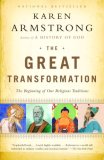
The Great Transformation by Karen Armstrong

The Great Transformation

The Beginning of Our Religious Traditions

by Karen Armstrong
  • BookBrowse Review:
  • Critics' Consensus (8):
  • Readers' Rating (3):
  • First Published:
  • Mar 1, 2006, 496 pages
  • Paperback:
  • Apr 2007, 560 pages
  • Rate this book

About this Book

Book Club Discussion Questions

Print PDF


For supplemental discussion material see our Beyond the Book article, Karen Armstrong and our BookBrowse Review of The Great Transformation.


Please be aware that this discussion guide will contain spoilers!

About This Book

In the period from the ninth century to the second century BCE, the peoples of four distinct regions of the civilized world created the religious and philosophical traditions that have continued to nourish humanity to the present day: Confucianism and Daoism in China, Hinduism and Buddhism in India, monotheism in Israel, and philosophical rationalism in Greece. Later generations further developed these initial insights, but we have never grown beyond them. In The Great Transformation, Karen Armstrong reveals how the sages of this pivotal era—whose ideas share the values of selflessness, empathy, and respect for others—can speak clearly and helpfully to the violence and desperation that we experience in our own times and teach us to revive the spirit of compassion that is the basis of all religious traditions.

She traces the development of the Axial Age chronologically, examining the contributions of such figures as the Buddha, Socrates, Confucius, Jeremiah, Ezekiel, the mystics of the Upanishads, Mencius, and Euripides. All of the Axial Age faiths began in principled and visceral reaction against the unprecedented violence of their time. Despite some differences of emphasis, there was a remarkable consensus in their call for an abandonment of selfishness and a spirituality of compassion. With regard to dealing with fear, despair, hatred, rage, and violence, the Axial sages gave their people and give us, Armstrong says, two important pieces of advice: that first there must be personal responsibility and self-criticism, and it must be followed by practical, effective action. In her opening and concluding chapters, Armstrong urges us to consider how these spiritualities challenge the way we are religious today.

The Great Transformation revives for its readers the most wise and sensible of ancient spiritual practices—practices that hold the possibility for healing in our own troubled times.


Reader's Guide

  1. At the very beginnings of the Axial Age, the Aryans of the steppes of southern Russia developed a concept of the divine: "Humans, deities, animals, plants, and the forces of nature were all manifestations of the same divine 'spirit.' . . . It animated, sustained, and bound them all together" [p. 4]. How is this concept of the holiness and interconnectedness of all life further developed and reinforced in the other, later religions discussed in the book?
  2. Armstrong notes that the Axial religions all arose out of a revulsion against violence. Zoroaster was incensed at the murderousness of cattle raiders on the steppes [pp. 8–12], Israel's breakthrough "followed hard upon the heels of a massacre" [p. 77], and in China, the horror of total war on civilians "intensified the quest for a new religious vision" [p. 317]. How did the thinking of the sages seek to put an end to violence? What kinds of approaches do these religions have in common?
  3. "In the Middle East, holiness was a power that lay beyond the gods, like brahman. The word ilam ('divinity') in Mesopotamia referred to a radiant power that transcended any particular deity. . . . The gods were not the source of ilam, but like human beings, mountains, trees, and stars, they participated in this holiness" [p. 54]. How does this generalized idea of divinity contrast with the monotheism of the Israelites, which developed in the same area?
📖

Get the full reading guide

Join BookBrowse free to unlock all 17 discussion questions, author background, themes, and more for The Great Transformation.

Join free — it takes 30 seconds

Already a member? Log in →

  1. How does the author develop themes of identity and belonging throughout the narrative?
  2. What role does the setting play in shaping the characters' decisions and relationships?
  3. Discuss how the ending reframes the events of the story. Were you surprised?


Unless otherwise stated, this discussion guide is reprinted with the permission of Anchor Books. Any page references refer to a USA edition of the book, usually the trade paperback version, and may vary in other editions.
Membership Advantages
  • Reviews
  • "Beyond the Book" articles
  • Free books to read and review (US only)
  • Find books by time period, setting & theme
  • Read-alike suggestions by book and author
  • Book club discussions
  • and much more!
  • Just $60 for 12 months or $20 for 3 months.
  • More about membership!

Beyond the Book:
  Karen Armstrong

BookBrowse Book Club

Book Jacket
A Pair of Aces
by Marie Benedict, Victoria Christopher Murray
Two women on opposite sides of the law team up to bring down gangster Lucky Luciano in this gripping novel.

Members Recommend

  • Book Jacket
    The Reimagining of Thornwood House
    by Jaleigh Johnson
    A witch and her ward discover a magical walking house and find the true meaning of home.
  • Book Jacket
    Feast
    by Catherine Kurtz
    In 19th-century France, a girl with a magical taste becomes a duc’s poison taster amid nobility and danger.
  • Book Jacket
    Somebody Worth Killing
    by Jessica Payne
    Meet Nadia Davis, loving mom, devoted wife, secret assassin… and she needs a babysitter.
  • Book Jacket
    Summer's Never Over
    by Darby Bozeman
    A woman revisits a Southern summer camp where a counselor's death may not have been an accident.
  • Book Jacket
    The Jellyfish Problem
    by Tessa Yang
    A marine biologist rescues a Maine island menaced by a giant glowing jellyfish in this inventive debut.
Who Said...

The only real blind person at Christmas-time is he who has not Christmas in his heart.

Click Here to find out who said this, as well as discovering other famous literary quotes!

Book
Trivia
  • Book Trivia

    Can you name the title?

    Test your book knowledge with our daily trivia challenge!

Wordplay

Solve this clue:

S the B

and be entered to win..

Your guide toexceptional          books

BookBrowse seeks out and recommends the best in contemporary fiction and nonfiction—books that not only engage and entertain but also deepen our understanding of ourselves and the world around us.




