Book Club Discussion Questions
For supplemental discussion material see our Beyond the Book article, and our BookBrowse Review of Ordinary Heroes.
Please be aware that this discussion guide will contain spoilers!
The questions and discussion topics that follow are designed to enhance your
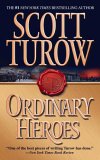
reading of Scott Turow's
Ordinary Heroes. We hope they will enrich your
experience of this mesmerizing novel and the frontlines it brings to life.
Courts of law have set the stage in each of Scott Turow's bestselling books.
With
Ordinary Heroes, Turow introduces an attorney who is operating in a
new setting and period—on the killing fields of World War II's European theater,
under highly unusual circumstances. A JAG lawyer assigned to a case in which the
enemy may prove to be his own government, with no law office and no research
library, David Dubin is ordered to bring a fellow soldier to justice.
Ordinary Heroes is narrated by Kindle County journalist Stewart Dubinsky
(whom readers may recognize from some of Turow's previous novels) and by
Stewart's father. Stewart discovers an unexpected chapter of family lore after
the death of his father, David Dubin, who Americanized the surname that Stewart
later reclaimed.
Through wartime letters, military archives, and eventually the notes for a
memoir that Dubin wrote in prison, Stewart pieces together the secret history of
his father's clandestine actions, which led to his court-martial. Unfolding
through the eyes of father and son, the truth becomes a tantalizing mystery for
readers to solve.
Stewart had always believed that his parents met when Dubin rescued his future
wife from the horrors of the Balingen concentration camp. Stewart's research
will lead him to a very different truth; he will discover that his father was
there not as a liberator but to serve a warrant for the arrest of a wayward OSS
officer named Robert Martin. Dubin had pursued Martin and his seductive cohort,
Gita Lodz, through a series of daring escapades. Despite Martin's spectacular
bravery with the French Resistance, Dubin's superiors think Martin is a
Communist sympathizer.
Marked by high-caliber suspense and stirring dilemmas that capture the essence
of love and war,
Ordinary Heroes is a novel rich with topics for your reading
group.
Discussion Questions
- Discuss the effect of the V-mails on the book's opening pages. What was it
like to
read David Dubin's eyewitness account through the "artifacts" that comprise
much
of the rest of the book? Do father and son have different perceptions of life
in Ordinary Heroes?
- In chapter two, Dubin writes about his reasons for enlisting. What were
his true
motivations in going to war?
- What are Dubin's initial impressions of Staff Sergeant Bidwell? How does
Biddy's
perception of racism compare to Dubin's perception of it, both before and
after
Biddy makes his revelations about racial passing? What common ground do the
two
men share?
📖
Get the full reading guide
Join BookBrowse free to unlock all 16 discussion questions, author background, themes, and more for Ordinary Heroes.
Join free — it takes 30 seconds
Already a member? Log in →
- How does the author develop themes of identity and belonging throughout the narrative?
- What role does the setting play in shaping the characters' decisions and relationships?
- Discuss how the ending reframes the events of the story. Were you surprised?
Unless otherwise stated, this discussion guide is reprinted with the permission of Grand Central Publishing.
Any page references refer to a USA edition of the book, usually the trade paperback version, and may vary in other editions.

 Book Reviewed by: