
-
Your next favorite book
is waiting.
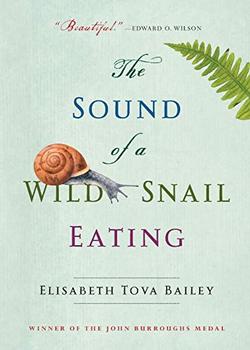
A True Story
by Elisabeth Tova Bailey Book Reviewed by:
Elisabeth Tova Bailey isn't the first to turn illness toward inspiration; however, I'm fairly certain that she may be the first to incorporate the companionship of a snail to do so. While bookstore shelves are teeming with shattering memoirs and incredible life-changing events, a unique and quiet calm surrounds The Sound of a Wild Snail Eating that gently lifts Bailey's story a bit above the rest.
When Bailey's health is sapped by a mysterious virus, she's suddenly forced to reshape her view of the world. Once strong and independent, she now finds herself helplessly confined and totally reliant on others for her care, struggling to reconcile her old vibrant self with the newly weakened one. With nothing but endless hours of introspection at hand, Bailey begins to despair: "Given the ease with which health infuses life with meaning and purpose, it is shocking how swiftly illness steals away those certainties. It was all I could do to get through each moment, and each moment felt like an endless hour, yet days slipped silently past."
The hero of this story enters...well...rather slowly. It doesn't don a cape or sport a lightning bolt on its chest, but when a visiting friend places an acorn-sized snail in the planter next to Bailey's bed, its effects are monumental. Mesmerized by the snail's practical courage and easy adaptability as it starts its life anew, Bailey begins to brighten. Without much fuss the tiny snail ekes out a new home, and Bailey is drawn by the similarity of their situations: "After being transported from the woods, the snail had emerged from its shell into the alien territory of my room, with no clue as to where it was or how it had arrived; the lack of vegetation and the desertlike surroundings must have seemed strange. The snail and I were both living in altered landscapes not of our choosing; I figured we shared a sense of loss and displacement."
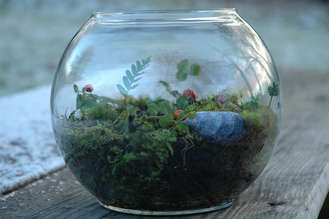 As the author's affinity for the snail swells, so too does the reader's. In perfect harmony Bailey flows back and forth between her own evolution and that of the Neohelix albolabris, or woodland snail. Sound boring? Not at all. The actions of this tiny mollusk become all-consuming and leave you desperately snail-sitting, too worried to leave our teeny friend alone for even a moment. Though small in stature, this little luminary becomes a beacon of hope for Bailey and a promise of continuity and universal connection for us all.
Everything about this slip of a book is unassuming, yet its petite size, prose, and characters rise like quiet giants from its pages. Where many would lash out at the unfairness of it all, you won't find bitterness in Elisabeth Tova Bailey's book. Rather than a whiny diatribe about the cruelties of fate, the author approaches her illness with a strength and equanimity mirroring that of her resilient snail. Eloquent and insightful, The Sound of a Wild Snail Eating is a lovely tale of communion that proves we are all, in fact, inextricably bound.
 This review was originally published in September 2010, and has been updated for the
September 2016 paperback release.
Click here to go to this issue.
This review was originally published in September 2010, and has been updated for the
September 2016 paperback release.
Click here to go to this issue.
at my feet
when did you get here?
snail
- Kobayashi Issa (1763-1828)
It's no coincidence that Elisabeth Tova Bailey chose Kobayashi Issa as one of several selected poets to gently ease us into the passages of The Sound of a Wild Snail Eating. The haiku poet's simplicity and grace complement Elisabeth Tova Bailey's quiet observations as she interprets the larger natural world through that of her tiny snail. Sometimes less is so much more, and like the mighty message of this story's small snail, haiku is a fitting medium to deepen its meaning.
Most western school-children learn that haiku is a form of Japanese poetry that uses a three-lined format of 5-7-5 syllables. This is actually wrong on a number of counts.
Firstly, Japanese haiku are not measured in syllables but in what in English are called morae or moras (from the Latin, to linger or delay), or "on" in Japanese. A fairly complex linguisitic term, moras basically measure the emphasis or weight given to a syllable so that a short syllable would be one mora, whereas a long syllable might be two or more. So, a Japanese haiku might measure 17 moras, but far fewer syllables.
A seventeen syllable haiku written in English would likely be overly verbose, and the translation of a Japanese haiku into English would usually require fewer syllables than the original. Because the essence of haiku is in its brevity, haiku poets writing in English, and those who translate haiku from Japanese, do not tend to follow the 5-7-5 rule, so as to maintain the spare integrity of the original form.
Secondly, traditional Japanese haiku are not written on three lines but in one line, usually consisting of two pairs of sensory images relating to nature separated by a pause so that the two images contrast or complement.
While the Japanese haiku that date back centuries are truly magnificent, modern poets who are able to translate their complexities without losing content are stunning in their own right. For more on the art of haiku and those whose knowledge and translations contributed to The Sound of a Wild Snail Eating, visit haikuguy.com and ahapoetry.com.
This review was originally published in September 2010, and has been updated for the
September 2016 paperback release.
Click here to go to this issue.
Your guide toexceptional books
BookBrowse seeks out and recommends the best in contemporary fiction and nonfiction—books that not only engage and entertain but also deepen our understanding of ourselves and the world around us.
