
-
Your next favorite book
is waiting.
 Book Reviewed by:
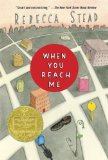
When You Reach Me by Rebecca Stead is an intellectual mystery of just exactly the type I adore. It’s meaty, thought-provoking, warm, and wise. I love it. And it makes sense that I would, because it stands on the shoulders of A Wrinkle in Time (1973) by Madeleine L’Engle, a book Miranda devours just as I did as a child. That book has probably inspired millions of people in the 47 years since it was first published with its blend of magical science and prosaic mystery. It inspired me. I am now both a writer of children’s fantasy and a physicist. I believe that all truly great writers carry on a dialogue with each other through their works. Though they might write in solitude, they are never without the voices of the writers who have written something that spoke to them. The conversation begun by L’Engle which Stead continues in When You Reach Me is about the nature of time and the possibility of space and time travel.
When Marcus, the strange braniac-physicist new kid, punches Sal for apparently no reason in the beginning of the book, he sets into motion a causal chain that stretches into the future and back again in what becomes a bizarre and heady mystery that Miranda must solve in order to save Sal’s life at the end. Stead continues "the conversation" on time through Marcus: "Those ladies lied in the beginning of [A Wrinkle in Time]," he says to Miranda, by way of introduction. "They promise [Meg] that they’ll have her home five minutes before she left. But they don’t. ...Think. At the beginning of the book… she can see the garden from where she’s sitting," but, "the garden is where they appear when they get back at the end of the book… So if they had gotten home five minutes before they left… then they would have seen themselves get back. Before they left."
When You Reach Me continues throughout to further explore and explain the nature of time and possibility of time-travel presented in A Wrinkle in Time. Meg explains in the former book that there is a fourth spatial dimension (after length, breadth, and depth): "I guess if you want to put it into mathematical terms you’d square the square. But you can’t take a pencil and draw it like the first three. I know it’s got something to do with Einstein and time. I guess maybe you could call the fourth dimension Time." Meg’s little brother adds that time travel is possible by "tessering," or folding space-time like you might fold a skirt and then jumping from one place to another. Marcus, however, contends that, "[t]ime isn’t a line stretching out in front of us, going in one direction. It’s - well, time is just a construct, actually." He explains that all times happen simultaneously and explores the rational implications of going backward (as we think of it) in time. This explanation of time is necessary to understand the book’s central mystery, and it is given to both Miranda and the reader in a timely and fascinating way without ever seeming forced or didactic.
In many ways, When You Reach Me goes further than A Wrinkle in Time to clarify, explain, and bring in more modern physics research and thinking. But it leaves intact the sense of wonder and magic in the real world that L’Engle captured so well in her work. I believe that Rebecca Stead's When You Reach Me will go on to inspire a new generation just as L’Engle's A Wrinkle in Time did. And besides this, it will warm hearts with its strange and well-drawn cast of characters (from the senile homeless man on the corner, to the Deli owner who hordes folded $2 bills in a piggy bank) and its rich and vibrant setting of New York City in the 80’s. I highly recommend this book to any child who loves to ask questions or any grownup who still believes in his heart of hearts that the real world is magic.
 This review was originally published in September 2009, and has been updated for the
December 2010 paperback release.
Click here to go to this issue.
This review was originally published in September 2009, and has been updated for the
December 2010 paperback release.
Click here to go to this issue.
Einstein’s Theory of Relativity is, at its heart, about frames of reference. If I were in a dark, windowless train with no bumps that was going in one direction at a constant speed, then I would think I was standing still, but my sister on the train platform would see me speeding away from her. According to Einstein, if I then looked out the window, I would have every right to believe, in fact, that the world was speeding away behind me while I stood still. My sister, of course, would also be right that she was standing still. Hence, reality becomes relative to the frame of reference of the observer.
Time, as well, becomes relative to the observer’s frame of reference. This has been proven both mathematically and experimentally. One bizarre outcome of this "relativity" of time is known as "The Twin Paradox:" If I leave my sister behind on that platform while I travel far out through the universe going near the speed of light, I may age forty years in the trip out and back, but when I return, my sister will be long dead. Time will pass normally for my sister. Time will pass normally for me. But our times relative to each other are quite different.
This seems like it contradicts common sense because none of our frames of reference are traveling that much faster than each other compared to the speed of light - to a physicist walking, biking, driving, and even flying are pretty much the same speed, though time-dilation has been verified with atomic clocks on airplanes.
For a look at how quantum mechanics (another mind-bending theory that Einstein helped father) would affect us if its effects were big enough to be experienced in our day-to-day lives, take a look at The New World of Mr. Tompkins by George Gamow.
And for a readable prescription for how to actually build a time-machine by Stephen Hawking, one of the foremost physicists of our time, check out The Universe in a Nutshell.
This review was originally published in September 2009, and has been updated for the
December 2010 paperback release.
Click here to go to this issue.
Your guide toexceptional books
BookBrowse seeks out and recommends the best in contemporary fiction and nonfiction—books that not only engage and entertain but also deepen our understanding of ourselves and the world around us.
