
-
Your next favorite book
is waiting.
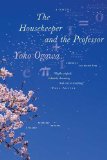
A Novel
by Yoko Ogawa Book Reviewed by:
Upon meeting the tenth
housekeeper hired to care for him, the
Professor launches into a math lesson on
magical numbers, focusing on the special
prime numbers. Rather than being annoyed or
intimidated like the others, the Housekeeper
becomes intrigued, determined to make the
relationship work. She draws the Professor
out, asking him to explain his ideas, and he
blossoms further when her young son begins
to visit with him after school. Since the
Professor's memory constantly dissolves, the
introductions begin anew every morning and
each day is an opportunity to create a new
relationship.
The title characters are known to the reader
only by their professions, and the symbolic
anonymity adds to the fable-like feel of the
story. The Housekeeper's ten-year-old son is
known as Root – so named by the Professor
because of the shape of the boy's head and
hair reminds him of the
square root symbol. Root's name is
further symbolic; he is clearly the anchor
and sustaining force in his mother's life.
As the Professor and Root spend more time
together, they discover a common passion:
baseball. Root avidly follows the Tigers, a
major league team, and the Professor is a
fan of Enatsu, the team's star player from
twenty years ago. The Housekeeper convinces
the Professor to join her and Root at a
game, and although he has a fear of crowds,
and still believes Enatsu is playing, the
three bond over the game. Slowly, the
unlikely trio becomes a wonderfully unusual
family. Even though the Professor cannot
remember that he has met Root before, his
growing love for the boy doesn't disappear
with his memories – it takes up residence
deep in his heart and changes him.
The Professor's math lessons achieve what
only the very best math teachers can: he
makes math seem beautiful, almost magical.
As he describes his passion to the
Housekeeper, "The mathematical order is
beautiful precisely because it has no effect
on the real world. Life isn't going to be
easier, nor is anyone going to make a
fortune, just because they know something
about prime numbers."
Yoko Ogawa's writing is delicate and poetic,
describing sounds you can almost hear:
the gentle patter of the rain was punctuated
by the scratching of pencil on paper, or
crafting metaphors that drive to the heart
of abstract emotions: the image I have of
my father is that of a statue in a museum.
No matter how close I come to him, I can't
get his attention, he continues to stare off
into the distance without looking down, and
never reaches out his hand to me.
Ogawa's fine prose and enchanting characters
easily wind their way into your heart as
their simple story unfolds to give voice to
complex ideas about math, love, family and
memory. The Housekeeper and the Professor
will make you smile, and leave you pondering
its meaning long after you have finished it.
 This review is from the February 5, 2009 issue of BookBrowse Recommends.
Click here to go to this issue.
This review is from the February 5, 2009 issue of BookBrowse Recommends.
Click here to go to this issue.
The Story Behind the Book
Hakase no aishi ta
sushiki was
originally published in
Japan in 2003, selling
more than 2.5 million
copies and garnering the
prestigious Yomiuri
Prize. The title is more
literally translated as
The Professor and His
Beloved Equation,
and is often referred to
as such prior to the
American publication of
The Housekeeper and
the Professor. Yoko
Ogawa has published more
than 20 works of fiction
and nonfiction, many
translated into French,
German, and other
languages, but The
Housekeeper and the
Professor is her
first full-length novel
to be translated into
English. The translator,
Stephen Snyder, has also
translated Ogawa's
collection of three
novellas, entitled
The Diving Pool,
published by Picador in
2008, and a short story,
The Cafeteria in the
Evening and a Pool in
the Rain, for
The New Yorker
(September, 2004).
Hakase no aishi ta
sushiki was made
into a successful
Japanese
film in 2006,
garnering many awards,
including Best Feature
at the 2007 Syracuse
International Film
Festival. While the
novel is narrated by the
Housekeeper, the film is
told from the point of
view of the adult math
professor Root, as he
recounts the story of
his childhood to his
students.
Paul Erdos
(1913-1996)
A biography of the
Hungarian mathematician
Paul Erdos (The Man
Who Loved Only Numbers,
by Paul Hoffman) is
cited as a source in the
bibliography of
Hakase no aishi ta
sushiki, and it's
easy to see how Ogawa's
Professor might have
been inspired by Erdos's
notoriously eccentric
personality.
Erdos was singularly
focused, lived on coffee
and often amphetamines,
and did little else
besides think about
math, yet he was also
known for a quirky sense
of humor and joie de
vivre. Although he won
cash prizes for his
work, he frequently gave
the money away to other
mathematicians. Paul
Hoffman describes Erdos
as a "mathematical
monk", whose belongings
could fit in two
suitcases. He never
married, and had no
children.
Ogawa gave many of these
ascetic characteristics
to the Professor. He
also worked on difficult
math problems, entering
many contests and
winning large sums of
money, leaving prize
checks uncashed and
crumpled up in a box in
the closet. Erdos was
called "uncouth and
unconventional" during
his fellowship at
Princeton, and was
described by friends as
"a nervous and agitated
person," all
descriptions befitting
Ogawa's Professor.
Erdos was known more for
solving problems than
developing theories, and
he published nearly 1500
papers during his
lifetime, working with
over 500 collaborators.
This unparalleled
collaboration gave rise
to the
Erdos Number, a kind
of degrees-of-separation
rating well-known among
mathematicians. As in
the game
Six Degrees of Kevin
Bacon, the lower a
person's Erdos number,
the closer he or she is
to Erdos.
This review is from the February 5, 2009 issue of BookBrowse Recommends.
Click here to go to this issue.
Your guide toexceptional books
BookBrowse seeks out and recommends the best in contemporary fiction and nonfiction—books that not only engage and entertain but also deepen our understanding of ourselves and the world around us.
